

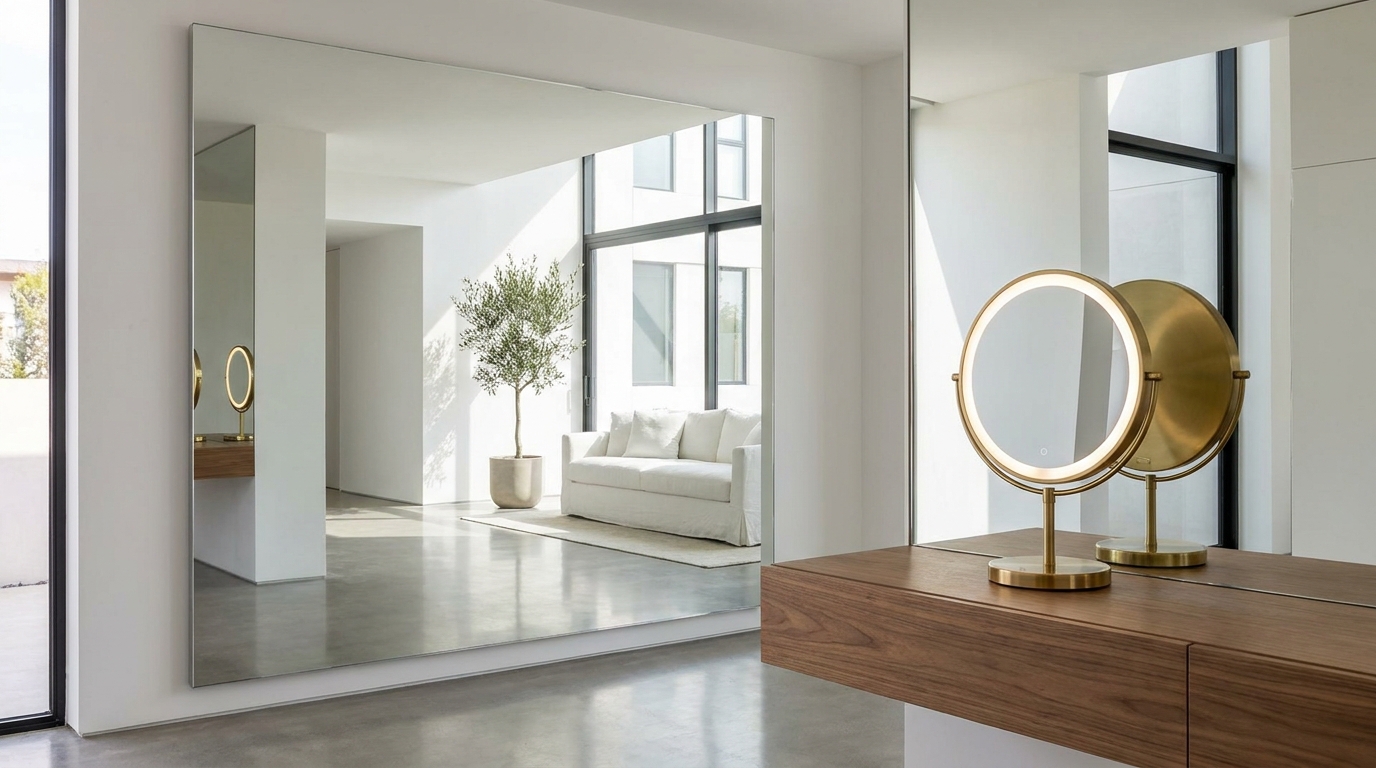
Mirrors and Custom Glass
Almost no mirror or glass panel worth having comes in a standard size. Daltex Glass cuts, edges and finishes mirrors and glass to your dimensions , wall mirrors, vanity mirrors, gym and studio mirrors, tabletops, shelves, cabinet glass and decorative panels , and installs them where installation is part of the job.
Ordering is straightforward: send the sizes, the thickness if you know it, and the edge finish you want. If you are unsure what to measure, send a photograph with a tape measure in shot and the team will work it out. Email Or****@*********ss.com or call 214-865-9961.
Custom Wall Mirrors
A mirror cut to fill a specific wall reads as part of the room rather than an object hung on it. Full-wall and oversized mirrors make a space feel considerably larger, and are widely used in hallways, dining rooms, retail fitting areas and small apartments.
Edge finish is the main decision. A polished edge is smooth and slightly rounded and suits a frameless installation; a bevelled edge cuts a shallow angled border that catches light and gives a more traditional look; a seamed edge is a safety finish only, intended for mirrors that will sit inside a frame or channel.
Bathroom and Vanity Mirrors
Bathroom mirrors need more than a size. Humidity is constant, so the backing and the edge sealing matter , this is where cheap mirrors fail first, with black spotting creeping in from the edges after a couple of years.
- Cut to the vanity width, or wall to wall between cabinets
- Cut-outs for sconces, outlets and switch plates, machined before delivery
- Polished or bevelled edges for frameless installation
- Fixed with mirror clips, a channel, or adhesive with mechanical support depending on size and substrate
Give the team the vanity dimensions and the position of anything that needs a cut-out, and the mirror arrives ready to fix rather than needing work on site.
Fitness-Center and Studio Mirrors
Gym and dance studio mirrors are a specification, not just a large mirror. They are usually installed as a run of panels across a full wall, and the details that matter are flatness, joint alignment and how they are fixed.
- Panels sized so joints fall in sensible places rather than through eye level
- Consistent thickness across the run so adjacent panels sit flush
- Safety backing where a mirror could be struck, so fragments are retained
- Fixing into structure, not just drywall, since a wall of mirror is heavy
- A clear floor gap or base channel so mirrors are not sitting directly on a wet floor
Distortion is the thing users notice most and clients complain about, and it comes from uneven fixing surfaces as much as from the glass. Wall preparation is worth discussing before the panels are cut.
Restaurant and Hospitality Mirrors
In hospitality, mirrors do design work. Antique and smoked mirror gives a bar back warmth that clear mirror cannot, a full-height mirror doubles the apparent size of a narrow dining room, and mirrored panels behind shelving make a back bar read far deeper than it is.
Because these installations are seen at close range under low light, edge quality and joint alignment matter more here than almost anywhere else. Cleaning access is also worth thinking about early, since mirror behind fixed shelving becomes very difficult to reach later.
Glass Tabletops
A glass top protects a table surface underneath or forms the table surface itself. Both are made to order.
- Protective tops, usually thinner glass laid over timber or stone with clear bumpers underneath
- Structural tops, in thicker toughened glass supported by a base or frame
- Shapes cut to template, including rounds, ovals and irregular outlines
- Polished or bevelled edges, since a table edge is touched constantly
- Toughened glass wherever the top is structural or within reach of children
For a replacement top, a paper or cardboard template beats a set of measurements for anything that is not a plain rectangle.
Glass Shelves
Glass shelving keeps sightlines open in retail displays, bathrooms, alcoves and cabinets. Thickness is driven by span and load rather than appearance: a long shelf carrying weight needs thicker glass or an intermediate bracket, and deflection over a long span is the usual complaint when a shelf is under-specified. All shelf edges are polished, since they are handled directly.
Cabinet Glass
Cabinet door glass turns a solid run of units into something lighter. Clear glass suits display cabinets, obscured or reeded glass hides contents while keeping the effect, and back-painted glass gives a solid colour panel. Panels are cut to the rebate size rather than the door size, which is the measurement most people get wrong, so send the rebate dimensions or a photograph of the frame if you are unsure.
Decorative Glass and Interior Design Features
Decorative glass covers the treatments that make a panel part of an interior scheme rather than a functional necessity: acid-etched and satin finishes, sandblasted patterns, back-painted colour, low-iron glass where a genuinely neutral appearance matters, and textured or fluted glass for softer light.
These are used for splashbacks, feature wall panels, headboards, reception details and screens. Where a design is being repeated across a project, agreeing a sample panel before full fabrication is worth the extra step, because finishes read differently at scale than they do on a swatch.
Custom-Cut Glass to Any Size
Beyond the categories above, Daltex Glass cuts glass to size for whatever the job needs: shelf inserts, picture glass, appliance panels, machine guards, replacement panes for furniture and light fittings, and template-cut shapes. Clear, tinted, obscured, toughened and laminated stock is available, along with polished, bevelled and seamed edge finishes.
The wider range of glass services offered covers the window and door side of the business if your project needs both.
How to Order
Send dimensions, or a template for anything that is not a simple rectangle
Say what the glass or mirror is for, since that determines thickness and whether it needs to be toughened
Note any cut-outs, notches or holes, with their positions measured from a stated edge
Choose an edge finish: polished, bevelled or seamed
Confirm collection or delivery
Cut-outs and holes must be machined before toughening. Once glass is toughened, nothing further can be cut or drilled into it, so every detail needs to be confirmed before fabrication begins.
Why Choose Daltex Glass
In-house fabrication and more than 25 years in glass, aluminum and window products, across both trade supply and finished installation. That means one-off pieces and full project quantities are handled the same way. Company background is on the about Daltex Glass page, and finished work is shown in the installation gallery.
11419 Ferrell Dr #108, Farmers Branch, TX 75234Mon-Fri 8:00 AM to 5:00 PM · Sat 8:00 AM to 1:00 PM214-865-9961
Frequently Asked Questions
How do I measure for a custom mirror?
Measure the width and height in at least three places each, and use the smallest figure, because walls and openings are rarely square. Note the position of anything needing a cut-out, measured from a stated edge. For anything that is not a plain rectangle, supply a paper or cardboard template rather than dimensions.
What edge finish should I choose for a mirror?
Choose a polished edge for a frameless mirror mounted flat against a wall, since it is smooth, clean and modern. Choose a bevelled edge for a more traditional look, as the angled border catches light around the perimeter. A seamed edge is a safety finish only and is intended for mirrors that will sit inside a frame or channel.
Why do bathroom mirrors go black around the edges?
Moisture has reached the reflective backing at the edge and started to break it down. It usually indicates poor edge sealing, direct contact with a wet surface, or an adhesive that attacked the backing. Specifying a mirror suited to humid conditions and fixing it with a small gap at the base both help considerably.
What thickness should a glass shelf be?
It depends on the span and the load rather than on preference. A short shelf holding light items can use thinner glass; a long shelf carrying weight needs thicker glass or an intermediate bracket to prevent visible deflection. Tell the team the span, the bracket positions and roughly what will sit on it.
Can you cut glass to an irregular shape?
Yes. Shapes, curves, radiused corners and irregular outlines are all possible, and a template gives a far more accurate result than a written description. Note that any cut-outs or holes must be machined before toughening, so the design has to be finalised before fabrication starts.
Do glass tabletops need to be toughened?
A protective top laid over an existing table surface often does not, since it is fully supported and not structural. A top that forms the table surface itself, or one within reach of children, should be toughened so that if it breaks it does so into small blunt granules rather than large shards.
Send Your Sizes
Dimensions, a template or a photograph is enough to get a price. Call 214-865-9961, email Or****@*********ss.com, or send your mirror and glass sizes for a quote.


