

Blog
Adjustable vs Fixed Shower Door Hinges: Which Should You Choose?

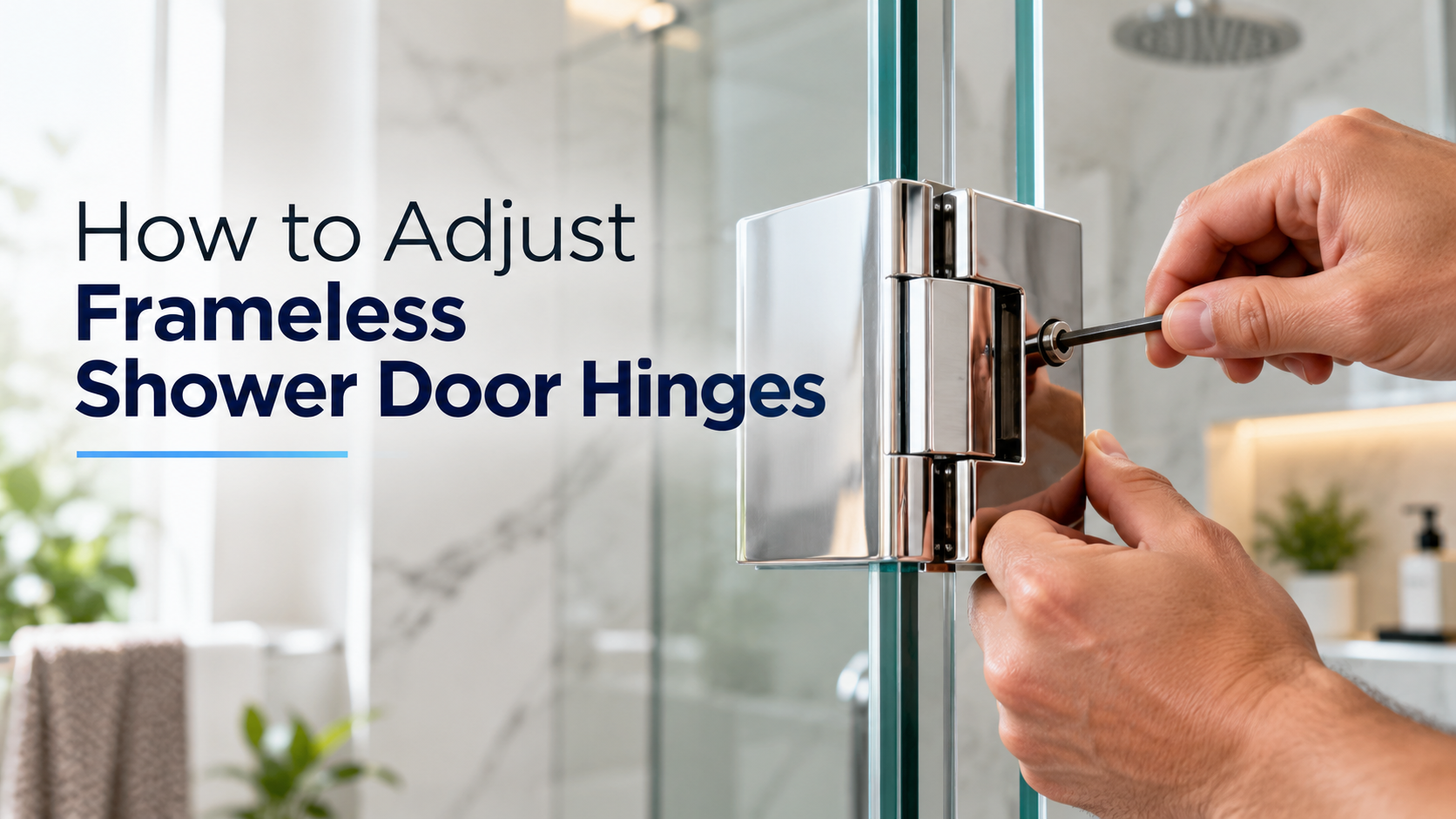


Selecting the correct hinges is one of the most important decisions when planning a frameless glass shower enclosure. Hinges must support the weight and width of the door while maintaining suitable clearances, smooth movement, and a dependable closed position. During product selection, buyers commonly compare adjustable vs fixed shower door hinges, but the difference is not simply whether one hinge moves and the other does not. Both types allow the door to swing, while adjustability generally refers to whether the hinge’s closing position or alignment can be modified during installation. Understanding how each design works can help contractors, installers, designers, and homeowners select hardware that fits the glass, opening, and intended door operation.
What Are Adjustable Shower Door Hinges?
Adjustable shower door hinges allow an installer to modify a specific aspect of the hinge after it has been positioned on the door. Depending on the model, this may include changing the closing angle, setting the door slightly inward against a strike seal, or making limited alignment corrections during installation. Some adjustable hinges use Allen set screws that can be loosened while the supported door is moved to the intended closed position, after which the screws are tightened according to the manufacturer’s instructions. The available adjustment varies considerably between products, so an adjustable hinge should never be assumed to correct every measurement error, severely out-of-plumb wall, incorrect glass cutout, or unsuitable door size.
What Are Fixed Shower Door Hinges?
Fixed shower door hinges have a factory-defined geometry and closing position that cannot be changed through an adjustment mechanism. A standard self-centering hinge may return the door to a preset zero-degree position when the door enters its closing range, while other fixed models may be manufactured for a particular wall-to-glass or glass-to-glass angle. These hinges can provide a simple and dependable solution when the opening is accurately measured, the walls and panels are correctly aligned, and the glass has been fabricated for the exact hinge template. Their simplicity may reduce the number of adjustment components, but it also means that installation errors cannot usually be corrected by changing the hinge’s closing angle.
Adjustable vs Fixed Shower Door Hinges
| Comparison Factor | Adjustable Hinges | Fixed Hinges |
|---|---|---|
| Closing position | Can be modified within the product’s stated range | Uses a predetermined closing position |
| Installation flexibility | Offers limited correction for specific alignment conditions | Requires accurate measurements and alignment |
| Setup process | Usually requires additional adjustment and testing | Generally more straightforward when the opening is correct |
| Maintenance | Adjustment screws and settings may require inspection | Fewer adjustable components to inspect |
| Best application | Custom layouts, angled panels, or controlled over-closing | Square and accurately prepared openings |
| Product cost | May cost more because of the adjustment mechanism | Often simpler and potentially more economical |
| Compatibility | Must match the glass thickness, cutout, weight, and configuration | Must also match the exact glass and mounting requirements |
When Adjustable Shower Door Hinges Make Sense
Adjustable hinges can be useful when the door must close against a vinyl strike, when a glass-to-glass panel is installed at a specific angle, or when the desired closing position differs slightly from the factory-standard position. They may also help an experienced installer achieve more consistent contact between the door edge and the seal without forcing the glass or placing unnecessary pressure on adjacent components. However, the adjustment range is normally limited, and the hinge should not be treated as a solution for inaccurate fabrication or inadequate structural support. Before choosing this option, verify whether the product adjusts the closing angle, horizontal position, pivot location, or another specific feature because the word “adjustable” can describe different functions across hinge models.
When Fixed Shower Door Hinges Are a Better Choice
Fixed hinges are often suitable for straightforward frameless shower doors installed in properly measured and prepared openings. When the wall is plumb, the threshold is level, the fixed panel is correctly positioned, and the glass cutouts match the hardware template, a fixed hinge can provide smooth operation without additional closing-angle adjustments. This type of hinge may be preferred when the installer wants a simple setup and the selected model already offers the required swing direction, self-centering action, and closing position. A fixed hinge is not automatically stronger or more durable than an adjustable model because actual performance depends on construction quality, glass compatibility, fasteners, gaskets, installation, and the manufacturer’s stated door capacity.
Compare the Glass and Door Specifications First
Hinge adjustability should never be the first or only selection criterion because every hinge has limits for glass thickness, door weight, door width, mounting configuration, and number of hinges. A product designed for 3/8-inch tempered glass may not be suitable for a different glass thickness, and a hinge that supports a smaller door may be inadequate for a wide or heavy panel. Buyers must also distinguish between wall-to-glass, 90-degree glass-to-glass, 135-degree glass-to-glass, 180-degree glass-to-glass, and pivot hinge configurations. The glass fabrication template is equally important because tempered glass cannot be recut after tempering, which means the selected hinge must match the existing cutouts when hardware is being replaced.
Consider the Closing Action and Swing Direction
Some frameless shower door hinges are self-centering, meaning the hinge guides the door toward its resting position when it moves within a particular closing range. Other products may provide positive-close action, a hold-open position, inward and outward swing, or a preset inward closing angle intended to improve contact with a strike seal. These features are separate from the general question of adjustable vs fixed shower door hinges, so every specification should be reviewed individually. The enclosure layout, nearby fixtures, curb position, seals, handles, and required user clearance should all be considered before deciding how far the door should swing and where it should rest when closed.
Installation and Maintenance Requirements
Both adjustable and fixed shower door hinges must be installed against suitable structural support and used with the correct gaskets, fasteners, glass preparation, and torque requirements. Adjustable hinges may require additional testing to confirm that the upper and lower hinges share the load and return the door to the same closed position. Fixed hinges still require accurate alignment because tightening hardware against a poorly positioned door can create uneven gaps or stress around the glass cutouts. Routine maintenance should include checking door movement, visible fasteners, gaskets, wall plates, seals, and finish condition without using abrasive cleaners or making unapproved changes to the hardware.
Which Shower Door Hinge Should You Choose?
Choose adjustable shower door hinges when the enclosure design genuinely requires a configurable closing position and the selected hardware provides the exact adjustment needed. Choose fixed shower door hinges when the opening is accurately prepared, the required closing position matches the factory setting, and simplicity is a priority. In either case, confirm the door weight, width, glass thickness, hinge quantity, mounting type, swing direction, cutout pattern, and structural support before ordering. Product appearance and finish are important, but compatibility and load capacity should always take priority because the hinges are responsible for supporting a heavy moving glass panel.
Frequently Asked Questions
Are Adjustable Shower Door Hinges Better?
Adjustable hinges are not automatically better than fixed hinges because each design serves different installation requirements. Their main advantage is the ability to modify a specific setting, such as the closed position, within the manufacturer’s permitted range. A fixed hinge may be more appropriate for a correctly measured square opening that does not require additional adjustment. The best choice is the product that matches the glass specifications, enclosure geometry, mounting surface, and desired closing action.
Can Adjustable Hinges Fix an Out-of-Plumb Wall?
Certain shower systems provide limited adjustment for minor out-of-plumb conditions, but this capability should not be assumed for every adjustable hinge. Closing-angle adjustment is different from changing the installed position of the entire door, and neither feature can correct severely inaccurate measurements or unsuitable structural support. The product data and installation template should state which adjustment is available and how much correction is permitted. If the opening is significantly uneven, a glass professional should evaluate whether different hardware, a wall profile, or newly fabricated glass is required.
Final Thoughts
The comparison between adjustable vs fixed shower door hinges should focus on the enclosure’s geometry, glass specifications, closing requirements, and installation conditions. Adjustable hinges provide useful control when a door needs a configurable resting position or limited alignment correction, while fixed hinges provide a straightforward solution for accurately prepared openings. Neither option should be selected without checking the manufacturer’s weight, width, thickness, cutout, and mounting requirements. Daltex Glass offers shower door hinges and related glass hardware for different frameless shower configurations, allowing contractors and installers to select components that suit the specific door and project.


