

Patriot vs Cambria Pivot Hinges: Beveled vs Square Styles
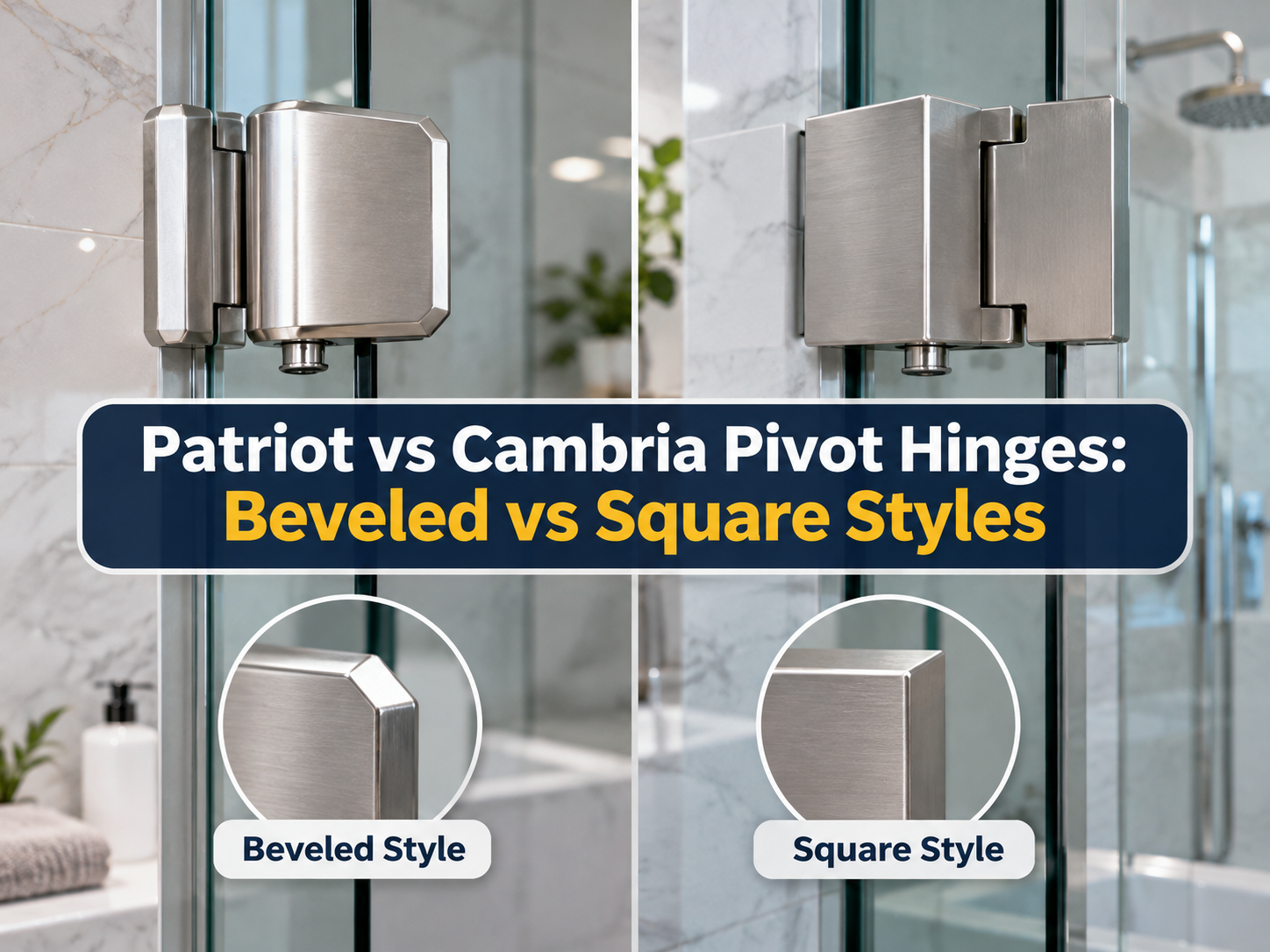


Choosing between Patriot and Cambria pivot hinges is primarily a question of visual profile, enclosure style and hardware coordination rather than a choice between two completely different operating systems. Both product families include top-or-bottom pivot hinges designed for 3/8-inch tempered shower glass, and both can support a door weighing up to 100 pounds and measuring up to 31 inches wide when two compatible hinges are used. The most noticeable difference in a Patriot vs Cambria pivot hinge comparison is that Patriot has a beveled profile with softened edges, while Cambria has a clean square profile that suits more angular bathroom designs.
Patriot vs Cambria Pivot Hinge Comparison
The Patriot and Cambria models perform similar structural functions within a frameless shower enclosure. They create a vertical pivot axis at the top and bottom of the door, allow the door to rotate around that axis and help return the glass toward its closed position. Their different profiles make each series better suited to a particular design language, but the final selection must still account for glass thickness, door width, door weight, fabrication templates and the available support above and below the door.
| Feature | Patriot Pivot Hinge | Cambria Pivot Hinge |
|---|---|---|
| Hardware profile | Beveled with softened edges | Square with straight edges |
| Compatible glass | 3/8-inch tempered glass | 3/8-inch tempered glass |
| Capacity with two hinges | Up to 100 pounds | Up to 100 pounds |
| Maximum door width | 31 inches | 31 inches |
| Closing behavior | Self-centering near closed position | Self-centering near closed position |
| Positive-close option | Compatible 5-degree pivot option | Adjustable secondary 5-degree setting |
| Construction | Solid brass | Plated solid brass |
| Typical application | Transitional, classic or softened designs | Modern, geometric or minimalist designs |
These capacity figures are not interchangeable with permission to exceed either limit. A 95-pound door that measures 33 inches wide is outside the published width limit even though its weight remains below 100 pounds. Contractors should verify both measurements before releasing glass for fabrication and should review the appropriate pivot hinge guide when planning the complete top-and-bottom support arrangement.
Choose Patriot for a Softer Beveled Appearance
The Patriot Series uses beveled edges that reduce the visual sharpness of the hinge body and coordinate well with curved handles, rounded towel bars and bathroom fixtures with softened contours. It is a strong aesthetic match for transitional bathrooms that combine traditional materials with frameless glass, as well as hospitality projects where the hardware should look refined without appearing aggressively modern. The bevel affects appearance, but it does not eliminate the need to confirm the correct Patriot model, glass cutout and pivot position for the proposed enclosure.
A beveled hinge may also help create visual consistency when the remaining shower hardware already has rounded or chamfered details. This consideration becomes especially important in premium residential bathrooms where hinges, clamps, handles and support components are visible together. Selecting the Patriot profile solely because it looks softer, however, is not enough if the enclosure geometry requires a different pivot configuration or if surrounding fixtures interfere with the door swing.
Choose Cambria for a Square Architectural Style
The Cambria Series has a square profile that aligns naturally with rectangular pull handles, square clamps, straight support bars and contemporary plumbing fixtures. Its crisp geometry is often preferred in modern frameless shower enclosures where the designer wants each visible component to follow the same clean architectural language. Contractors considering this style can review the Cambria pivot hinge offered by Daltex for finish availability, fabrication templates and current ordering information.
The Cambria top-or-bottom pivot hinge uses 3/8-inch tempered glass and has a dual-degree pivot pin. Its standard setting supports normal closing at 90 degrees, while a secondary setting can provide an additional 5 degrees of closing when the door needs a firmer position against a compatible jamb or seal. This feature should be planned with the enclosure geometry and sealing method, because positive closing cannot correct inaccurate glass dimensions, an out-of-plumb opening or an incorrectly positioned pivot axis.
Understand How Top and Bottom Pivot Hinges Carry the Door
A pivot shower door rotates around aligned upper and lower pivot points instead of hanging entirely from two side-mounted wall hinges. Much of the vertical load is transferred through the lower pivot location, while the upper fitting stabilizes the door and maintains the intended axis. This arrangement can create useful handle clearance and a clean appearance, but the curb, header, ceiling support or adjacent fixed panel must be suitable for the selected system.
Accurate alignment is essential because the upper and lower components must share the same pivot line. An out-of-level curb or an incorrectly located upper fitting can cause binding, uneven gaps or poor closing even when the hinges themselves are undamaged. The glass fabricator and installer should therefore coordinate the hardware layout before tempering, since holes and notches in tempered glass cannot be added or moved after fabrication.
Compare Closing Action and Seal Contact
Both hinge families are designed to help the door return toward its intended closed position when it enters the centering range. This self-centering action improves everyday operation but does not make the enclosure automatically watertight. Door gaps, sweeps, jamb seals, curb slope and showerhead direction still determine how effectively the finished enclosure controls water.
A 5-degree closing option can be useful when the door must rest more firmly against a seal or jamb. It should be selected as part of the original system rather than used as a repair for inaccurate measurements. Daltex’s positive-close hinge guide explains how this closing feature relates to seals, door alignment and enclosure design.
Verify Glass, Fabrication and Door Capacity
Both compared models require 3/8-inch tempered safety glass and product-specific fabrication. Laminated glass should not be substituted where the product documentation identifies it as incompatible, and a standard hinge cutout should not be assumed to fit every pivot series. The fabricator must work from the template associated with the exact item number and planned pivot position.
Door weight and width must also be calculated independently because exceeding either limit can overload the hardware. Glass size, handle weight and any attached accessories should be considered before confirming the hinge selection. When the project includes several unfamiliar components, the hardware component guide can help contractors coordinate hinges, clamps, seals, handles and support hardware as one system.
Coordinate the Hardware Finish
Patriot and Cambria pivot hinges are available in several commonly specified bathroom finishes, including polished chrome, brushed nickel, matte black, satin brass, polished nickel, brushed bronze and oil-rubbed bronze within their respective product ranges. Availability can vary by exact model and inventory, so finish selection should be verified before the glass order is finalized. Ordering hinges, clamps and handles from coordinated product families also reduces the risk of noticeable differences in color, sheen or texture.
Finish choice should follow the broader bathroom design rather than being treated as an isolated decision. Matte black and satin brass often emphasize the square Cambria profile, while polished chrome and brushed nickel can work with either family. Daily drying with a soft cloth and cleaning with a mild nonabrasive product will help protect the finish after installation.
Which Pivot Hinge Should You Choose?
Choose Patriot when the enclosure calls for beveled edges, rounded coordinating hardware or a softer transitional appearance. Choose Cambria when the design uses square handles, straight lines and a distinctly contemporary hardware package. If both styles are visually acceptable, base the final choice on exact product availability, fabrication requirements, finish coordination and compatibility with the complete pivot system.
For Dallas-Fort Worth residential, hospitality and remodeling projects, Daltex can help contractors compare shower hardware with the required custom glass. Planning the glass and hardware together through custom shower enclosures reduces the likelihood of ordering a hinge that does not match the door dimensions, cutouts or surrounding support conditions.
Frequently Asked Questions
1. What is the main difference between Patriot and Cambria pivot hinges?
The primary difference is the exterior profile. Patriot has a beveled shape with softened edges, while Cambria uses a square profile with clean, straight lines. Their comparable 3/8-inch glass capacity means the choice often depends on appearance, coordinating hardware and the exact pivot configuration.
2. Can Patriot and Cambria hinges support 1/2-inch glass?
The specific Patriot and Cambria top-or-bottom pivot hinges compared here are designed for 3/8-inch tempered glass. Contractors should not add thicker gaskets or modify the hinge to accept 1/2-inch glass. A pivot hinge specifically rated for the selected glass thickness should be used instead.
3. Can one Patriot hinge and one Cambria hinge be used on the same door?
Mixing hinge families on the same pivot door is not recommended because the profiles, pivot components, templates and closing characteristics may not coordinate correctly. The top and bottom hardware should be selected as a compatible system. Using matching components also produces a more consistent finish and appearance.
4. Are these pivot hinges suitable for laminated glass?
The product information identifies these models for tempered safety glass and warns against using laminated glass. Laminated glass behaves differently around holes and cutouts, so compatibility cannot be assumed. The glass type must match the hinge manufacturer’s published specifications.
5. Do pivot hinges make a shower enclosure waterproof?
Pivot hinges control movement and support the glass, but they do not make the enclosure waterproof by themselves. Water control depends on properly sized gaps, compatible seals, a suitable curb slope and thoughtful showerhead placement. A well-designed enclosure manages water without relying on excessive hinge pressure.
6. Should a contractor order the hinges before fabricating the glass?
Yes, the exact hinge model and fabrication template should be confirmed before the glass is cut and tempered. Tempered glass cannot be drilled or notched after fabrication without breaking it. Ordering the hardware first also allows the contractor to verify finish, availability and all required top-and-bottom components.


