Inswing vs Outswing Shower Doors: Safety and Hinge Choices
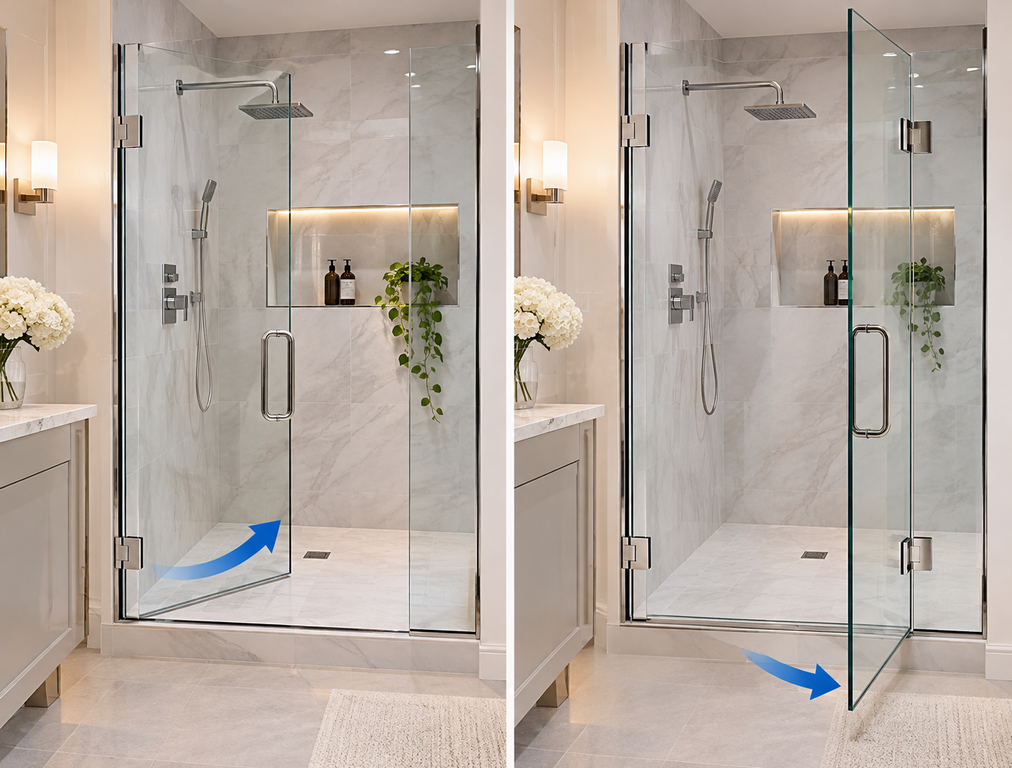


When we compare an inswing versus outswing shower door, we do not treat the decision as a simple matter of which direction feels more convenient in the bathroom. The swing direction affects emergency access, clearance around toilets and vanities, water control, hinge selection, door stops, glass fabrication, and whether the completed enclosure satisfies the building code adopted for the project. A frameless glass door can sometimes be designed to move in both directions, but the ability to open outward remains particularly important because current model residential code language specifically requires hinged shower doors to open outward.
The 2024 International Residential Code states in Section P2708.1 that hinged shower doors shall open outward. It also requires a clear and unobstructed shower access opening of at least 22 inches. Local jurisdictions can adopt different code editions or amendments, so installers still need to verify the requirements applicable to the actual project. The practical design principle is clear, however: an inswing-only hinged shower door should not be assumed to satisfy a code requirement that requires outward opening, while a properly designed double-acting door may allow inward movement for convenience while retaining the required outward-opening capability.
What Is an Outswing Shower Door?
An outswing shower door opens from the shower enclosure into the bathroom. This is the most straightforward way to satisfy an outward-opening requirement because the normal operating direction is also the direction needed for egress.
Outswing doors can work very well when the bathroom provides enough clear space outside the enclosure. The designer needs to verify that the moving glass will not strike a toilet, vanity, towel bar, wall, cabinet hardware, another glass panel, or an entry door. Because frameless doors can be large and heavy, the complete swing arc should be checked before glass dimensions are finalized rather than estimated after installation.
The hinge must also be appropriate for the intended movement. A free-swinging one-direction hinge behaves differently from a self-centering conventional shower hinge, and a double-acting hinge behaves differently again. We therefore choose swing direction and hardware together rather than treating the door swing as an adjustment that can always be changed later.
What Is an Inswing Shower Door?
An inswing shower door moves into the shower compartment when it opens. This can appear attractive in a compact bathroom because the glass does not sweep across the room outside the enclosure.
The difficulty is that a hinged shower door must still satisfy applicable outward-opening requirements. The current 2024 IRC language does not say that a hinged door may open only inward. It says hinged shower doors shall open outward.
For that reason, when an inward swing is desired for everyday convenience, we generally look at hardware and enclosure arrangements that preserve outward-opening capability as required rather than designing an inswing-only primary door and assuming that limited bathroom floor space overrides egress considerations.
The shower itself also needs enough interior clearance for inward-moving glass. A bench, grab bar, shower control, freestanding accessory, or user occupying the enclosure can conflict with the door swing even when the bathroom outside is very tight.
Why Outward Opening Matters for Safety
The outward-opening requirement is not merely a hardware preference. It protects access to and from a relatively confined shower compartment.
If someone falls or becomes incapacitated inside the shower, an inswing-only door can become difficult to open when the person’s body or another obstruction is against the glass. An outward-opening door does not require the same interior clearance to create an exit.
This is one reason we avoid treating an inward-only door as an easy solution to bathroom clearance problems. The surrounding bathroom layout may need to change, the door width may need to change, or a different enclosure configuration may be more appropriate.
The National Kitchen & Bath Association’s planning guidance also references the IRC requirement that hinged shower doors open outward, reinforcing its importance in bathroom planning.
Can a Shower Door Swing Both In and Out?
Some frameless shower hinge systems permit double-acting movement, allowing the glass to swing inward and outward from the closed position. When properly designed, this can combine outward egress capability with the convenience of moving the door inward after use.
The exact behavior depends on the hinge model. We do not assume that every standard wall-mount hinge automatically swings freely in both directions.
FHC’s current Glendale documentation distinguishes its adjustable models and specifically states that Glendale adjustable hinges can swing inward and outward. Other Glendale models use a defined self-centering closing position and may be combined with compatible limit hardware where the installation requires control over the swing.
The project therefore needs to identify whether it requires outswing only, double acting, or another controlled movement before the glass is fabricated.
Why an Inward Swing Can Still Be Useful
Allowing the door to move inward can be convenient even when outward opening remains necessary.
After a shower, a user may prefer to push the glass inward so water dripping from the door remains over the shower floor rather than moving across the bathroom floor. In a compact bathroom, inward movement can also reduce interference with a vanity or walkway during normal use.
Those conveniences do not remove the need to verify outward movement, interior shower clearance, and local code requirements.
When both directions are allowed, we also check whether seals, sweeps, thresholds, and handles can operate properly throughout the full movement. A component designed around a one-direction door may interfere with double-acting operation.
Bathroom Clearance Can Determine the Practical Door Layout
Before selecting an outswing hinge, we draw the entire swing arc.
A 28-inch glass door does not simply occupy 28 inches when moving. The handle extends beyond the glass, and the door sweeps through an area that can intersect with bathroom fixtures.
We check toilets, vanities, drawers, towel bars, faucets, shower curbs, freestanding tubs, bathroom entry doors, and other elements that may enter the swing path.
If outward clearance is limited, the correct response may be a narrower door, different hinge location, pivot configuration, sliding enclosure, or bifold system rather than forcing a conventional large door into the available space.
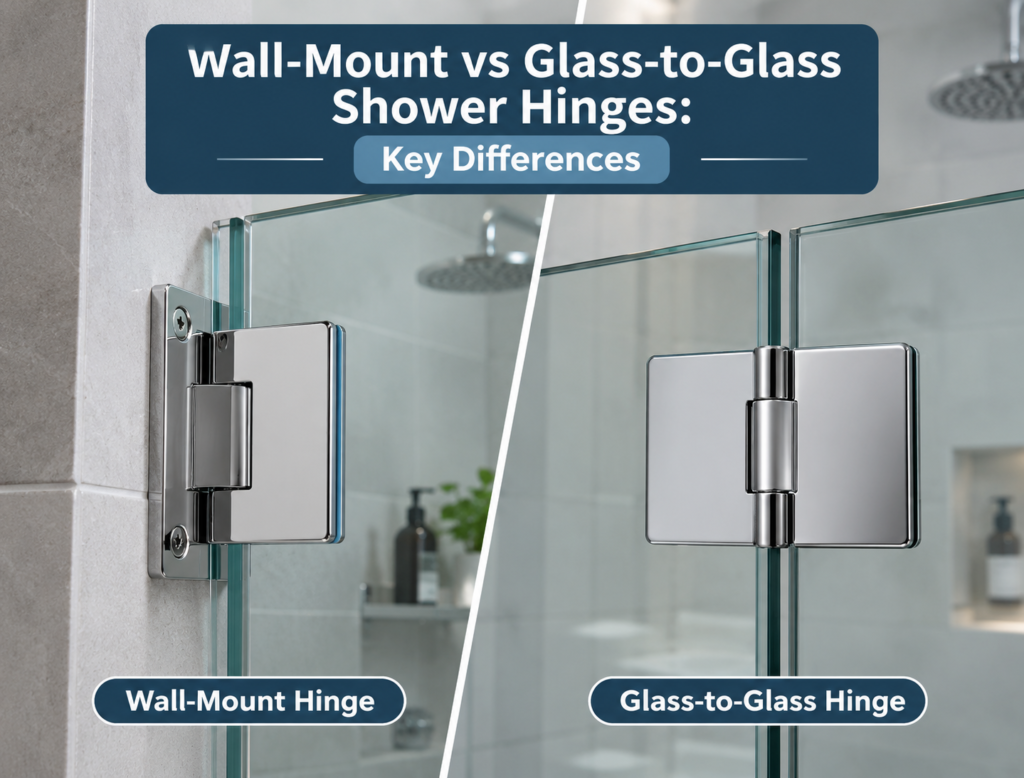
This is where understanding the differences among wall-mount and glass-to-glass hinges becomes useful because hinge location affects where the door is supported and how the opening can be configured.
The Shower Interior Needs Clearance Too
Double-acting or inward-moving doors need an interior sweep calculation as well.
We check whether the inward glass can contact a bench, niche projection, grab bar, shower control, handheld shower, towel hook, or another fixed panel.
The user also needs enough room to move safely without the door forcing them into a narrow section of the compartment.
This is particularly important in small showers where an inward swing may look like the obvious space-saving solution from outside but creates a worse clearance problem inside.
Hinge Choice Determines How the Door Behaves
The terms “inswing” and “outswing” describe movement, but they do not identify one universal hinge design.
A conventional wall-mount shower hinge can be self-centering near the closed position. A specialty one-direction hinge may free-swing in only the direction for which it is designed. A bifold hinge may allow one glass panel to fold relative to another. A pivot hinge changes the axis of rotation entirely.
We therefore select a hinge based on the full enclosure geometry rather than choosing a product first and trying to make its movement fit later.
The supplied Glendale full back plate hinge is a useful example of a conventional wall-mounted frameless shower hinge. Daltex lists it for 3/8-inch to 1/2-inch tempered glass with a full back plate, and FHC identifies the model as self-centering within 15 degrees of the closing position.
Glendale Full Back Plate Hinge Capacity
Hinge movement is only one part of the specification. Door size must remain within the manufacturer’s limits.
Daltex currently lists the Glendale Series full back plate wall-mount hinge for 3/8-inch to 1/2-inch tempered glass. Using two hinges, the published maximum is 80 pounds with a maximum door width of 28 inches. With three hinges, the maximum increases to 120 pounds and 32 inches of width.
Both limits matter. Adding a third hinge does not allow an installer to ignore the maximum width, and a lightweight door that exceeds the permitted width is not automatically acceptable.
The hinge is also specified for tempered glass and is not listed for laminated glass.
Self-Centering Is Different From Swing Direction
A self-centering hinge is designed to return the door toward a defined closed position when the glass enters the hinge’s centering range.
FHC lists the standard Glendale wall-mount hinge as self-centering within 15 degrees of the closing position. This feature helps the door return to the intended seal or jamb position after use.
Self-centering should not be confused with whether the door is allowed to move inward, outward, or both. Those are separate characteristics.
We therefore verify the hinge’s movement limits, center position, optional limit plates, and enclosure clearances individually.
Positive Close Does Not Correct a Bad Door Swing
Certain Glendale models use a reversible five-degree pivot pin or dedicated positive-close configuration to create firmer positioning against a jamb or seal. FHC identifies this feature within the Glendale family.
A positive-close adjustment can improve the final closing relationship, but it should not be used to compensate for incorrect glass dimensions, an out-of-plumb wall, or a swing direction that conflicts with the enclosure.
We decide first where the door needs to close and which directions it needs to move. Then we select and configure the hinge to support that geometry.
Daltex’s guide to positive-close shower hinges provides additional context on this distinction.
Door Stops Matter on One-Direction Hinges
Some specialty hinges are intentionally free-swinging and designed to move in one direction only. Those hinges can require a physical door stop to prevent the door from traveling beyond its intended range.
The FHC Zephyr family, for example, specifies one-direction free-swinging behavior and requires a door stop.
This is very different from a conventional self-centering Glendale wall hinge.
A door stop is therefore not an optional decorative accessory when the hinge manufacturer requires it. It becomes part of the system controlling how the glass moves and where it stops.
Seals Need to Match the Swing
A sweep or jamb seal that works on an outswing-only door may behave differently when the same door is permitted to move inward.
We check whether the seal flexes properly, whether it creates excessive resistance, and whether the door can pass the seal without damaging the material.
The bottom sweep also needs to clear the threshold through the required movement.
A double-acting hinge does not automatically produce a double-acting enclosure. Every adjoining component needs enough clearance and flexibility to support the intended movement.
Water Control Can Favor One Everyday Direction
While safety and code requirements make outward-opening capability critical, water control can influence how the homeowner normally uses a double-acting door.
Allowing the wet glass to rest inward after use can help dripping water stay inside the shower rather than falling onto the bathroom floor.
That advantage depends on the enclosure layout, threshold, bottom sweep, and showerhead direction. We do not rely on swing direction alone to control water.
A frameless shower still requires thoughtful gaps, seals, and water-management geometry.
Frameless Glass Needs Accurate Fabrication
Changing hinge type or swing strategy after the glass has been tempered can be expensive.
The Glendale hinge uses a specific glass cutout, and both Daltex and FHC direct fabricators to the appropriate template.
Tempered glass should not be treated like material that can simply be drilled or notched on site to accommodate another hinge.
We therefore settle the hinge series, mounting type, door size, glass thickness, swing direction, and required stops before releasing the glass for fabrication.
Structural Backing Still Matters
An outswing door can place substantial repeated load on a wall-mounted hinge every time the door opens.
The wall needs suitable structural backing where the hinge fasteners land. Tile and backer board should not be assumed to provide the complete support required for a heavy frameless door.
A full back plate gives the hinge a particular mounting footprint, but the plate does not replace structural preparation behind the finished wall.
Whenever possible, we coordinate blocking and hinge location before tile installation.
Hinges Should Not Be Selected Only by Finish
Matte black, polished chrome, brushed nickel, satin brass, polished nickel, and other finishes can coordinate the enclosure beautifully, but the finish should be one of the last selections.
The project must first establish glass thickness, door dimensions, structural support, swing direction, clearance, closing behavior, and plate configuration.
Once those requirements are satisfied, the compatible finish can be coordinated with the handle, clamps, channels, and other bathroom hardware.
The Glendale full back plate family is currently available through Daltex in multiple finishes, so the technical choice does not necessarily require sacrificing the overall visual design.
Inswing-Only Hardware Requires Particular Caution
Specialty inswing hinges exist, including within families designed for bifold doors. That does not mean an inswing-only hinge is appropriate as the only egress hinge for every shower.
Because the 2024 IRC expressly requires hinged shower doors to open outward, we would not specify an inswing-only primary hinged door without verifying the code requirements and complete enclosure arrangement applicable to the project.
A specialty inswing component may instead be part of a bifold system where the complete door assembly still opens outward through another hinge relationship.
Understanding the difference between the movement of one panel and the egress movement of the entire door assembly is crucial.
When an Outswing Door Is the Straightforward Choice
A conventional outswing arrangement is often the simplest solution when the bathroom has sufficient exterior clearance and the wall or stationary panel can support the required hardware.
The outward movement directly supports the code requirement and avoids using shower interior space during egress.
We still check nearby fixtures, door width, glass weight, handle clearance, and water-control details before finalizing the design.
Simple does not mean unplanned. A large frameless panel still needs a complete swing study.
When Double-Acting Movement Can Be Useful
A hinge system that allows both inward and outward movement can provide convenience in bathrooms where the user wants to move the door inward after use but still needs outward-opening capability.
The complete assembly must be compatible with that movement, including seals, stops, handles, surrounding fixtures, and code requirements.
We also verify whether hinge limit plates or other approved controls are needed to prevent the glass from striking an adjacent surface.
FHC currently notes that certain Glendale hinges can be used with compatible hinge limit plates, giving designers another tool for controlling movement where the product and installation allow it.
When Another Door Style May Be Better
If a conventional outward-opening door collides with bathroom fixtures and an inward swing creates unsafe or impractical shower clearance, the enclosure may need another approach.
A pivot arrangement can change the rotational axis. A sliding door eliminates the conventional swing arc. A bifold system can divide the moving width into smaller panels.
The right solution is therefore not always deciding between inswing and outswing on the same conventional door.
Sometimes the room is telling us that the door type itself should change.
Final Thoughts
The most important distinction in an inswing versus outswing shower-door discussion is that outward opening is not merely a style preference. The 2024 International Residential Code states that hinged shower doors shall open outward, and local projects need to follow the code actually adopted in their jurisdiction.
That does not mean every shower door must operate only outward. Appropriate hinge systems can sometimes provide inward convenience while retaining outward-opening capability. The choice needs to be coordinated with bathroom clearance, interior shower space, door stops, seals, structural backing, glass thickness, door weight, and the exact hinge movement.
For a conventional wall-mounted frameless door, the Glendale full back plate hinge provides a useful hardware option when its published specifications fit the enclosure. Daltex currently lists it for 3/8-inch to 1/2-inch tempered glass, up to 80 pounds and 28 inches with two hinges or 120 pounds and 32 inches with three.
The best door direction is therefore the one that provides safe outward egress, fits the physical room, protects the glass from surrounding obstacles, and uses hardware specifically designed for the movement the enclosure requires.
FAQs
Do shower doors have to open outward?
Under the 2024 International Residential Code, hinged shower doors are required to open outward. Local jurisdictions may use different adopted editions or amendments, so the applicable local code should still be verified.
Can a shower door swing both inward and outward?
Yes, certain hinge systems can support double-acting movement. The complete enclosure still needs outward-opening capability where required, along with adequate clearance, compatible seals, and appropriate hardware.
Is an inswing-only shower door safe?
An inswing-only primary hinged door raises an important code and egress concern because current IRC language requires hinged shower doors to open outward. The actual project should be evaluated against its locally adopted code and enclosure design.
How much glass can a Glendale full back plate hinge support?
Daltex currently lists a maximum of 80 pounds and 28 inches of door width with two hinges, or 120 pounds and 32 inches with three hinges. Both the weight and width limits must be respected.
Should we choose the shower hinge before ordering the glass?
Yes. Frameless shower hinges require product-specific glass fabrication, so hinge type, glass thickness, cutout, door dimensions, and swing arrangement should be determined before the glass is tempered.