

Bifold Glass Shower Doors: How Zephyr Hinges Make Them Work
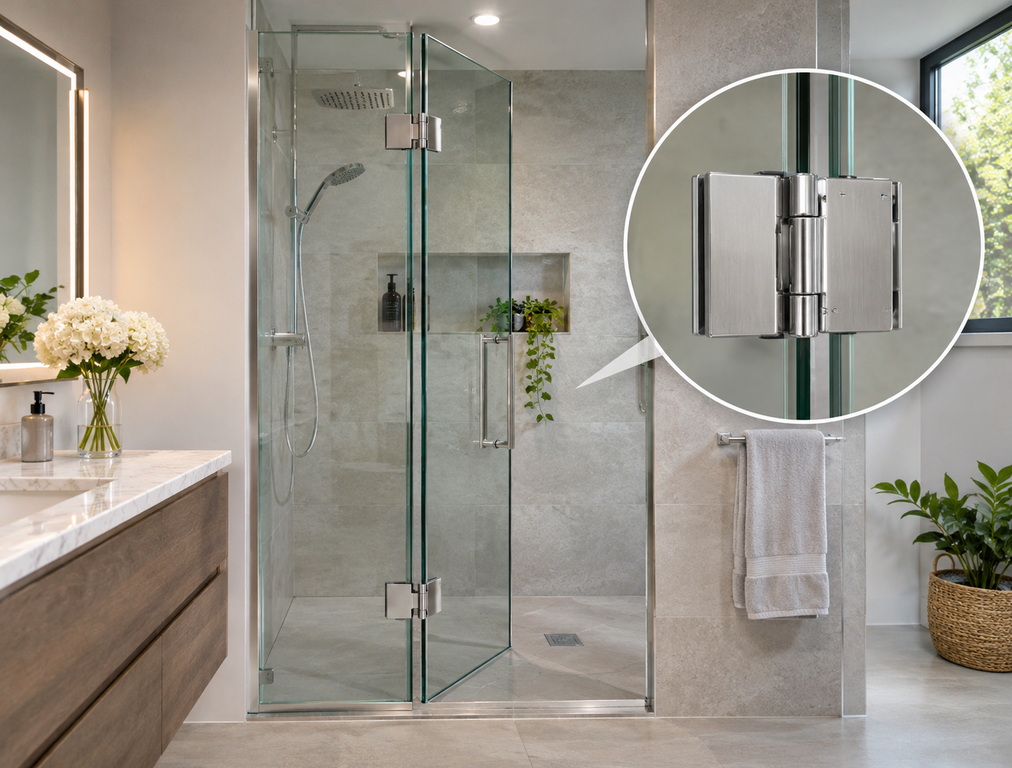


A frameless bifold glass shower door solves a different layout problem from a conventional single-panel swing door. Instead of requiring one wide piece of glass to sweep through the bathroom, a bifold system divides the moving assembly into two panels that rotate relative to each other. One hinge relationship controls how the assembly moves from the wall or supporting structure, while another glass-to-glass hinge allows the second panel to fold against the first. This can reduce the effective swing footprint and create an alternative for bathrooms where a full-width conventional door would interfere with fixtures.
The hinge selection is what makes this movement possible. FHC’s current Zephyr Series is specifically described as a family of inswing and outswing bifold hinges for 3/8-inch tempered glass. The family includes wall-mounted inswing and outswing models as well as several 180-degree glass-to-glass configurations designed around different fold directions. The hinges are free-swinging, have no self-centering mechanism, move in one direction only, and require a door stop. This is fundamentally different from a standard self-centering shower hinge, so a bifold enclosure needs to be planned as a complete hardware system rather than assembled from unrelated hinges.
What Is a Bifold Glass Shower Door?
A bifold shower door uses two connected moving glass panels rather than one wide moving panel.
The wall-side panel rotates from its mounting point, while the second panel folds relative to the first through a glass-to-glass hinge. As the two movements happen together, the door can collapse into a smaller footprint than a conventional single glass door of similar total opening width.
This makes bifold hardware particularly useful when the bathroom does not provide a large clear arc for one full-size outswing door.
The system still uses heavy tempered glass, so “folding” should not be interpreted as lightweight accordion-door behavior. Each panel needs hardware sized for its load, precise glass fabrication, controlled movement, and sufficient structural support.
Why a Standard Shower Hinge Does Not Create a Bifold Door
A standard wall-mounted hinge can rotate a single panel from the wall, but it cannot make a second glass panel fold relative to the first.
A bifold assembly therefore needs at least two hinge relationships. The first connects the door assembly to the wall or supporting panel. The second connects the two moving glass panels.
The geometry of those hinges determines whether the panels fold inward, outward, overlap, or remain inline through the intended movement.
This is why FHC produces Zephyr as a family rather than one universal “bifold hinge.” The catalog includes dedicated wall-mount and glass-to-glass models for different movement combinations.
What Does the Zephyr ZEP05 Do?
The supplied Zephyr wall-mount outswing hinge is the wall-side component for an outswing arrangement.
FHC identifies ZEP05 specifically as a wall-mounted outswing hinge for 3/8-inch glass. Its role is to allow the wall-side door panel to rotate outward from the shower while controlling the movement in the direction for which the hinge was designed.
The hinge is free-swinging rather than self-centering and must be used with a door stop.
That distinction matters because the ZEP05 should not be expected to return the door automatically to a centered closed position in the same way a conventional self-centering shower hinge does.
The Glass-to-Glass Hinge Creates the Fold
The second part of the bifold system is the hinge between the two glass panels.
FHC’s Zephyr family includes several 180-degree glass-to-glass models. ZEP02 is identified as a 180-degree glass-to-glass inswing hinge that can function as a bifold outswing hinge, while ZEP01 is identified as a 180-degree glass-to-glass outswing hinge that can function as a bifold inswing hinge.
That terminology illustrates why bifold hinge selection can initially appear confusing. We need to consider both the movement at the individual hinge and the movement of the complete folded assembly.
For an outswing bifold design using a wall-mounted ZEP05, the matching glass-to-glass configuration needs to be selected according to the intended fold geometry and the manufacturer’s layout rather than simply choosing another hinge labeled “outswing.”
How the Two Panels Move Together
Imagine a bifold assembly consisting of Panel A beside the wall and Panel B connected to Panel A.
ZEP05 allows Panel A to move outward from the wall. A compatible Zephyr glass-to-glass bifold hinge allows Panel B to fold relative to Panel A.
As the user opens the enclosure, the panels can therefore collapse toward each other while the assembly moves outward. The total moving width is divided between two pieces of glass, reducing the space needed for one large rigid panel to sweep across the bathroom.
The exact fold direction, overlap, clearances, and stopping point depend on the selected Zephyr components and glass dimensions.
We never assume that reversing the physical installation of a one-direction hinge will safely reverse its intended operation.
Zephyr Hinges Swing in One Direction Only
This is one of the most important Zephyr specifications.
FHC states that Zephyr bifold hinges are free-swinging, do not have a self-centering mechanism, and swing in one direction only. The manufacturer also requires them to be used with a door stop.
That means the system relies on enclosure geometry and physical stopping components to define the useful range of travel.
A conventional self-centering hinge may help a door return toward a closed position. Zephyr’s free-swinging behavior serves a different purpose by allowing the folding movement needed for a bifold assembly.
Installers should therefore not substitute one hinge type for another simply because the glass thickness and finish appear similar.
Why the Door Stop Is Required
Without an appropriate stop, a free-swinging one-direction panel can travel farther than the enclosure design intended.
That can allow glass to contact another panel, wall, handle, vanity, tile edge, or other hard surface.
FHC explicitly states that Zephyr hinges must be used with a door stop.
The stop therefore needs to be considered part of the hardware system from the design stage. It should be positioned to protect the glass and hinge without creating a trip hazard or interfering with the intended opening.
We do not wait until after installation and then decide how to prevent the panels from overtraveling.
Zephyr Is Designed for 3/8-Inch Tempered Glass
The Zephyr bifold family described in FHC’s current catalog is designed for 3/8-inch, 10 mm tempered glass.
The ZEP05 template likewise specifies 3/8-inch tempered glass only and states that monolithic tempered glass is required.
This is a critical fabrication requirement.
A designer should not plan the enclosure around 1/2-inch glass and assume the same Zephyr hardware will accommodate the change. Glass thickness, panel weight, gasket arrangement, cutout, and hinge capacity are interconnected.
The hardware choice therefore needs to be made before the glass purchase order is released.
Weight and Width Still Limit the Door
Folding the door does not eliminate hinge capacity requirements.
FHC’s current Zephyr catalog lists a maximum door capacity of 100 pounds and 36 inches of width when using two hinges, or 150 pounds and 40 inches of width when using three hinges for the applicable 3/8-inch glass configuration. The manufacturer explicitly warns not to exceed either the maximum weight or width.
That means an installer cannot look only at total square footage or only at weight.
Panel dimensions, hinge quantity, and the way the complete bifold assembly transfers load all need to follow the manufacturer design and templates.
The Two Panels Should Not Be Sized by Guesswork
A common misconception is that a bifold door simply divides the opening into two equal pieces.
The actual panel dimensions depend on hinge geometry, overlap or inline arrangement, required gaps, handle location, seals, stops, and the clear opening the project needs.
One panel may therefore be different in width from the other.
The fabricator should work from the selected Zephyr hinge templates and the enclosure dimensions rather than splitting the opening mathematically and ordering two pieces of glass.
Glass Cutouts Are Product-Specific
FHC provides specific fabrication templates for Zephyr hinges, including ZEP05. The ZEP05 template identifies exact hole positions and instructs fabricators not to scale the drawing but to use the published dimensions.
That instruction is particularly important for bifold doors because two separate hinge relationships need to align correctly.
Once the glass has been tempered, changing to another hinge that uses a different fabrication pattern can require replacement glass.
We therefore finalize every Zephyr component before glass fabrication begins.
Wall Support Remains Critical
The wall-mounted hinge carries the moving assembly through its connection to the wall.
Tile, drywall, or backer board should not be treated as the full structural support for a heavy glass bifold door.
The project needs appropriate backing where the ZEP05 fasteners land.
Because the folded assembly can create complex loads as two pieces of glass move together, we prefer to coordinate wall preparation before tile installation whenever possible.
The wall-side hinge may look small, but it is supporting a substantial moving glass system.
Bifold Doors Can Solve Tight Bathroom Layouts
The main spatial advantage of bifold glass is reducing the swing footprint compared with one broad rigid panel.
Consider a bathroom where a conventional door would strike a vanity before reaching a useful opening angle. Dividing the door into two folding sections can reduce how far the outer edge projects into the room.
That does not mean every small bathroom should automatically use bifold glass.
We still check where the folded panels sit when fully open, whether the handle remains accessible, whether the user can enter comfortably, and whether the glass can clear all nearby fixtures.
A bifold system is a geometry solution, not a substitute for measuring the room.
Bifold Design Still Needs Outward Egress
The current 2024 IRC states that hinged shower doors shall open outward.
For a bifold assembly, this means the complete operating arrangement needs to provide the required outward-opening egress where that code applies.
This is one reason the Zephyr family includes both inswing and outswing components rather than assuming one universal movement is appropriate for every enclosure.
A specialty inswing hinge can be one component of a coordinated bifold system, but we do not interpret the inward movement of an individual folding panel as permission to create an entire primary shower door that cannot open outward.
Local adopted codes should always be confirmed for the actual project.
Folding Changes Handle Placement
A handle installed without considering the folded position can collide with the second panel or prevent the door from folding as intended.
We therefore model both the closed and fully folded positions before choosing handle style and location.
Knobs, back-to-back pulls, towel-bar handles, and longer ladder-style handles occupy different amounts of space.
The handle also needs to remain usable when the door is partially folded.
Hardware coordination is therefore particularly important on bifold doors because several moving components occupy the same general area.
Seals Need to Accommodate Two Moving Joints
A conventional single-panel door typically has one moving hinge side plus a closing edge.
A bifold system adds another moving joint between the two glass panels.
We need to determine how water will be controlled at the wall, between the panels, along the bottom, and at the closing edge.
Rigid seals that restrict the folding hinge can create excessive resistance or prevent the door from reaching its intended position.
We choose seals only after the movement geometry is known.
The Showerhead Direction Matters
Bifold hardware can operate perfectly and the enclosure can still leak if water is directed aggressively toward moving joints.
Whenever possible, the showerhead and body sprays should direct water toward solid walls and away from door gaps.
This is especially important in frameless systems because operating clearances are necessary for the glass to move.
We therefore treat water management as part of enclosure design rather than expecting seals to correct every unfavorable spray direction.
Bifold and Pivot Doors Solve Different Problems
A pivot door changes the rotational axis of one main glass panel. A bifold door uses multiple panels that fold relative to each other.
Both can reduce certain clearance problems, but they do so differently.
A pivot can reduce the amount of glass projecting to one side of the axis, while a bifold reduces the effective swing width by collapsing the door into multiple sections.
The best choice depends on opening width, wall and glass support, desired clear opening, nearby fixtures, and visual preference.
Daltex’s broader guide to shower door hardware can help compare these different hinge and pivot families.
Bifold and Sliding Doors Also Serve Different Layouts
A sliding door generally avoids a swing arc completely but requires overlapping panels and sufficient track length.
A bifold door keeps a hinged opening while reducing the size of the swing.
This distinction can matter in a bathroom where the owner wants a frameless hinged appearance but cannot accommodate one full-width outswing panel.
The choice should be made according to the room geometry rather than assuming one system is inherently more premium.
Zephyr Is Different From Self-Centering Hinges
FHC’s Zephyr hinges are specifically free-swinging with no self-centering mechanism.
That characteristic is central to their folding function.
By contrast, products such as the Glendale Series are available with self-centering behavior near the closed position.
Neither approach is universally better. They solve different movement requirements.
When replacing existing hardware, identifying whether the original door used free-swinging bifold hardware or a self-centering conventional hinge is therefore essential.
Finish Should Be Selected Within the Correct Zephyr Model
FHC’s current Zephyr catalog lists common finish options including brushed nickel, matte black, polished chrome, and satin brass within the family. Daltex also lists finish choices for its Zephyr products.
We choose finish after the correct movement and model numbers have been identified.
Two Zephyr hinges can appear visually related while being engineered for opposite movement directions.
Ordering according to finish before verifying ZEP01, ZEP02, ZEP03, ZEP05, or ZEP07 application can create a very expensive mistake if the glass has already been fabricated.
Bifold Systems Need Careful Installation Sequencing
Because several hinge points must work together, installation order matters.
The wall-side panel needs to be properly supported and aligned, the glass-to-glass connection needs to preserve the intended fold geometry, and stops and seals need to be positioned only after the actual movement has been verified.
We avoid forcing the panels into alignment by overtightening hardware.
The glazing gaskets, fasteners, glass cutouts, and manufacturer torque or installation guidance should be followed for the specific components.
Maintenance Should Focus on Movement and Fasteners
A bifold shower door has more moving relationships than a conventional single-panel door, so periodic inspection is valuable.
We look for unusual movement, loose hardware, seal interference, stop damage, and changes in panel alignment.
Glass should never be allowed to strike another hard surface during operation.
Cleaning products should also be compatible with the hardware finish and glass system.
The goal is maintaining smooth controlled movement rather than waiting until a loose component creates a larger alignment problem.
When a Zephyr Bifold Door Is a Good Fit
We consider a bifold system when the bathroom needs outward-opening egress but does not provide enough clear space for one large conventional swinging panel.
The system can also suit projects where the visual goal favors frameless glass over a traditional framed folding enclosure.
The design still needs adequate wall structure, correct 3/8-inch tempered glass, proper hinge selection, required stops, safe folding clearance, appropriate seals, and manufacturer-compliant fabrication.
When those requirements align, Zephyr hardware can make a compact hinged opening practical without turning the enclosure into a sliding-door system.
Final Thoughts
A bifold glass shower door works because two hinge relationships divide the motion of the door. The wall-side hinge moves the assembly relative to the enclosure, while a compatible glass-to-glass hinge allows the second panel to fold relative to the first.
Within the Zephyr family, the wall-mount outswing hinge provides the wall-side outswing function, while FHC offers matching 180-degree glass-to-glass configurations designed for different folding directions.
The system is designed for 3/8-inch tempered glass, uses free-swinging one-direction hinges rather than self-centering hardware, and requires a door stop. The current catalog lists capacity up to 100 pounds and 36 inches with two hinges or 150 pounds and 40 inches with three, subject to the exact configuration and manufacturer’s requirements.
A successful bifold enclosure therefore begins with geometry, not hardware appearance. We determine the required outward movement, fold direction, panel sizes, wall structure, clear opening, stops, seals, and nearby bathroom fixtures first. Then we select the specific Zephyr components and fabricate the glass around that system.
FAQs
How does a bifold glass shower door work?
It uses two connected moving glass panels. One hinge relationship connects the assembly to the wall or supporting structure, while a glass-to-glass hinge allows the second panel to fold against the first as the door opens.
What does the Zephyr ZEP05 hinge do?
ZEP05 is FHC’s wall-mounted outswing hinge for 3/8-inch glass. It allows the wall-side portion of the Zephyr door system to swing outward and is designed as free-swinging one-direction hardware.
Are Zephyr bifold hinges self-centering?
No. FHC states that Zephyr bifold hinges are free-swinging and have no self-centering mechanism. They are designed to swing in one direction and must be used with a door stop.
What glass thickness is used with Zephyr shower hinges?
The current Zephyr bifold family is designed for 3/8-inch, 10 mm tempered glass. The ZEP05 template also specifies monolithic tempered glass for the product.
Why use a bifold shower door instead of one large swing door?
A bifold assembly can reduce the amount of bathroom floor area required by a single large swinging panel because the moving glass folds into multiple sections. It can be useful where outward-opening capability is required but nearby fixtures limit the swing arc of a conventional door.


