

Blog
How to Choose the Right Shower Door Seal for Your Glass Door

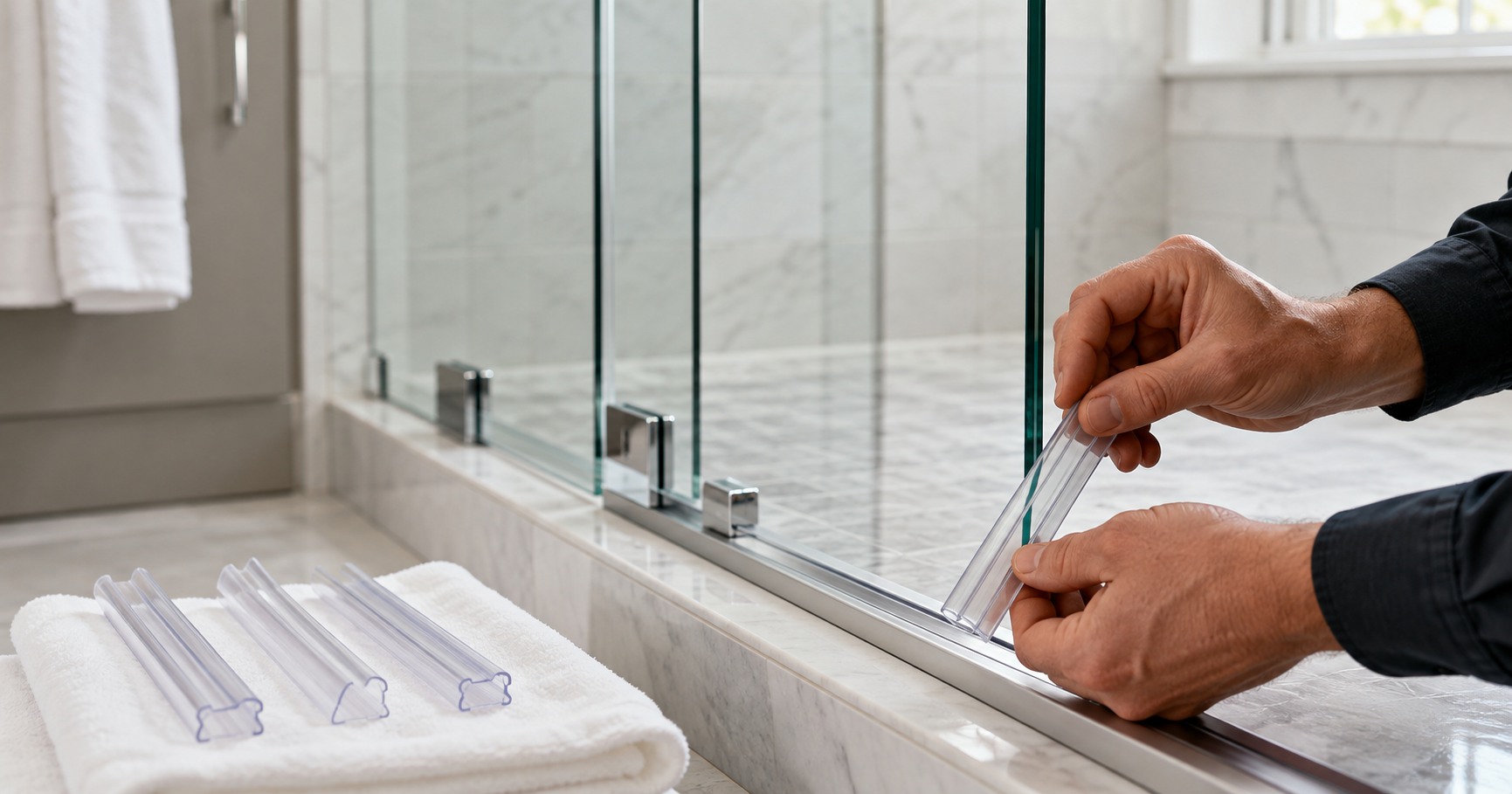


Choosing the right shower door seals starts with five details: glass thickness, seal location, gap size, door movement and seal profile. A bottom sweep will not solve a leak between two vertical glass panels, while a magnetic side seal will not work properly if the door edges do not meet correctly.
The right seal should fit securely over the glass, allow the door to move freely and direct water back into the shower. Understanding how each type works can help you avoid leaks, dragging doors and poorly fitting replacement parts.
Quick Answer: Which Shower Door Seal Do You Need?
Use this quick comparison to identify the most likely seal for your glass door.
| Leak or gap location | Recommended seal | Typical application |
|---|---|---|
| Under a swinging door | Bottom sweep or drip rail | Frameless hinged doors |
| Between a door and fixed panel | H-jamb or inline seal | 180-degree glass connections |
| Between glass at a corner | 90 or 135-degree seal | Corner shower enclosures |
| Door closing against glass | Magnetic strike seal | Swinging glass doors |
| Door closing against a wall | Bulb or jamb seal | Wall-side gaps |
| Sliding glass overlap | Sliding bulb or fin seal | Bypass and sliding doors |
| Water crossing the curb | Threshold with bottom seal | Shower curb or sill |
Daltex Glass carries multiple profiles of shower door seals for bottom, side, inline and angled applications. The correct option depends on the enclosure rather than appearance alone.
1. Identify Where the Water Is Escaping
Before removing the existing seal, run the shower and locate the source of the leak. Water may escape from:
- Under the moving door
- Along the vertical edge beside a wall
- Between the door and a fixed glass panel
- At the corner where two panels meet
- Through the overlap of sliding glass doors
- Across the shower curb or threshold
A leak under the door normally requires a bottom sweep. A vertical leak between two inline panels may need an H-jamb seal. Corner enclosures can require 90 or 135-degree profiles, depending on the angle between the glass panels.
Do not assume that every leak is caused by a worn seal. Water can also escape when a door is misaligned, a threshold slopes outward or the showerhead directs water at an opening.
2. Measure the Glass Thickness
Shower seals are designed to grip specific glass thicknesses. Common shower glass sizes include:
- 1/4-inch glass
- 3/8-inch glass
- 1/2-inch glass
The channel of the seal must correspond to the actual thickness. A channel that is too small may crack, split or refuse to slide onto the glass. A channel that is too large can become loose and fall off during normal door movement.
Use a caliper for the most accurate measurement. If one is unavailable, check the original glass specification or measure carefully with a tape measure. Do not round the measurement to the nearest convenient size.
Many custom shower enclosures use 3/8-inch or 1/2-inch tempered glass, while some framed and sliding systems use thinner glass.
3. Measure the Gap the Seal Must Cover
Glass thickness determines whether a seal fits the panel, but gap size determines whether its fin, bulb or magnetic section reaches the adjacent surface.
Measure the distance between:
- The bottom of the door and the threshold
- The door edge and the wall
- The door and a fixed panel
- Two overlapping sliding panels
Take measurements at the top, middle and bottom. Walls, curbs and fixed panels are not always perfectly level or plumb. If the measurements differ significantly, the enclosure may have an alignment issue rather than a simple seal problem.
The flexible section should bridge the gap without being crushed. Excessive pressure makes the door harder to operate, while insufficient contact leaves a path for water.
4. Match the Seal to the Door Movement
Swinging shower doors
A hinged door needs seals that allow it to open and close without binding. Bottom sweeps, magnetic strike seals, H-jambs and bulb seals are common options.
The bottom fin should make light contact with the threshold or curb. It should not drag heavily across tile because excessive friction can loosen the seal and place unnecessary stress on the door hardware.
Sliding shower doors
Sliding doors require low-friction seals that will not obstruct the rollers or tracks. Bulb seals, soft-fin profiles, overlap seals and bottom guides help control water while preserving smooth movement.
If the door shakes, jumps off the guide or fails to overlap correctly, the problem may involve rollers or other replacement shower parts rather than the seal alone.
Fixed glass panels
Fixed panels may use U-shaped seals, H-jambs, wall jambs or clear silicone joints. The correct solution depends on whether the panel meets another piece of glass, a wall or a moving door.
5. Choose the Correct Seal Profile
Bottom sweeps and drip rails
A bottom sweep attaches to the lower edge of a swinging glass door. Flexible fins close the gap, while an integrated drip rail directs water toward the inside of the enclosure.
Choose a sweep that matches both the glass thickness and the distance between the door and threshold.
H-jamb seals
An H-jamb profile connects or seals two inline pieces of glass. One side grips a fixed panel while the other creates a strike or sealing surface for the moving door.
These seals are common when a door closes against a fixed panel in a straight line.
Magnetic seals
Magnetic seals are usually installed as a matching pair. They pull the door into the closed position and help maintain contact along the vertical edge.
The angle matters. Magnetic profiles may be designed for 90, 135 or 180-degree configurations. The magnets must also face the correct direction and polarity.
Bulb seals
Bulb seals use a flexible rounded section that compresses against a wall, panel or overlapping door. They are useful when the gap varies slightly or when a softer contact point is required.
Fin and wipe seals
A fin seal uses one or more flexible blades to block or redirect water. These are available for door bottoms, vertical edges and sliding-door overlaps.
Thresholds
A threshold is installed on the curb beneath the door. It works with the bottom seal to reduce water crossing the opening. A threshold does not replace a correctly fitted sweep.
6. Consider the Seal Material
Most clear shower seals are manufactured from vinyl, PVC or another flexible plastic. The material should remain firm enough to hold its profile while providing enough flexibility to maintain contact.
Clear profiles are popular because they preserve the appearance of frameless glass. Black seals may suit dark hardware systems or locations where the seal needs to visually match the enclosure.
Exposure to cleaning products, heat, soap residue and mineral buildup can eventually make flexible materials cloudy, brittle or distorted. Material condition is more important than age alone when deciding whether to replace a seal.
How to Install a Replacement Shower Door Seal
Most snap-on shower seals can be replaced without removing the glass door.
- Remove the old seal carefully from one end.
- Clean the glass edge with a non-abrasive cleaner.
- Remove soap residue, adhesive and mineral deposits.
- Dry the glass completely.
- Compare the new seal with the old profile.
- Cut the new seal to length using an appropriate fine-tooth tool.
- Press or slide it evenly onto the glass.
- Position the flexible fin or drip rail toward the shower interior.
- Open and close the door slowly to check clearance.
- Run water and inspect every edge for leakage.
Avoid striking the seal onto tempered glass with a metal tool. If the channel is extremely difficult to install, confirm the glass thickness before applying more force.
The surrounding shower door hardware should also be checked when the door does not close evenly.
Common Shower Seal Selection Mistakes
Choosing by appearance
Two seals may look similar while being designed for different glass thicknesses, angles or door movements. Always compare dimensions and profile shape.
Using the wrong angle
A 180-degree magnetic seal will not perform correctly at a 90-degree corner. Confirm the relationship between the door and adjacent panel.
Ignoring door alignment
A new seal cannot correct a sagging door, loose hinge or incorrectly positioned fixed panel. Address the mechanical issue first.
Installing the drip rail outward
The rail and fin should normally guide water toward the shower interior. Reversing the profile can direct water outside.
Cutting the seal too short
A short seal leaves an open path at the edge. Measure twice and make the first cut slightly longer if adjustment is possible.
Expecting a completely watertight enclosure
Shower seals are water-control components, not structural waterproofing. Their purpose is to reduce water movement through normal gaps while allowing the door to operate.
When Should Shower Door Seals Be Replaced?
Replace a seal when it:
- Becomes cracked or brittle
- Stays bent after the door opens
- No longer grips the glass
- Has a torn or missing fin
- Allows water through a previously sealed gap
- Has severe mineral buildup that cannot be removed
- Prevents the door from closing correctly
- Has become heavily discolored
If the glass is chipped around the edge or the door is visibly misaligned, professional glass repair services may be necessary before installing a new seal.
Frequently Asked Questions
What is the best seal for a frameless glass shower door?
The best seal depends on its position. A bottom sweep is generally used beneath the door, while H-jambs, magnetic seals or bulb seals are used along vertical edges. The channel must match the glass thickness.
How do I know what size shower door seal to buy?
Measure the glass thickness, seal length and gap the flexible section must cover. Check these measurements against the product specifications rather than relying on the appearance of the old seal.
Can I replace a shower door seal without removing the door?
Many snap-on and slide-on seals can be replaced while the door remains installed. Door removal may be necessary when access is restricted or when the hardware also requires repair.
Should a bottom shower seal touch the floor?
It should make light contact with the threshold or sit close enough to control water. It should not drag heavily because this can affect door movement and loosen the seal.
Why does my shower door still leak after replacing the seal?
The seal may have the wrong profile, glass thickness or gap coverage. The door could also be misaligned, the threshold may slope outward or water may be directed at an unsealed opening.
Are magnetic shower door seals universal?
No. Magnetic seals vary by glass thickness, angle, profile and magnetic orientation. Matching pairs should be selected for the exact door configuration.
Can I cut a shower door seal to fit?
Most vinyl and PVC seals can be trimmed to length. Use an appropriate fine-tooth cutting tool and smooth any sharp or rough edges before installation.
Final Takeaway
The right shower door seal must match the glass thickness, installation position, gap size and door movement. Begin by locating the leak, then measure the glass and surrounding gap accurately. Select a bottom sweep, jamb, magnetic seal, bulb seal or fin profile based on how the door and adjacent panels connect.
A properly selected seal should grip the glass securely, allow smooth operation and guide water back into the enclosure without excessive friction.


