

Shower Hinges for 1/4-Inch Glass: A Junior Series Guide
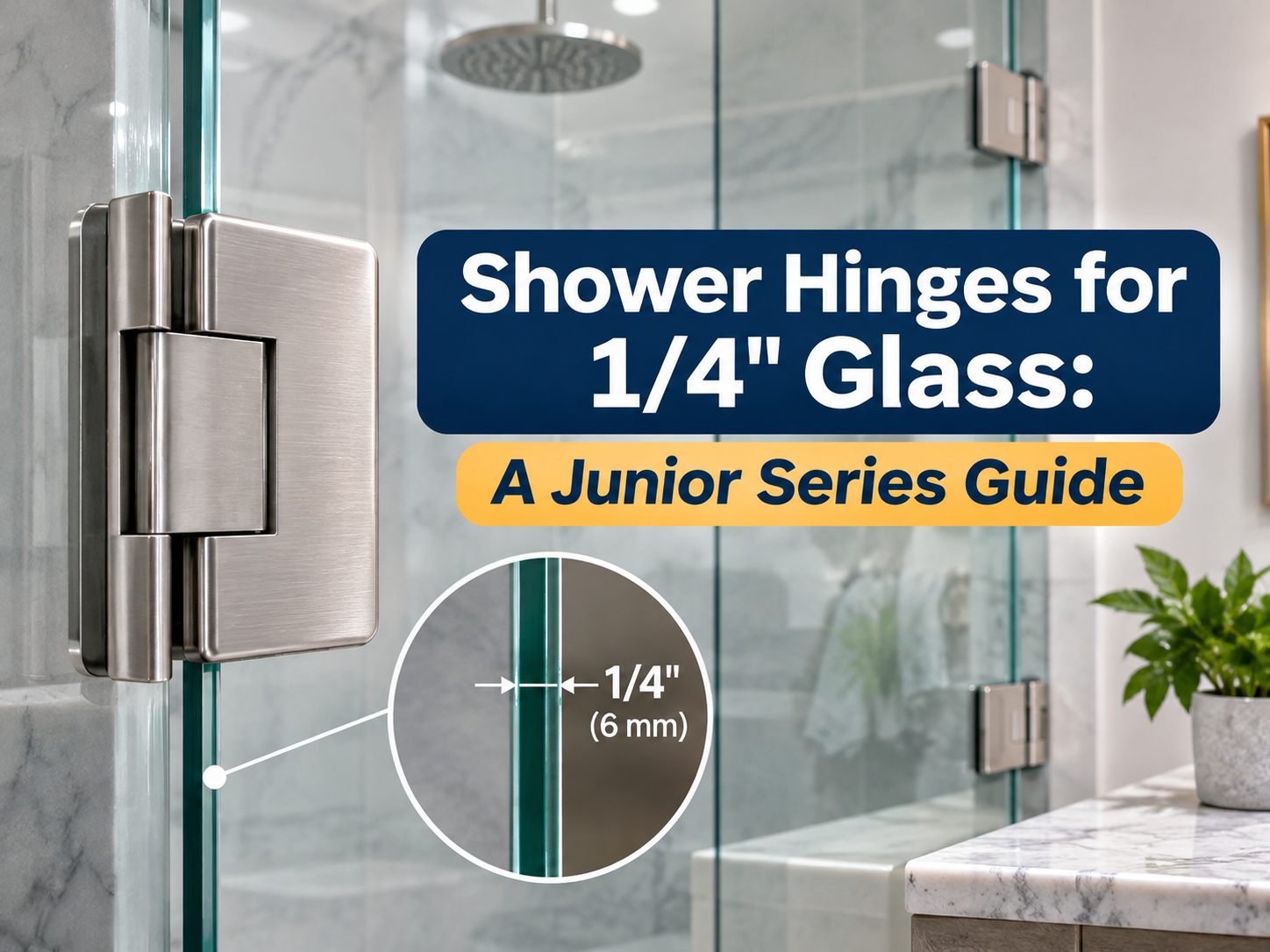


Selecting a shower hinge for 1/4 glass requires more than finding a smaller gasket for a standard heavy-glass hinge. The hinge body, clamp dimensions, fasteners, glass cutout and door-capacity rating must all be engineered for 1/4-inch tempered glass. Junior Series hinges address this requirement with compact hardware designed for lighter shower doors, making them useful for smaller enclosures, tub applications and projects where 3/8-inch or 1/2-inch glass is unnecessary.
Why 1/4-Inch Glass Needs a Compatible Junior Hinge
A hinge designed for 3/8-inch glass should not be adapted to hold a 1/4-inch panel unless the manufacturer specifically lists both thicknesses. Improvised gasket combinations may prevent the clamp from applying pressure correctly and can allow the glass to slip or become overstressed. Using a dedicated Junior Series hinge provides the correct clamping range and gives the fabricator a defined template for holes and cutouts.
Although 1/4-inch glass weighs less than heavy shower glass, it still creates substantial leverage when used as a moving door. The hinge must support the calculated door weight while controlling repeated opening and closing cycles. Tempered safety glass, accurate fabrication and suitable wall backing remain essential even when the door is relatively small.
Junior Glendale 5-Degree Hinge Specifications
The Junior Glendale hinge is a square-profile wall-mount model with a full back plate and a 5-degree closing position. It is constructed from solid brass and designed specifically for 1/4-inch tempered glass. The model is available in brushed nickel, matte black, oil-rubbed bronze and polished chrome, allowing it to coordinate with several common bathroom fixture finishes.
| Specification | Junior Glendale Details |
|---|---|
| Glass thickness | 1/4 inch, or 6 mm |
| Approved glass | Tempered glass only |
| Mounting style | Wall mounted |
| Back plate | Full back plate |
| Profile | Square |
| Maximum with two hinges | 55 pounds and 32 inches wide |
| Maximum with three hinges | 85 pounds and 36 inches wide |
| Hinge dimensions | 3 inches high by 1-13/16 inches wide |
| Compatible material | Solid brass |
| Laminated glass | Not approved |
The published limits require the door to remain within both the weight and width values. A door weighing 50 pounds but measuring 34 inches wide does not qualify for a two-hinge installation because it exceeds the 32-inch width limit. The hinge quantity, glass size and hardware layout should be settled before the glass fabrication order is released.
What the 5-Degree Closing Position Does
A 5-degree hinge is designed to move the door toward a slightly offset resting position so it can press more firmly against a compatible jamb or seal. This can improve contact at the closing edge when the enclosure was intentionally designed around that position. It does not mean the hinge can compensate for a wall that is severely out of plumb or glass that was fabricated to incorrect dimensions.
The closing angle must be considered together with door swing, seals, handles and surrounding fixed panels. If the opening requires a standard 90-degree resting position, a different hinge model may be more appropriate. Daltex’s guide to positive-close hinges provides more information about how angled closing positions affect shower-door alignment.
Why a Full Back Plate Matters
A full back plate provides a broad mounting surface against the wall and creates a conventional, symmetrical hinge appearance. It is useful when there is adequate flat tile area and solid backing behind the mounting location. The full plate can also coordinate visually with square handles and clamps, particularly in contemporary shower designs.
A larger plate does not remove the need for framing or structural blocking. The screws must engage an approved support material rather than relying only on tile or wallboard. If plumbing, trim or an adjacent return panel limits the available mounting area, the installer may need a short plate, offset plate or a different enclosure configuration instead.
Two Hinges vs Three Hinges for 1/4-Inch Glass
The Junior Glendale model permits up to 55 pounds and 32 inches of door width when two hinges are used. Three hinges increase the published capacity to 85 pounds and 36 inches, but the additional hinge must be positioned according to the manufacturer’s instructions and included in the original glass fabrication. Adding a third hinge after tempering is generally impossible because the required glass cutout cannot be safely created in an existing tempered panel.
A third hinge should not be treated as permission to build an unlimited door. Both the 85-pound maximum and the 36-inch width maximum still apply, and the wall must support the complete assembly. The hinge quantity guide explains why width, weight, glass thickness and hinge spacing must be considered together.
Glass Fabrication Must Match the Exact Model
Junior hinges require product-specific holes or notches, and similar-looking hinges may use different templates. The fabricator should receive the exact item number and current template instead of working from a photograph or an old door. All machining must be completed before tempering because tempered glass will fracture if it is drilled, cut or ground afterward.
The glass should also be checked for edge quality, dimensions and proper clearances before installation. Excessively tight gaps can create glass-to-tile contact, while oversized gaps can reduce seal performance and make the door look poorly fitted. The selected sweep, jamb seal and handle should be coordinated with the hinge layout through a complete shower hardware guide.
When 1/4-Inch Glass Is the Right Choice
One-quarter-inch glass can be appropriate for smaller shower doors where reduced weight, compact hardware and a lighter visual profile are desired. It may work well for tub enclosures, guest bathrooms and space-conscious remodels that remain within the Junior hinge capacity. It can also provide a cost-conscious alternative when the project does not require the substantial appearance of 3/8-inch or 1/2-inch glass.
Larger doors, high-use hospitality bathrooms and enclosures requiring greater stiffness may benefit from thicker glass and a corresponding heavy-glass hinge system. The glass thickness should be chosen with the door size, support configuration and user expectations rather than price alone. A professional glass supplier can help determine whether a Junior Series door is appropriate for the measured opening.
Finish and Hardware Coordination
The Junior Glendale square profile works naturally with straight pull handles, rectangular clamps and other modern shower components. Polished chrome creates a bright reflective appearance, brushed nickel provides a softer neutral finish, matte black adds strong contrast and oil-rubbed bronze suits warmer traditional palettes. All visible components should be compared before ordering because similarly named finishes from different product lines may vary slightly.
Regular care can help preserve the selected finish. The hardware should be dried with a soft cloth and cleaned using a mild, nonabrasive product rather than harsh chemicals or abrasive pads. Installers should also avoid power tools when the product instructions require hand tightening, since excessive torque can damage the finish, fasteners or glass.
Order the Glass and Hinge as One System
The safest ordering process begins with field measurements, followed by selection of the exact hinge model, confirmation of door capacity and preparation of the matching glass template. Glass fabrication should begin only after the finish, hinge quantity and closing position have been approved. This sequence reduces the risk of receiving tempered glass that cannot accept the selected hardware.
Daltex supplies shower hardware and fabricated glass for projects throughout Dallas-Fort Worth. Contractors and homeowners planning custom shower enclosures can coordinate the Junior hinge, glass dimensions, cutouts, seals and matching accessories before installation begins.
Frequently Asked Questions
1. Can a standard 3/8-inch hinge hold 1/4-inch glass?
A standard 3/8-inch hinge should not be used unless its manufacturer specifically approves 1/4-inch glass and provides the required gasket arrangement. A visibly tight clamp does not prove that the glass is being held safely. The correct Junior hinge should match the glass thickness, fabrication template and calculated door capacity.
2. How many hinges does a 1/4-inch glass shower door need?
The required quantity depends on the selected hinge’s published weight and width limits. For the Junior Glendale model, two hinges support up to 55 pounds and 32 inches of width, while three support up to 85 pounds and 36 inches. Neither the weight limit nor the width limit may be exceeded.
3. Does 1/4-inch shower glass need to be tempered?
Yes, this hinge is specified for tempered safety glass. Tempering improves the glass’s behavior if breakage occurs and is a fundamental requirement for this shower-door application. Laminated or annealed glass should not be substituted without explicit product and code approval.
4. What does a 5-degree shower hinge mean?
A 5-degree hinge positions the closed door slightly beyond a standard neutral position so it can make firmer contact with a compatible seal or jamb. The enclosure must be measured and fabricated for that intended closing position. The feature cannot correct improperly sized glass or severe wall misalignment.
5. Can a third hinge be added after the door is installed?
Adding another clamp-style hinge usually requires an additional cutout in the glass. Because installed shower doors are typically tempered, the required cutout cannot be safely added afterward. The need for two or three hinges should therefore be determined before fabrication.
6. Is 1/4-inch glass suitable for every frameless shower door?
No, 1/4-inch glass is best suited to doors that remain within the capacity of a compatible Junior hinge system. Larger or heavier doors may require 3/8-inch or 1/2-inch glass with heavy-duty hardware and a different support arrangement. Door size, wall backing, traffic level and desired rigidity should guide the final decision.


