

Blog
U-Channels vs Glass Clamps for Frameless Shower Panels

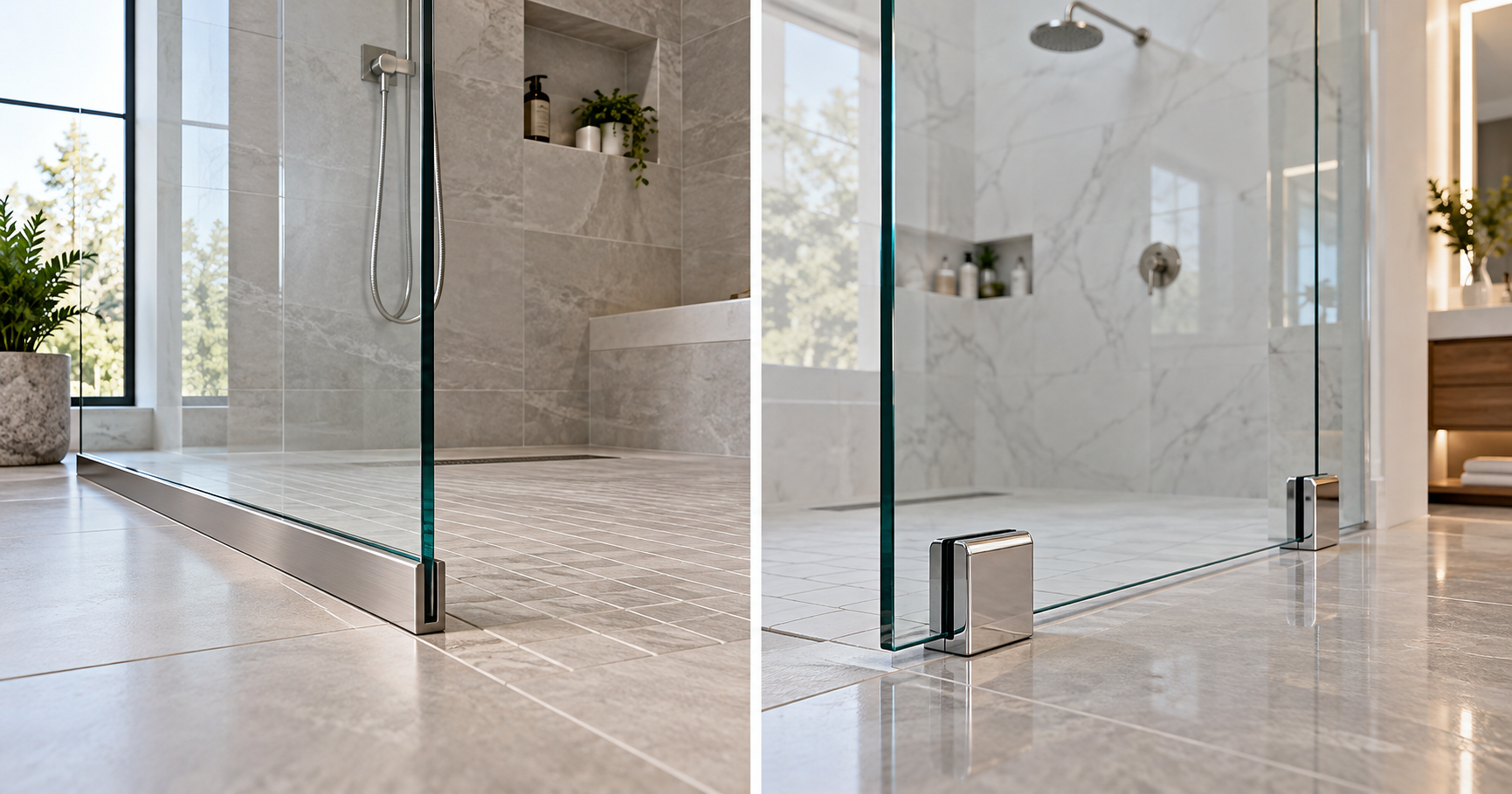


U-channels and glass clamps are two common ways to secure fixed panels in frameless shower enclosures. A U-channel supports the glass along a continuous edge, while clamps hold the panel at selected mounting points.
U-channels generally provide more installation tolerance, continuous support and a more defined perimeter. Glass clamps expose more of the glass and create a more minimal appearance, but they usually require highly accurate measurements and precise hardware placement.
Neither option is automatically better for every shower. The right choice depends on panel dimensions, glass thickness, wall and curb conditions, water management, structural support and the desired appearance.
Quick Comparison: U-Channels vs Glass Clamps
| Feature | U-Channels | Glass Clamps |
|---|---|---|
| Appearance | Continuous metal profile | Minimal visible hardware |
| Glass exposure | Covers the panel edge | Leaves most edges exposed |
| Support style | Continuous edge support | Support at individual points |
| Measurement tolerance | Usually more forgiving | Requires greater precision |
| Glass fabrication | May require fewer holes or notches | Often requires specific holes or notches |
| Water control | Continuous perimeter can simplify sealing | Open joints require carefully applied sealant |
| Cleaning | Continuous metal edges require cleaning | More exposed glass, but hardware corners still collect residue |
| Installation | Often simpler for fixed panels | Requires precise clamp and glass alignment |
| Replacement | Channel can sometimes accommodate minor differences | New hardware must match glass preparation |
| Best for | Practical support and installation flexibility | A highly frameless, minimal appearance |
What Is a Shower Glass U-Channel?
A shower glass U-channel is a narrow metal profile shaped like the letter U. The edge of the fixed glass panel sits inside the channel.
The channel may be installed along:
- A wall
- The shower curb
- The bathroom floor
- The ceiling
- Multiple sides of a fixed glass panel
U-channels are commonly made from aluminum, stainless steel or another corrosion-resistant material. They are available in finishes such as polished chrome, brushed nickel, matte black, brass and bronze.
The internal width of the channel must match the thickness of the glass and the specified setting materials.
How Does a U-Channel Support Glass?
The U-channel creates continuous contact along the installed edge of the panel. Setting blocks, glazing material and manufacturer-approved sealant may be used to position and protect the glass.
The channel itself must be securely attached to a suitable mounting surface. Sealant should not be treated as a replacement for required structural fasteners.
Continuous support can help distribute contact along the glass edge. However, the total capacity still depends on the channel design, panel dimensions, glass thickness, anchoring method and enclosure configuration.
What Are Glass Clamps?
Glass clamps are compact metal components that secure a fixed panel at specific mounting points. They are also sometimes called glass clips or panel clips.
Common configurations include:
- Wall-to-glass clamps
- Floor-to-glass clamps
- Ceiling-to-glass clamps
- Glass-to-glass clamps
- Corner clamps
- Square clamps
- Beveled clamps
Glass clamps expose more of the panel edge than a U-channel. This creates the minimal appearance commonly associated with fully frameless shower enclosures.
The shower hardware selected for an enclosure must match the glass thickness, mounting direction and required fabrication.
How Do Glass Clamps Hold a Panel?
Glass clamps secure the panel through controlled pressure, mechanical fasteners and protective gaskets. Depending on the clamp design, the glass may require a hole, notch or another specific preparation.
Manufacturer drawings should be reviewed before the glass is fabricated. Tempered glass cannot be safely drilled or notched after manufacturing.
Clamps should never place unprotected metal directly against the glass. Proper gaskets help distribute pressure and protect the glass surface.
Which Option Looks More Frameless?
Glass clamps normally create the more frameless appearance.
Because clamps contact the panel only at selected points, most of the glass edge remains visible. This can make the enclosure appear lighter and more open.
U-channels create a continuous line of metal along the panel edge. Although the profile is much smaller than a traditional frame, it remains more visible than individual clamps.
The best visual choice depends on the bathroom design.
Glass clamps may be preferable when:
- Minimal visible metal is a priority
- The bathroom has clean architectural lines
- The walls and curb are accurately constructed
- The glass edges are intended to remain visible
- A custom luxury appearance is desired
U-channels may be preferable when:
- A continuous finish line complements other fixtures
- The panel edge should be partially concealed
- Installation flexibility is more important than removing every visible metal line
- The enclosure already uses matching channels or headers
A coordinated finish can make either option look intentional.
Which Provides Better Support?
U-channels provide continuous support along the installed edge, while glass clamps create support at individual points.
This does not mean a U-channel is always stronger or that clamps are unsuitable for large panels. Properly specified clamps can safely support frameless shower glass when the number, spacing and mounting conditions follow the system requirements.
The appropriate support method depends on:
- Panel height and width
- Glass thickness
- Panel weight
- Number of supported edges
- Wall and curb materials
- Presence of a return panel
- Use of a support bar
- Exposure to door movement
- Manufacturer specifications
- Applicable building requirements
A fixed panel attached to a moving door may experience different forces from a panel that stands independently. Hinges mounted to a fixed panel can transfer part of the door load into that panel and its supporting hardware.
For this reason, hardware selection should consider the complete enclosure rather than the stationary panel alone.
Which Option Handles Uneven Walls Better?
A U-channel is generally more forgiving when walls or curbs are slightly out of plumb or uneven.
Some channels provide enough depth to accommodate small variations while maintaining a clean visible line. The exact adjustment range depends on the channel profile and glass dimensions.
Glass clamps require the panel to align accurately with specific mounting points. If the wall is significantly out of plumb, the glass may need to be specially shaped or positioned with carefully calculated gaps.
Clamps do not correct poor construction. Large variations can result in:
- Uneven silicone joints
- Misaligned hardware
- Excessive gaps
- Glass stress
- Poor water control
- An unfinished appearance
The opening should be measured after the finished tile and curb are complete.
U-Channels vs Glass Clamps for Water Control
U-channels can simplify water management because they create a continuous profile along the panel edge. The joint between the channel and the surrounding surface can be sealed according to the manufacturer’s instructions.
Glass clamps leave more of the glass-to-tile joint exposed. The open sections generally require a continuous bead of suitable glazing sealant to reduce water passage.
Both methods can manage normal shower water when properly installed. Performance also depends on:
- Curb slope
- Panel position
- Showerhead direction
- Floor drainage
- Joint preparation
- Sealant quality
- Door gaps
- Adjacent seals and sweeps
A frameless shower is designed to control splashing, but it is not a completely watertight container.
Which Is Better for a Curb?
A U-channel along the curb can create a clean, continuous base for the panel. It may also conceal setting blocks and the bottom glass edge.
Clamps create a more open appearance but leave larger sections of the bottom edge exposed. The remaining joint must be carefully sealed.
Before drilling into a curb, the installer should understand the waterproofing system beneath the finished surface. Penetrating a curb without an approved installation method can compromise waterproofing.
Which Requires More Glass Fabrication?
Glass clamps often require more specific glass preparation than U-channels.
Depending on the selected clamp, the panel may need:
- Holes
- Notches
- Cutouts
- Precise edge distances
- Polished exposed edges
A basic U-channel installation may not require hardware holes along the supported edge. However, the panel may still require fabrication for hinges, handles, brackets or other components.
All holes and cutouts must be planned before tempering. Once the glass has been tempered, it should not be drilled, cut or reshaped.
This makes accurate hardware selection essential during the design stage of custom enclosures.
Which Option Is Easier to Install?
U-channels are often easier to install because they provide a continuous receiving profile for the panel. They may allow the installer to position the glass before final alignment and sealing.
Glass clamps require each mounting point to align with the hardware and any corresponding glass preparation. Errors in hole location, notch size or clamp spacing can prevent installation.
A typical U-channel installation involves:
- Confirming the finished opening measurements
- Cutting the channel to the required length
- Locating approved mounting points
- Attaching the channel to suitable backing
- Positioning setting blocks
- Placing and aligning the glass
- Applying the specified glazing material
- Sealing the required joints
A typical clamp installation involves:
- Confirming the glass and clamp specifications
- Marking individual mounting positions
- Preparing the correct structural attachment points
- Installing protective gaskets
- Positioning the glass
- Aligning each clamp with the holes or notches
- Tightening fasteners to the specified requirements
- Sealing exposed perimeter joints
Both methods require accurate measurement and safe glass-handling equipment.
Which Option Is Easier to Clean?
Glass clamps expose more of the panel surface and edge, which can support a clean, minimal appearance. However, mineral deposits and soap residue may collect around clamp edges, gaskets and fasteners.
U-channels create longer metal seams where water can settle. Mineral deposits may become visible along the channel and sealant line if the enclosure is not cleaned regularly.
For either option:
- Dry the glass and hardware after use
- Use non-abrasive cleaning products
- Avoid harsh chemicals that may damage finishes
- Keep sealant joints free from persistent buildup
- Inspect gaskets and fasteners periodically
- Address corrosion or movement promptly
The hardware finish and local water conditions can have a greater effect on maintenance than the mounting method alone.
U-Channels vs Clamps for Long-Term Maintenance
U-channels have fewer separate hardware points along the supported edge. However, the continuous channel and sealant joints should be inspected for movement, corrosion and moisture buildup.
Clamps have individual fasteners and gaskets that may require periodic inspection. A loose clamp should not simply be tightened without supporting the glass and identifying why it moved.
Maintenance concerns for clamps include:
- Loose fasteners
- Compressed gaskets
- Finish deterioration
- Movement around a notch or hole
- Cracked sealant between mounting points
Maintenance concerns for U-channels include:
- Loose mounting screws
- Deteriorated sealant
- Mineral deposits
- Corrosion
- Movement inside the profile
- Damaged setting materials
Replacement shower parts should match the original system rather than being selected by appearance alone.
Which Costs More?
Glass clamps may result in a higher installed cost when the design requires multiple pieces of hardware, additional glass fabrication and more precise installation.
U-channels are often a cost-efficient option because one continuous profile can support a full edge and may reduce the number of glass cutouts.
However, there is no universal price difference. Cost depends on:
- Panel dimensions
- Glass thickness
- Number of clamps
- Channel length
- Hardware material
- Decorative finish
- Required glass cutouts
- Wall and curb preparation
- Labor requirements
- Support bars or additional brackets
A high-quality U-channel system may cost more than basic clamps, while premium architectural clamps may cost more than a standard channel.
The full installed system should be compared rather than the price of an individual component.
Can U-Channels and Glass Clamps Be Used Together?
Yes. A hybrid installation can use both U-channels and glass clamps.
Common combinations include:
- U-channel along the curb with clamps at the wall
- U-channel at the wall with clamps along the bottom
- U-channel along two edges with a support clamp at the top
- Clamps around visible edges with a concealed channel at the base
A hybrid approach can balance appearance, support, water control and installation flexibility.
For example, a base channel may provide continuous support and simplify sealing, while wall clamps preserve a more open vertical edge.
The combined system must still be approved for the panel size and configuration.
When Should You Choose a U-Channel?
A U-channel may be the better option when:
- The wall or curb has small dimensional variations
- Continuous edge support is preferred
- Water management is a high priority
- Fewer glass holes or notches are desired
- A defined metal line suits the bathroom design
- Installation flexibility is valuable
- The bottom glass edge should be concealed
- A large fixed panel needs continuous support
A U-channel can also be useful when the enclosure includes other continuous metal components and a consistent finish is desired.
When Should You Choose Glass Clamps?
Glass clamps may be the better option when:
- A highly frameless appearance is the main goal
- The walls and curb are accurately constructed
- The glass dimensions are precisely measured
- Exposed polished edges are part of the design
- Minimal metal coverage is preferred
- The panel size is suitable for point-mounted support
- Compatible glass fabrication has been planned
- The installer can access secure structural mounting points
Clamps work best when the enclosure has been designed around their exact locations rather than added after the glass has been ordered.
Important Factors to Check Before Choosing
Glass Thickness
The channel or clamp must be designed for the exact glass thickness. A profile intended for one thickness may not safely hold another.
Panel Dimensions
Width and height affect panel weight and movement. Large panels may require additional support regardless of the selected mounting method.
Glass Preparation
Confirm whether the hardware requires holes, notches or cutouts. Manufacturer templates should be used before tempering.
Mounting Surface
Fasteners must connect to appropriate structural backing. Tile and drywall alone may not provide sufficient support.
Curb and Wall Alignment
Measure plumb, level and square conditions after the finished surfaces are complete.
Door Configuration
Determine whether the fixed panel will support hinges or receive force from a moving door.
Hardware Finish
Compare physical samples when possible. Finish names such as brushed gold or matte black can vary between manufacturers.
Waterproofing
Consider how the channel or clamp fasteners interact with the waterproofing system, particularly around the shower curb.
Common Selection and Installation Mistakes
Choosing Only by Appearance
Minimal hardware may look attractive, but the panel still requires sufficient support and secure mounting.
Ordering Glass Before Selecting Hardware
Clamp holes and notches are hardware-specific. The glass should not be fabricated until the mounting system has been confirmed.
Assuming Clamps Are Universal
Clamps vary by glass thickness, hole pattern, mounting angle, gasket type and load capacity.
Using Sealant as Structural Support
Sealant helps manage water and stabilize joints, but it does not replace required clamps, channels or structural fasteners.
Ignoring Out-of-Plumb Walls
A glass panel cannot compensate for severe construction variations without proper measurement and fabrication.
Overtightening Clamps
Excessive pressure can damage gaskets, distort hardware or create stress around glass holes and notches.
Drilling Tempered Glass
Tempered shower glass cannot be safely drilled or modified after fabrication.
Can an Existing U-Channel Be Replaced With Clamps?
Replacing a U-channel with clamps may be possible, but it is rarely a simple hardware swap.
The existing panel may not have the holes or notches required for clamps. Because tempered glass cannot be drilled after manufacturing, new glass may be necessary.
The surrounding surfaces must also have suitable structural attachment points at the proposed clamp locations.
Changing from clamps to U-channel may also require new glass if the original dimensions do not fit the channel depth and required clearances.
Professional glass replacement can determine whether the existing panel can remain in service.
Frequently Asked Questions
Are glass clamps stronger than U-channels?
Neither option is automatically stronger. Performance depends on panel size, glass thickness, hardware capacity, clamp quantity, channel design and structural attachment.
Do glass clamps require holes in the glass?
Many clamps require holes or notches, but some designs use pressure and gaskets without the same glass preparation. Always follow the hardware manufacturer’s template.
Does a U-channel make a shower framed?
No. A frameless shower can use narrow U-channels to support fixed panels. It still has substantially less framing than a traditional framed enclosure.
Which option looks more frameless?
Glass clamps generally create the more frameless appearance because they leave most of the glass edge exposed.
Is U-channel better for an uneven wall?
A deep U-channel may accommodate small variations more effectively than clamps. Significant irregularities still require proper measurement and corrective work.
Which option prevents leaks better?
U-channels can simplify continuous sealing, but both systems can manage water when correctly installed. Curb slope, showerhead direction and perimeter sealant also matter.
Can U-channel be installed without drilling into the curb?
Some enclosure designs use alternative attachment methods, but the complete system must follow manufacturer instructions and local requirements. Sealant alone should not be assumed to provide structural support.
How many glass clamps are needed?
The required number depends on panel dimensions, glass thickness, clamp capacity and the number of supported edges. A universal clamp count should not be used.
Can I install clamps on existing tempered glass?
Only if the existing glass preparation matches the selected clamps. New holes or notches cannot be added safely to tempered glass.
Can a shower use both clamps and U-channel?
Yes. Hybrid systems are common and can combine continuous support at one edge with minimal hardware at another.
Final Verdict
Choose a U-channel when continuous support, installation tolerance, simpler glass preparation and water management are the main priorities.
Choose glass clamps when a highly frameless appearance, exposed glass edges and minimal visible metal are more important, and the opening can support precise fabrication and installation.
For many enclosures, a hybrid system offers the best balance. The final decision should be based on the complete enclosure design, not appearance alone. Panel dimensions, glass thickness, wall conditions, structural backing and hardware specifications must all be evaluated before the glass is manufactured.


