

Blog
The Most Common Glass Shower Door Parts and Their Functions

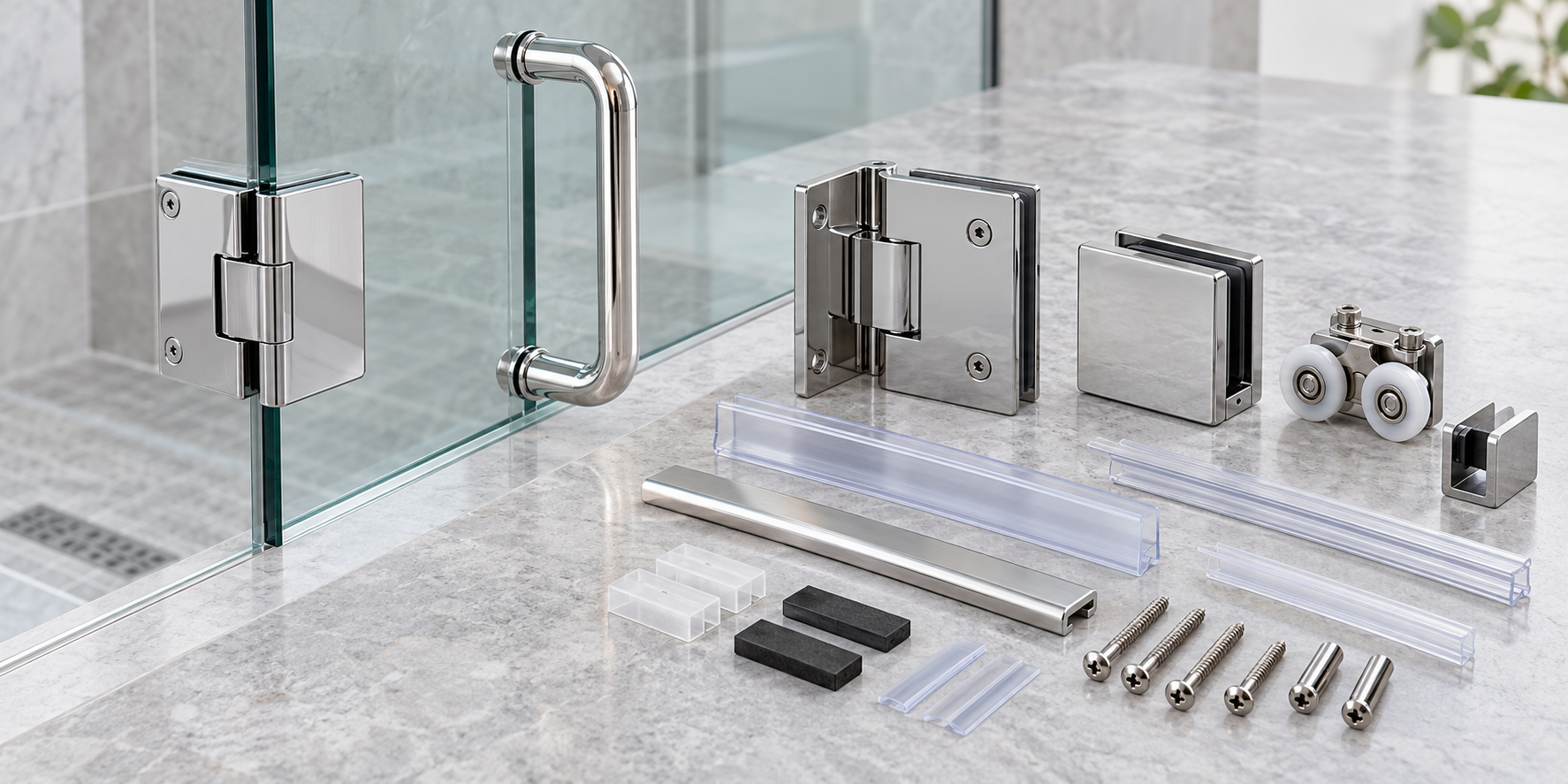


Glass shower doors rely on several parts to support the glass, control movement and manage water. The most common glass shower door parts include hinges, handles, clamps, channels, tracks, rollers, guides, sweeps, seals, thresholds, gaskets and fasteners.
Each component performs a specific function. Hinges and rollers move the door, clamps and channels secure the glass, while sweeps and seals reduce the amount of water escaping through the gaps.
Understanding these parts can help you identify a problem, find a compatible replacement and determine when professional repair is necessary.
Quick Guide to Glass Shower Door Parts
| Shower Door Part | Primary Function |
|---|---|
| Glass panel | Forms the door or fixed enclosure wall |
| Hinges | Support and move a swinging door |
| Pivot hardware | Allows the door to rotate from top and bottom points |
| Handle or knob | Provides a safe gripping point |
| Glass clamps | Secure fixed glass panels |
| U-channels | Hold and support glass edges |
| Header | Stabilizes the top of the enclosure |
| Support bar | Braces a stationary glass panel |
| Track | Guides a sliding shower door |
| Rollers | Allow a sliding door to move |
| Bottom guide | Keeps sliding panels aligned |
| Stops and bumpers | Limit movement and cushion contact |
| Bottom sweep | Reduces water leakage beneath the door |
| Vertical seal | Closes gaps between the door, wall or glass |
| Magnetic seal | Helps door edges close together |
| Threshold | Directs water toward the shower interior |
| Gaskets | Protect glass from direct metal contact |
| Fasteners | Attach hardware to the glass or surrounding structure |
1. Tempered Glass Panels
The glass panel is the main part of a shower door. It may function as a moving door, a stationary panel or a return panel positioned at an angle to the main enclosure.
Most modern glass shower doors use tempered safety glass. Tempering strengthens the glass and changes how it breaks if failure occurs.
Glass panels vary by:
- Thickness
- Height and width
- Edge finish
- Tint or texture
- Hole placement
- Hinge cutouts
- Handle holes
- Notches for clamps
Framed shower doors generally use thinner glass because the surrounding metal frame provides additional support. Frameless enclosures normally use thicker glass supported by heavy-duty hardware.
Tempered glass cannot be safely drilled, trimmed or reshaped after manufacturing. Replacement hardware must match the holes and cutouts already present in the panel.
2. Shower Door Hinges
Hinges support a swinging shower door and allow it to open and close. They carry the weight of the glass and control its movement.
Common types include:
Wall-to-Glass Hinges
Wall-to-glass hinges connect the shower door directly to a wall or vertical jamb. They require secure structural backing behind the finished wall.
Glass-to-Glass Hinges
Glass-to-glass hinges attach the moving door to a fixed glass panel. The stationary panel must be properly supported because it receives part of the door’s load.
Pivot Hinges
Pivot hinges support the door from the top and bottom. They allow the glass to rotate around a fixed point rather than swing from conventional side-mounted hinges.
Continuous Hinges
A continuous hinge runs along most of the door’s height. This design distributes weight across a longer area and is common in framed or semi-frameless systems.
Hinges are selected according to glass thickness, door width, door weight, swing angle and glass preparation. Different types of shower hardware are designed for specific enclosure configurations.
Signs of a Hinge Problem
A hinge may require adjustment or replacement if:
- The door sags
- The glass rubs against the curb
- The door no longer closes evenly
- The hinge clicks or shifts
- Gaskets are coming out
- Screws repeatedly become loose
- Corrosion is visible around the hinge
A heavy glass door should be supported before hinge screws are loosened.
3. Pivot Hardware
A pivot system normally includes a top pivot, bottom pivot, bushings, adjustment screws and mounting hardware.
Its main function is to support rotation from the top and bottom edges of the glass. Some pivot systems place the rotation point near the edge, while others position it farther inside the panel.
Pivot hardware is useful when:
- Side-wall mounting is limited
- The door needs to swing in both directions
- The enclosure uses a header
- A specific swing path is required
The upper and lower pivot points must remain precisely aligned. Incorrect alignment can cause binding, uneven gaps and excessive stress on the glass.
4. Handles, Pulls and Knobs
A shower door handle provides a secure gripping point for opening and closing the door. Handles are available in several configurations.
Back-to-Back Pull Handles
These handles have gripping surfaces on both sides of the door and are connected through holes in the glass.
Knobs
Knobs use less space than long pull handles. They are frequently used in small bathrooms or on compact shower doors.
Ladder Pulls
Ladder pulls are long handles with extended mounting points. Some designs include a towel bar on the exterior side.
Finger Pulls
Finger pulls have a low profile and are often used on sliding doors where a larger handle could interfere with panel overlap.
Replacement handles must match the existing hole spacing, hole diameter, glass thickness and clearance. A handle that looks similar may not fit the original glass preparation.
5. Towel Bars
Towel bars may be installed on the outside of a shower door or combined with a pull handle.
Their function is to provide convenient towel storage without requiring another wall-mounted accessory. However, a towel bar is not automatically designed to support body weight.
Unless specifically manufactured and installed as a safety grab bar, it should not be used for balance or support.
6. Glass Clamps
Glass clamps secure fixed panels to a wall, floor, ceiling or another glass panel. They provide a minimal appearance because they cover only a small portion of the glass.
Common clamp configurations include:
- Wall-to-glass clamps
- Floor-to-glass clamps
- Ceiling-to-glass clamps
- Glass-to-glass clamps
- Corner clamps
Some clamps require a hole or notch in the glass. Others hold the panel through controlled pressure and protective gaskets.
The correct clamp depends on glass thickness, panel size, mounting position and required glass preparation.
7. U-Channels
A U-channel is a narrow metal profile that holds the edge of a stationary glass panel.
It may be installed along:
- A wall
- The shower curb
- The floor
- The ceiling
- Multiple sides of the glass
U-channels provide continuous support and conceal some mounting fasteners. They can also make it easier to accommodate minor variations in walls or curbs.
The internal width of the channel must match the glass thickness and the required setting material.
8. Headers
A header is a horizontal metal component installed across the top of an enclosure.
Its function is to connect and stabilize the upper portions of the enclosure. A header may also support pivot hardware or sliding door components.
Headers are common in:
- Framed shower doors
- Semi-frameless enclosures
- Wide shower openings
- Multi-panel systems
- Pivot door configurations
A structural header should not be removed simply to create a more frameless appearance. It must be replaced with another approved support system if the enclosure still requires stabilization.
9. Support Bars
A support bar, sometimes called a stabilizer bar, braces a stationary glass panel.
Support bars are commonly used when a large fixed panel could flex or move. They may connect the panel to a wall, ceiling or another glass panel.
Common styles include:
- Wall-to-glass support bars
- Glass-to-glass support bars
- Ceiling-mounted supports
- Corner stabilizer bars
- Adjustable support arms
A support bar improves stability but cannot correct an improperly sized panel or an insecure base connection.
10. Sliding Door Tracks
A track guides the movement of a sliding shower door. Depending on the system, it may be installed at the top, bottom or both.
Common track configurations include:
Bypass Tracks
Bypass tracks allow two or more panels to slide past each other. They are frequently used for bathtub enclosures and framed shower doors.
Top-Hung Tracks
Top-hung systems carry the door’s weight from an upper rail. The bottom of the panel is controlled by a guide.
Barn-Style Tracks
Barn-style shower doors use visible rollers that travel along an exposed horizontal bar.
Tracks must match the complete sliding system. Track diameter, roller shape, panel overlap, glass thickness and weight capacity all affect compatibility.
11. Rollers and Hangers
Rollers allow sliding glass doors to move along a track. In a top-hung system, the rollers may carry most of the glass weight.
A typical roller assembly may include:
- Wheel
- Bearing
- Axle
- Hanger
- Adjustment screw
- Glass gasket
- Decorative cover
- Anti-jump component
Worn rollers may cause the door to drag, wobble or produce grinding sounds. A damaged bearing can also make the door difficult to move.
Replacement rollers must match the original wheel diameter, mounting hole, axle size, offset and weight rating.
12. Bottom Guides
A bottom guide keeps a sliding door aligned while allowing it to travel along the track.
The guide prevents the lower edge of the glass from swinging sideways. It may be attached to the shower curb, floor or an adjacent fixed panel.
A damaged guide can allow glass to contact another panel, the wall or metal hardware. This can create an unsafe operating condition.
The guide opening must match the glass thickness and the designed panel overlap.
13. Stops, Bumpers and Anti-Jump Devices
These small shower door parts control and protect the door’s movement.
Door Stops
Stops limit how far a sliding door can travel.
Bumpers
Bumpers cushion contact between the door and another surface.
Anti-Jump Devices
Anti-jump devices help prevent a sliding panel from lifting off the track.
Missing stops or anti-jump components should not be ignored. They are part of the complete operating and safety system.
14. Bottom Sweeps
A shower door sweep attaches to the bottom edge of the glass. Its function is to reduce the amount of water passing beneath the door.
Common sweep profiles include:
- Straight fin sweeps
- Double-fin sweeps
- Bulb seals
- Drip-rail sweeps
- Angled water deflectors
The sweep must match the glass thickness and the size of the gap beneath the door.
A sweep that is too long may drag across the curb and prevent the door from closing correctly. A sweep that is too short may leave a gap that allows water to escape.
Sweeps are normal wear parts. They may eventually become brittle, discolored, torn or misshapen. Compatible replacement parts should be selected by measurements and profile rather than appearance alone.
15. Vertical Jamb Seals
Vertical seals close the gap between the door and a wall, fixed panel or another door.
They may contain:
- A flexible fin
- A soft bulb
- A rigid channel
- An angled water deflector
The direction of the seal matters. An incorrectly installed fin may catch on the door or direct water toward the bathroom floor.
Hinge-side seals may also help prevent direct contact between adjacent glass edges.
16. Magnetic Seals
Magnetic seals help two closing edges meet and remain aligned.
They are commonly used on:
- Corner-entry showers
- Neo-angle enclosures
- Double-door systems
- Bi-fold doors
Magnetic seals are manufactured for specific glass thicknesses and closing angles. The two sides must also have compatible magnetic polarity.
A magnetic seal cannot correct a severely misaligned door. Hinge, pivot or roller problems should be repaired first.
17. Thresholds and Water Dams
A threshold is a low metal strip positioned beneath the shower door.
Its primary function is to redirect water toward the shower interior. It may work together with a bottom sweep to improve water control.
A threshold can be particularly useful when:
- The curb has minimal inward slope
- Water regularly reaches the entrance
- The gap under the door is relatively large
- A drip rail needs a defined landing point
A frameless shower enclosure is designed to manage normal splashing, but it is not a completely watertight container. Showerhead direction, curb slope and door position also affect water control.
18. Gaskets and Vinyl Inserts
Gaskets create a protective layer between glass and metal hardware.
They are used in:
- Hinges
- Clamps
- Handles
- Rollers
- Channels
- Support brackets
Gaskets help distribute pressure and prevent direct metal-to-glass contact. They may be made from rubber, vinyl, neoprene or another manufacturer-specified material.
Old gaskets can become compressed, cracked or hardened. Reusing a damaged gasket may prevent the hardware from gripping the glass correctly.
19. Setting Blocks and Spacers
Setting blocks support and position glass within a channel or frame. Spacers maintain the required distance between panels and surrounding surfaces.
Their functions include:
- Supporting the glass edge
- Maintaining alignment
- Preventing glass-to-metal contact
- Preserving installation clearances
- Distributing weight inside a channel
These parts may not remain visible after installation, but they are important to the stability of the enclosure.
20. Frames and Jambs
Framed shower doors use metal profiles around the glass. These profiles provide structural support and create controlled paths for seals and moving panels.
Common frame parts include:
- Wall jambs
- Bottom rails
- Header rails
- Vertical door frames
- Corner posts
- Glazing vinyl
- Screw covers
Framed shower door parts are often specific to the original manufacturer and model. A generic profile may not fit the existing frame.
21. Fasteners and Cover Plates
Fasteners attach shower door hardware to the glass, walls, floor or ceiling.
They may include:
- Machine screws
- Set screws
- Wood screws
- Masonry anchors
- Washers
- Threaded inserts
- Mounting plates
Cover plates hide the fasteners and create a finished appearance. However, the decorative cover does not provide structural support.
Fasteners must reach an appropriate mounting surface. Standard drywall anchors may not be suitable for hardware supporting heavy glass.
Parts Used by Different Shower Door Types
Different enclosure designs use different combinations of components.
Frameless Hinged Doors
A frameless hinged enclosure commonly uses:
- Heavy-glass hinges
- Pull handle or knob
- Bottom sweep
- Vertical seals
- Glass clamps or U-channels
- Support bar
- Threshold
Framed Sliding Doors
A framed sliding system commonly uses:
- Header track
- Bottom track
- Rollers
- Guides
- Door frame
- Wall jambs
- Towel bar or handle
- Bumpers
- Glazing vinyl
Frameless Sliding Doors
A frameless sliding system may use:
- Top support bar
- Exposed rollers
- Roller hangers
- Anti-jump devices
- Bottom guide
- Door stops
- Handle
- Seals
Pivot Doors
A pivot enclosure may include:
- Top pivot
- Bottom pivot
- Header or top support
- Handle
- Sweep
- Jamb seal
- Fixed-panel hardware
The hardware and glass should be planned as one system when installing custom enclosures.
How to Identify an Unknown Shower Door Part
Before removing or ordering a component, collect as much information as possible.
Identify the Door Type
Determine whether the door is hinged, pivoting, bypass sliding, single sliding, bi-fold, framed or frameless.
Look for a Brand or Model Number
Check the frame, track, handle, hinge covers and original paperwork for a manufacturer name or product number.
Photograph the Complete Enclosure
Take photographs of the entire shower door and close-up images of both sides of the part. The wider view helps identify how the component functions within the system.
Measure the Glass Thickness
Use an accurate glass measuring tool when possible. Do not select hardware based only on visual estimation.
Record Important Dimensions
Depending on the component, measure:
- Overall length and width
- Hole diameter
- Center-to-center hole spacing
- Distance from the glass edge
- Track diameter
- Roller diameter
- Channel width
- Seal profile
- Gap between panels
Keep the Original Part
Do not discard the old component until the replacement has been installed and tested. The original part provides valuable measurements and design details.
Are Glass Shower Door Parts Universal?
Most glass shower door parts are not universal.
Two parts may look similar while having different:
- Glass thickness requirements
- Hole spacing
- Cutout dimensions
- Weight capacities
- Mounting offsets
- Closing angles
- Fastener threads
- Gasket thicknesses
- Track profiles
Some flexible seals and sweeps are available in general sizes, but their glass channel and fin profile must still match the enclosure.
Which Shower Door Parts Can Be Replaced?
Handles, knobs, sweeps, seals, rollers, guides, bumpers and some fasteners can often be replaced without changing the glass.
Hinges, clamps and pivot hardware may also be replaceable if the new component matches the existing glass holes and cutouts.
New glass may be necessary when:
- The panel is chipped or cracked
- A required cutout does not match
- The replacement needs different holes
- The glass thickness is incompatible
- The panel dimensions no longer suit the enclosure
- Edge damage is present near the hardware
Professional glass replacement can determine whether the glass can remain in service.
Common Symptoms and the Parts to Inspect
| Problem | Parts to Inspect |
|---|---|
| Swinging door sags | Hinges, gaskets and wall fasteners |
| Sliding door drags | Rollers, bearings, track and bottom guide |
| Door does not close evenly | Hinges, pivots, seals or magnetic strips |
| Water leaks under the door | Bottom sweep, threshold and curb slope |
| Water leaks along the side | Vertical seal, door alignment and hinge position |
| Handle feels loose | Handle screws, gaskets and mounting holes |
| Fixed panel moves | Clamps, U-channel and support bar |
| Door makes a grinding sound | Rollers, bearings and track |
| Glass touches metal | Gaskets, setting blocks and alignment |
| Sliding panel lifts | Anti-jump devices and roller adjustment |
When Should You Call a Professional?
Professional inspection is recommended when:
- The glass is cracked or chipped
- A heavy door is sagging
- Structural wall backing is uncertain
- A fixed panel is moving
- Hinge cutouts cannot be identified
- The door repeatedly loses alignment
- Glass contacts tile, metal or another panel
- The replacement part has a different mounting pattern
- Sliding door safety devices are missing
Supporting and adjusting a heavy glass door without the correct equipment can be dangerous. Do not loosen structural hardware while the panel is unsupported.
Frequently Asked Questions
What are the most important parts of a glass shower door?
The most important structural and operating parts are the glass panel, hinges or rollers, clamps or channels, handle, guides, seals, gaskets and fasteners.
What is the plastic strip at the bottom of a shower door called?
It is normally called a shower door sweep or bottom seal. It helps direct water back into the shower.
What holds frameless shower glass in place?
Frameless fixed panels may be held by glass clamps, U-channels, support bars or a combination of these components.
What are the wheels on a sliding shower door called?
They are called shower door rollers. The complete component may also be described as a roller assembly or hanger.
Can shower door rollers be replaced?
Yes, rollers can often be replaced if the new assembly matches the track, glass thickness, mounting hole, wheel diameter and weight requirements.
Can shower door hinges be replaced without changing the glass?
They can be replaced if the new hinges match the existing glass thickness, holes and cutouts. If the preparation differs, replacement glass may be required.
Why does my shower door keep sagging?
Sagging may result from loose hinge fasteners, worn gaskets, incorrect hinge capacity, weak wall attachment or improper door alignment.
Are shower door handles universal?
No. Replacement handles must match the hole diameter, center-to-center spacing, glass thickness and clearance requirements.
How do I know which shower door seal I need?
Measure the glass thickness and gap, then compare the shape of the existing seal. The fin, bulb or magnetic profile must suit the door’s closing direction.
Can tempered shower glass be drilled for new hardware?
No. Tempered glass should not be drilled, cut or notched after manufacturing because it may shatter.
Final Thoughts
Glass shower doors use several structural, moving and water-control components. Hinges, rollers, clamps and channels support the glass, while handles, guides, sweeps and seals help the enclosure operate correctly.
When replacing a part, begin by identifying the door style, glass thickness, mounting pattern and original component dimensions. Similar appearance does not guarantee compatibility.
If the glass is damaged, the door is sagging or a structural component is loose, stop using the enclosure until it has been properly inspected.


