

Full vs Short vs Offset Back Plate Hinges Explained
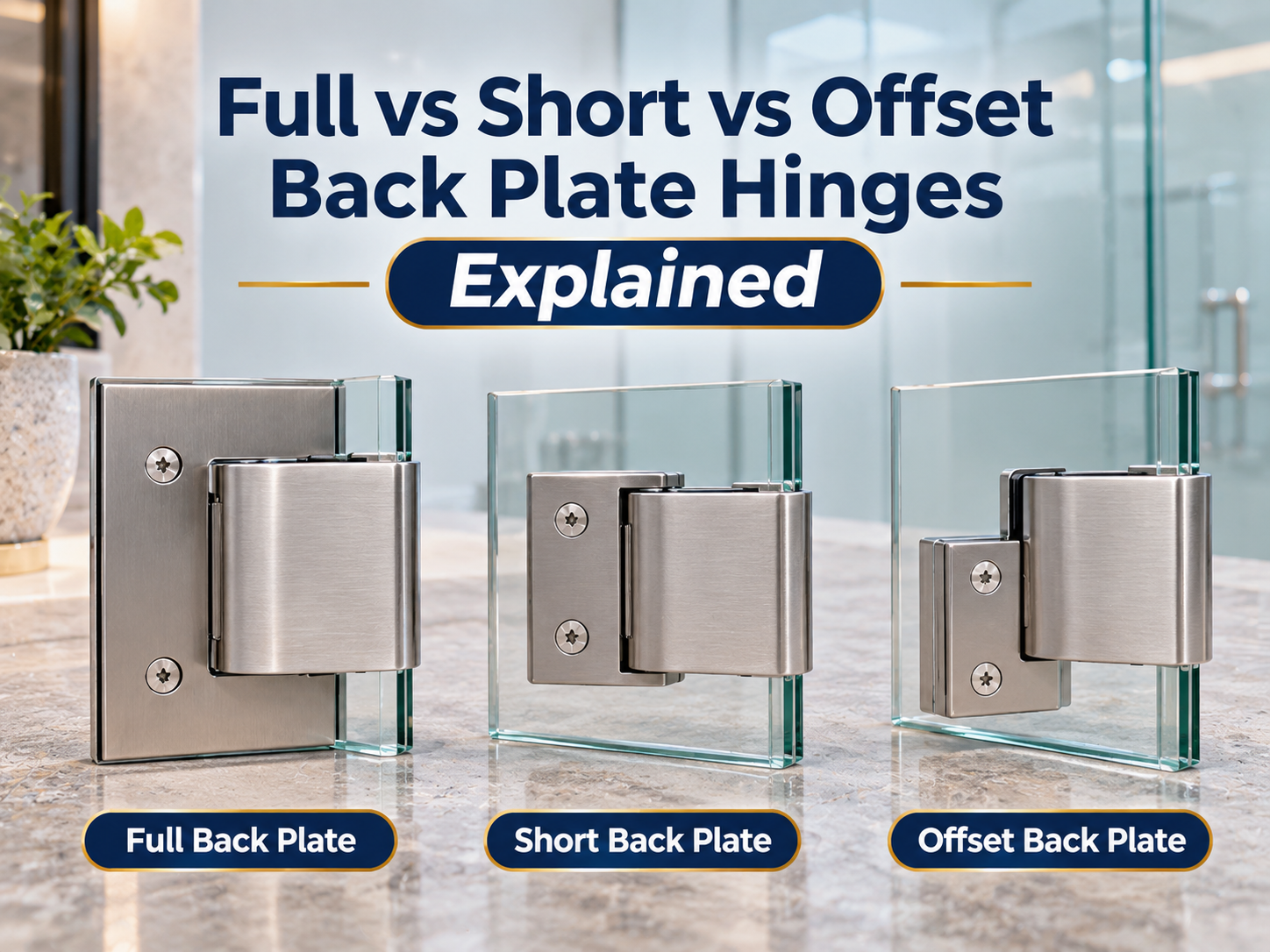


Full, short, and offset back plates can look like minor variations of the same shower hinge, but the plate configuration affects how a wall-mounted hinge fits the enclosure and where the fastening area sits relative to the glass. The choice should therefore be made from the hardware template, wall condition, door position, glass fabrication, and manufacturer specifications rather than from appearance alone. This becomes particularly important on frameless shower doors because the glass is fabricated for a specific hinge before tempering, and changing hinge families after fabrication may require a different cutout or a replacement piece of glass.
A wall-mounted shower hinge transfers the moving door load into the wall or structural jamb. That means the hinge plate is not simply decorative hardware sitting on tile. Suitable structural backing must exist behind the finished wall so the fasteners can support the repeated load created when a heavy tempered-glass door opens and closes. Daltex’s current comparison of wall-mount hinges makes the same distinction between a wall-mounted system, which transfers load into the wall, and a glass-to-glass system, which transfers load through a properly supported stationary panel.
What Does the Back Plate Actually Do?
The back plate is the wall-side portion of a wall-mounted shower hinge. It provides the mounting interface between the hinge assembly and the prepared wall structure while the glass-side portion grips the tempered door through the required cutout and gaskets. Because the back plate is connected to the structure supporting the door, its shape and position must match the hinge design rather than being selected simply because one plate looks cleaner than another.
Full, short, and offset plate descriptions refer primarily to mounting geometry. They do not automatically tell us that one hinge can carry more weight than another. A full plate can provide a broad, conventional wall-side footprint. A short plate changes that footprint by using a shorter wall-side configuration. An offset full plate shifts the mounting plate relative to the hinge body rather than keeping the plate centered in the same relationship as a conventional full back plate. The actual load rating still comes from the exact hinge model, glass thickness, permitted door width, required hinge quantity, fasteners, and supporting structure.
This is why a glazier should always select the exact hardware before ordering the glass. The plate style is part of a complete hinge geometry, not an accessory that should be swapped independently after fabrication.
What Is a Full Back Plate Shower Hinge?
A full back plate hinge uses a broad wall-side plate behind the hinge body and is often the most straightforward configuration when the wall condition, door position, and screw locations suit the standard hinge geometry. It provides a substantial visible mounting surface and can work well when there is adequate structural backing in the required location.
The current Venice Series full back plate model listed by Daltex is designed for 3/8-inch or 1/2-inch tempered glass. Its published capacity is up to 110 pounds and 36 inches of door width when using two hinges, or up to 140 pounds while remaining within a 36-inch maximum width when three hinges are used. Daltex also specifies that neither the maximum weight nor the maximum width should be exceeded.
That specification illustrates an important selection principle. Hinge quantity is not determined by weight alone. A door that is below the maximum weight but exceeds the permitted width is still outside the published capacity. Width creates leverage on the hinge system, so both dimensions need to be checked against the manufacturer’s data.
What Is a Short Back Plate Shower Hinge?
A short back plate hinge reduces the wall-side plate footprint while retaining the basic wall-to-glass hinge function. This configuration can be useful when the project geometry or desired hardware footprint favors a shorter plate, but it still requires proper structural backing where the mounting fasteners land.
The Daltex Venice short back plate hinge provides a useful comparison because its listed glass and door capacities are the same as the full back plate Venice model. It is designed for 3/8-inch to 1/2-inch tempered glass, with a maximum 110-pound, 36-inch door using two hinges and a maximum 140-pound, 36-inch door using three hinges. The product listing identifies the plate type specifically as a short back plate and requires the appropriate glass fabrication template.
That comparison shows why installers should not assume that a shorter-looking plate automatically means lower capacity. In this product family, the published capacities remain the same. Another hinge family may have different ratings, so the correct practice is to verify the individual product rather than generalize from plate length.
What Is an Offset Back Plate Shower Hinge?
An offset back plate hinge changes the relationship between the hinge body and the wall mounting plate. Instead of placing the plate in the same centered position used by a conventional full back plate, the plate is offset to one side. This can help the hardware fit enclosure geometry where the required wall mounting position does not align appropriately with a standard plate configuration.
The critical point is that “offset” describes the plate geometry, not a weaker or smaller version of a full hinge. Daltex lists the Venice offset back plate hinge as an offset full back plate model. It accepts 3/8-inch or 1/2-inch tempered glass and carries the same published Venice door limits of 110 pounds and 36 inches with two hinges or 140 pounds and 36 inches with three hinges. The listing also specifies solid-brass construction and a square profile.
For a fabricator or installer, the practical question is therefore not whether an offset plate is generally stronger or weaker. The question is whether that exact offset configuration positions the wall mounting area correctly for the enclosure while matching the required glass cutout and capacity.
Offset Does Not Mean Short
This distinction is easy to miss because back plate descriptions are sometimes treated as though full, short, and offset represent three sizes on one linear scale. They do not.
A short back plate changes the physical plate footprint. An offset back plate changes where the wall-side plate sits relative to the hinge body. A product can therefore be described as an “offset full back plate,” as Daltex does with the Venice offset model.
Understanding this terminology prevents a common specification error. Someone looking at a narrow wall condition might assume that “offset” means a smaller plate, when the actual reason to use it should come from mounting geometry and the manufacturer’s template. If reduced plate footprint is the requirement, a short back plate model may be the more relevant product to evaluate.
The Backing Location Matters More Than the Tile Surface
No back plate configuration eliminates the need for adequate structural support. Tile, stone, backer board, and drywall form the finished surface but should not be assumed to provide the complete structural anchorage required by a heavy swinging shower door.
The blocking or other approved supporting structure should be planned where the selected hinge requires its fasteners. This is especially important when comparing standard and offset plates because the screw locations can change with the hardware geometry.
Selecting an offset hinge after the wall has been closed without verifying the backing location can create a problem even if the glass fabrication is correct. The hinge may place its fasteners somewhere the installer did not originally prepare to receive the door load.
For new construction or remodeling, hinge selection is therefore best coordinated before wall finishing whenever possible.
Glass Fabrication Must Match the Exact Hinge
Frameless shower hinges require precise cutouts in tempered glass. Daltex’s Venice full, short, and offset models each direct the fabricator to the appropriate template for glass cutouts.
This is not a detail that can safely be corrected after tempering. Tempered safety glass cannot be drilled, notched, or trimmed in the field the way annealed glass can be fabricated before tempering. The hinge model, cutout position, door size, glass thickness, and handing where applicable should therefore be finalized before the fabrication order is released.
This is also why a replacement project needs more than a visual comparison of two hinges. A new hinge may look similar but use a different cutout, screw pattern, gasket arrangement, or plate geometry. Daltex’s guide to replacement hardware recommends identifying the actual component family and matching replacement hardware to the original application rather than substituting unrelated load-bearing parts.
Door Width and Weight Must Both Be Checked
The maximum weight rating is often the first specification people notice, but door width matters just as much. Wider glass creates greater leverage on the hinge even when the total glass weight remains within the nominal limit.
The Venice Series provides a clear example. Daltex lists 110 pounds maximum with two hinges and 140 pounds with three, but the maximum door width remains 36 inches. Adding a third hinge increases the allowed weight without increasing the published maximum width.
An installer should therefore calculate approximate glass weight and verify width against the exact product specification. Selecting three hinges does not automatically make an oversized door acceptable.
Glass Thickness Changes the Weight of the Door
Thicker glass increases the weight carried by the hinges. Daltex’s Venice specification notes approximate glass weights of about five pounds per square foot for 3/8-inch glass and about 6.4 pounds per square foot for 1/2-inch glass.
That means two doors with identical height and width can place different loads on the hinge system when their glass thickness differs. The hardware specification must therefore be checked after the final door dimensions and thickness are known.
Glass thickness also affects gasket selection. The Venice product documentation specifies different gasket arrangements for 3/8-inch and 1/2-inch glass, reinforcing that hinge selection is a complete system involving glass, gaskets, cutout, plate, and door load rather than only a finish and shape.
Back Plate Style Is Different From Hinge Profile
A hinge can also be described as square or beveled, and that characteristic should not be confused with its back plate type. The profile describes the visible edge styling of the hinge body, while full, short, and offset describe the wall-side mounting configuration.
For example, the Venice products discussed here use a square profile, while other Daltex families include beveled hinge designs. Two hinges may therefore share an offset plate concept but have different profiles, dimensions, capacities, and fabrication requirements.
When coordinating an enclosure, the installer should first satisfy the structural and fabrication requirements, then choose a compatible profile and finish that coordinates with handles, clamps, channels, and other shower hardware.
Closing Action Can Also Affect the Final Selection
Back plate geometry is not the only difference that matters between hinge models. Closing behavior should also be checked.
Daltex states that the Venice Series hinge uses a dual-degree pivot pin and is factory set at 90 degrees for normal closing. A secondary field-adjustable setting can provide an additional five degrees of closing when the project requires firmer positioning against an appropriate jamb or seal.
That adjustment should not be used as a substitute for accurate glass sizing or proper enclosure alignment. A closing adjustment can help the door engage the intended seal position, but it cannot correct a door that is fabricated too wide, a wall that was not accounted for properly, or a hinge installed outside its required geometry.
Daltex’s guide to positive-close hinges provides additional context on how closing position, enclosure angle, seals, and structural configuration work together.
When a Full Back Plate Makes Sense
A full back plate is a logical option when the enclosure uses a conventional wall-mounted hinge position, sufficient backing exists across the required mounting area, and the standard plate geometry aligns cleanly with the door and wall.
It can also provide a balanced, substantial appearance where visible hardware is intentionally part of the enclosure design. However, appearance should remain secondary to structural requirements, cutout compatibility, and manufacturer limits.
If a standard full plate fits correctly, choosing an offset or short plate simply because it looks different may introduce unnecessary fabrication or mounting changes.
When a Short Back Plate Makes Sense
A short back plate can be appropriate when the project calls for the reduced plate configuration offered by the selected hinge family and the structural backing supports its exact fastener positions.
The smaller visual footprint can also appeal in minimalist frameless installations, but the product’s technical requirements still govern the installation.
Because the Venice short plate carries the same published door capacity as the full and offset variants, the choice within this series is primarily about configuration and mounting suitability rather than obtaining a different capacity.
When an Offset Back Plate Makes Sense
An offset plate becomes useful when the plate needs to sit in a different relationship to the hinge body and glass. That can help accommodate specific wall-edge conditions or mounting geometry that would not suit the centered relationship of another plate configuration.
The exact reason should always be verified against the installation drawing and hinge template rather than assumed from the product name alone.
For projects considering the Venice Series, the offset model is particularly relevant because it retains the family specifications while changing the wall-side plate configuration. Daltex lists it for 3/8-inch and 1/2-inch tempered glass, up to 36-inch doors, with the published 110-pound two-hinge and 140-pound three-hinge limits.
How We Would Compare the Three Before Ordering
The most reliable sequence is to start with the enclosure geometry and structure, then choose the hardware that fits it. We verify where the door will pivot, where structural backing exists, which glass thickness and dimensions are being used, whether the selected hinge can carry that door, and which plate configuration places the fasteners correctly.
After that, we compare the glass fabrication template, closing behavior, visible profile, finish, seals, and surrounding hardware.
This order prevents cosmetic preferences from forcing a technically awkward installation. It also reduces the risk of ordering tempered glass before the correct hinge cutout has been confirmed.
Final Thoughts
Full, short, and offset back plate shower hinges are different mounting configurations rather than simple quality levels. A full back plate provides a conventional broad wall-side configuration, a short back plate reduces the plate footprint, and an offset back plate shifts the wall mounting relationship relative to the hinge body.
Within the Venice Series, Daltex currently lists full, short, and offset versions for 3/8-inch to 1/2-inch tempered glass with the same published door limits: up to 110 pounds and 36 inches with two hinges, or up to 140 pounds while remaining within 36 inches with three hinges. That makes an important point clear: plate style alone should not be used to predict capacity.
The correct hinge is the one whose mounting geometry, structural requirements, glass template, closing action, width limit, weight limit, and appearance all match the actual enclosure. Selecting that hardware before glass fabrication is one of the simplest ways to avoid expensive changes later in the project.
FAQs
Is an offset back plate shower hinge stronger than a full back plate hinge?
Not automatically. Capacity depends on the exact product. Daltex lists the Venice full and offset back plate models with the same maximum door capacities, so the offset configuration should be selected for mounting geometry rather than assumed additional strength.
What is the difference between a short back plate and an offset back plate?
A short back plate reduces the wall-side plate configuration, while an offset back plate shifts the plate position relative to the hinge body. Daltex identifies the Venice offset model specifically as an “Offset Full Back Plate,” demonstrating that offset does not simply mean short.
Can I change from a full back plate hinge to an offset hinge after the glass is tempered?
Only if the replacement hardware is verified to match the existing fabrication and installation requirements. Shower hinge cutouts are hardware-specific, and tempered glass should not be field drilled or notched to accommodate a different hinge.
Does adding a third hinge allow a wider shower door?
Not necessarily. For the Venice Series models discussed here, Daltex increases the published weight capacity from 110 pounds with two hinges to 140 pounds with three, but the maximum door width remains 36 inches.
Should hinge finish determine which back plate I use?
Finish should generally be selected after the structural, dimensional, and fabrication requirements have been satisfied. Plate geometry, glass compatibility, door capacity, backing, and cutout requirements are more important than the decorative finish.


One thought on “Full vs Short vs Offset Back Plate Hinges Explained”