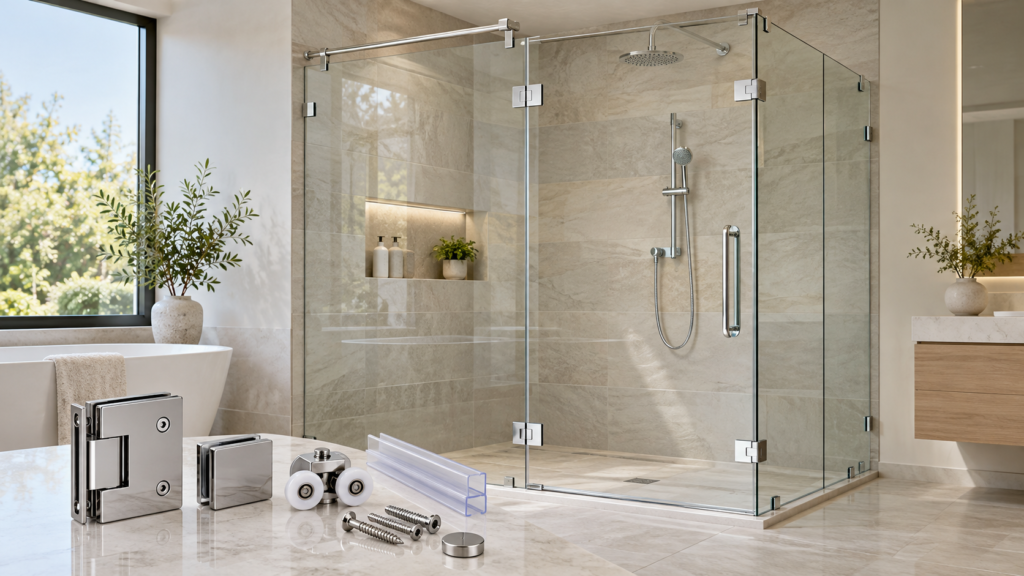
How to Identify the Shower Door Replacement Parts You Need
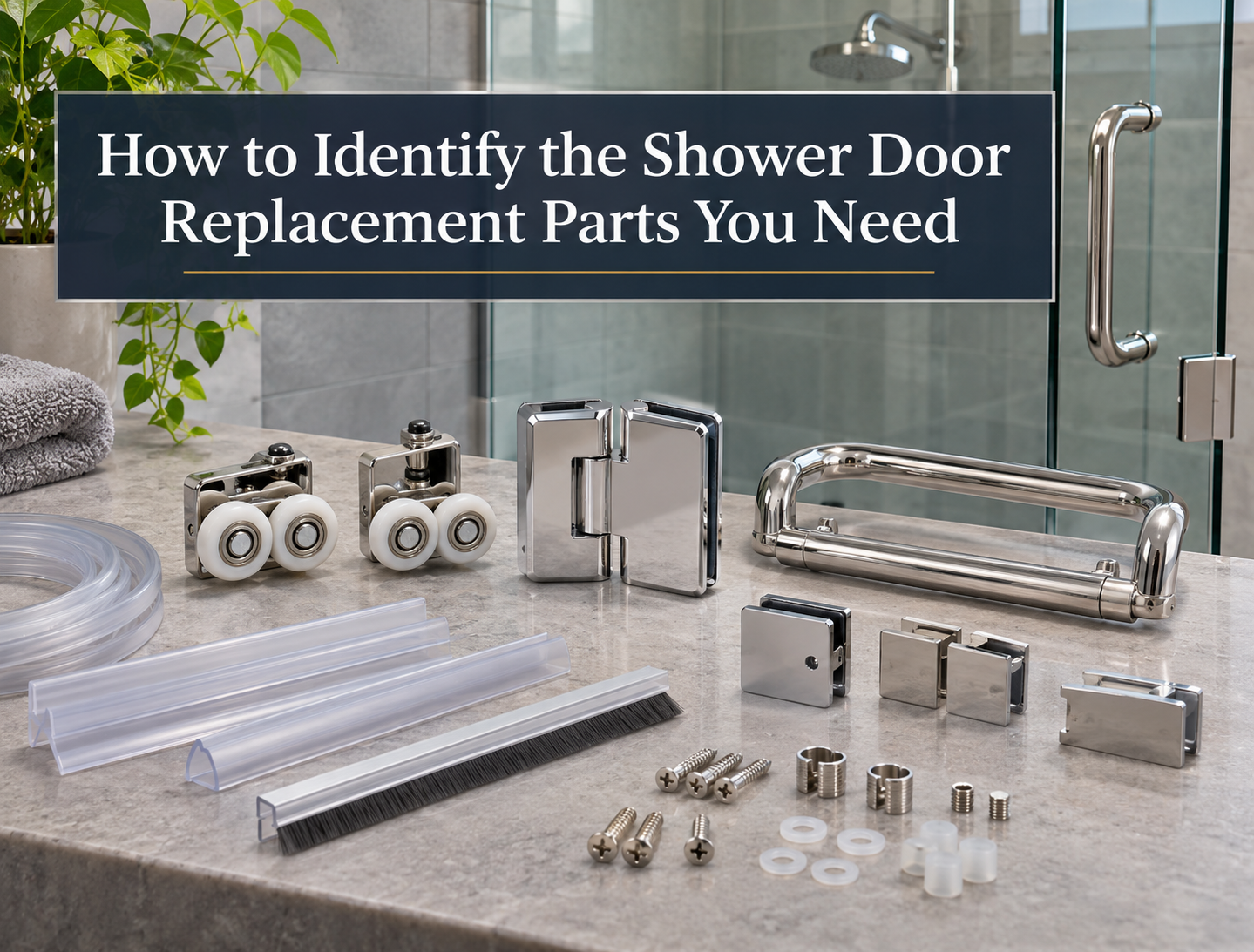


Identifying the correct shower door replacement parts requires more than comparing a damaged component with a product photograph. Hinges, rollers, seals, handles, guides, clamps, and gaskets may look nearly identical while using different dimensions, hole patterns, load ratings, or glass-thickness ranges. A reliable identification process begins with the complete enclosure and then narrows the search using measurements, markings, mounting details, and the symptoms of the problem.
Avoid removing or discarding the original component until the replacement has been confirmed. The old part may contain a model number, manufacturer mark, profile shape, or dimension that cannot be recovered after disposal. Photographs of the assembled enclosure are equally important because they show how the component interacts with the door, fixed panels, track, wall, curb, and surrounding seals.
Start With the Problem You Are Trying to Fix
The behavior of the enclosure can help identify which component needs attention, although the visible symptom does not always reveal the complete cause. A leaking door may have a worn seal, but it may also have dropped because of loose hinges or rollers. A door that will not remain closed could have a damaged magnetic strike, incorrect hinge centering, or a panel that has moved out of alignment.
| Symptom | Parts to Inspect | Additional Condition to Check |
|---|---|---|
| Swinging door sags | Hinges, gaskets, fasteners | Wall backing and glass cutouts |
| Sliding door drags | Rollers, track, bottom guide | Debris and panel alignment |
| Water escapes below door | Bottom sweep, drip rail, threshold | Curb slope and door clearance |
| Door will not stay closed | Hinges, strike, magnetic seal | Door alignment |
| Fixed panel moves | Clamps, U-channel, support bar | Structural attachment |
| Handle is loose | Handle fasteners and gaskets | Hole spacing and glass condition |
| Metal touches glass | Gaskets, sleeves, spacers | Hardware alignment |
| Door jumps or swings sideways | Anti-jump device or guide | Roller and track compatibility |
Inspect the complete enclosure before ordering a single part because several components may contribute to the same problem. Daltex’s overview of common glass shower parts can help you understand the function of each component before beginning the identification process.
Look for Manufacturer and Product Markings
Check hinges, roller covers, tracks, handles, clamps, guides, and decorative plates for engraved names, logos, stamped numbers, or removable labels. Original invoices, installation documents, product templates, and warranty records may also identify the manufacturer or series. A confirmed product number is generally more reliable than selecting a replacement from appearance alone.
When no markings are visible, photograph the component from the front, back, side, and mounting surface. Include a ruler or tape measure in close-up images to establish scale, but also take wide photographs showing the complete enclosure. A supplier may need to determine whether the part belongs to a hinged, bypass, barn-style, framed, semi-frameless, or fully frameless system.
Measure the Glass Before Measuring the Part
Glass thickness is one of the most important identification details because seals, hinges, clamps, rollers, and channels are manufactured for defined thickness ranges. Common shower-glass thicknesses include 1/4 inch, 3/8 inch, and 1/2 inch, but the actual panel should be measured instead of assumed. A seal made for 1/2-inch glass may fit loosely on 3/8-inch glass, while forcing a narrow component onto thicker glass can damage the part or create excessive edge pressure.
Record the door width, door height, and approximate panel weight when identifying load-bearing hardware. Hinges and rollers are rated for specific glass thicknesses, dimensions, and weight limits, so matching the holes alone is not sufficient. If accurate measurement is difficult because the panel is installed inside a frame or channel, a glass professional can confirm the thickness using an appropriate gauge.
Measure the Replacement Part Accurately
Measure the complete length, width, height, projection, hole spacing, fastener diameter, and any offset between mounting surfaces. For sweeps and seals, record the rigid channel width, fin length, profile shape, orientation, and total required length. For rollers, record the wheel diameter, wheel thickness, axle position, mounting-hole size, and distance between the wheel and glass.
Hinge identification may require the body dimensions, back-plate style, opening angle, closing position, mounting configuration, and glass cutout. Handles require center-to-center hole spacing rather than only overall length, while clamps require information about their glass-to-wall or glass-to-glass relationship. A complete measurement record reduces the risk of ordering a part that appears correct but cannot be installed.
Match the Existing Glass Holes and Cutouts
Tempered shower glass is fabricated with all necessary holes and notches before the tempering process. It cannot be safely drilled or trimmed afterward, so replacement hardware must match the existing glass preparation. Differences of only a small amount may prevent a hinge, handle, clamp, or roller assembly from sitting correctly.
Do not enlarge holes or force mismatched metal components into position. Improvised alterations may create concentrated pressure around the glass opening and prevent protective gaskets from sitting evenly. Daltex’s complete hardware component guide explains how hardware, glass preparation, and structural support work together.
Identify the Part by Component Family
Swinging doors typically use wall-to-glass hinges, glass-to-glass hinges, pivots, handles, sweeps, and jamb seals. Sliding doors use tracks, rollers, bottom guides, stops, anti-jump devices, overlap seals, and coordinated mounting brackets. Stationary panels commonly use clamps, U-channels, setting blocks, support bars, and clear seals at adjoining glass edges.
Once the component family has been identified, compare the original part with products designed for the same application. Do not substitute a general bracket for a load-bearing shower component or mix proprietary sliding-system parts without manufacturer approval. Tracks, rollers, guides, and stops are frequently engineered to operate as one system.
Determine Whether You Need a Part or a Complete Kit
A single-part replacement may be appropriate when the original product is identifiable and the remaining hardware is in good condition. Complete kits can be more practical when several coordinated parts are worn, when proprietary components are unavailable, or when the enclosure is being extensively rebuilt. However, changing the complete system may also require different glass holes, clearances, or structural supports.
Before selecting a kit, confirm which parts are included and whether seals, fasteners, handles, guides, and installation templates must be purchased separately. A kit described as complete may still exclude glass and certain installation-specific components. System compatibility should always take priority over the number of parts included in the package.
Check Seals by Profile and Position
Bottom sweeps, drip rails, H-jambs, bulb seals, magnetic strikes, and overlap seals perform different functions. Begin by identifying where the seal is installed, what gap it must close, and how the adjacent door or panel moves. Then measure the glass thickness, channel opening, flexible-fin length, closing angle, and required seal length.
An oversized fin can drag heavily and place unnecessary resistance on the hardware, while an undersized fin may leave a continuous path for water. Daltex’s guide to choosing a replacement seal provides a detailed process for matching profiles and glass thicknesses.
Prepare a Replacement-Part Identification Record
Before contacting a supplier, collect the enclosure type, glass thickness, panel dimensions, hardware finish, part measurements, model markings, and clear photographs. Describe the exact problem and note whether the door swings inward, outward, both ways, or slides along a track. Keeping these details together allows potential replacements to be compared efficiently and reduces unnecessary trial-and-error purchases.
If the glass is chipped, cracked, or damaged around a hole or notch, stop using the enclosure and arrange an inspection. The issue may require panel replacement rather than another hardware component. Daltex provides professional glass repair for shower glass, hardware, and other residential or commercial glass systems.
Frequently Asked Questions
How do I find the manufacturer of my shower door?
Inspect hinges, tracks, roller covers, handles, frames, and decorative plates for logos or stamped numbers. Original receipts, installation documents, and product templates may contain additional identification information. When no marking is available, photographs and detailed measurements can help narrow the possibilities.
Are shower door replacement parts universal?
Most replacement parts are not universal because dimensions, glass-thickness ranges, load capacities, and hole patterns vary between products. Similar appearance does not establish mechanical compatibility. Always compare specifications with the existing enclosure before ordering.
How do I measure a replacement shower door hinge?
Record the hinge-body dimensions, back-plate style, mounting configuration, fastener spacing, and existing glass cutout. You should also document the glass thickness, door width, door height, and expected door weight. The replacement must satisfy the hinge manufacturer’s complete capacity requirements.
Can I use a different brand of shower door roller?
A different brand may work only when its dimensions, load rating, track profile, mounting system, and safety features are fully compatible. Wheel diameter alone is not enough to confirm a match. Proprietary sliding systems should generally use approved coordinated components.
Can I replace shower door parts without removing the glass?
Handles, seals, and some decorative components can often be replaced while the glass remains installed. Structural hinges, rollers, clamps, and support components may require the panel to be safely supported or removed. Heavy-glass work should be handled by trained installers with suitable lifting equipment.
When does damaged hardware require replacement glass?
Replacement glass may be required when the panel is cracked, chipped near a mounting point, or fabricated with holes that do not match the new hardware. It may also be necessary when the enclosure configuration is being changed. Tempered glass cannot be drilled or recut after manufacturing.