

Bypass vs Single Sliding Shower Doors: Pros, Cons & Costs
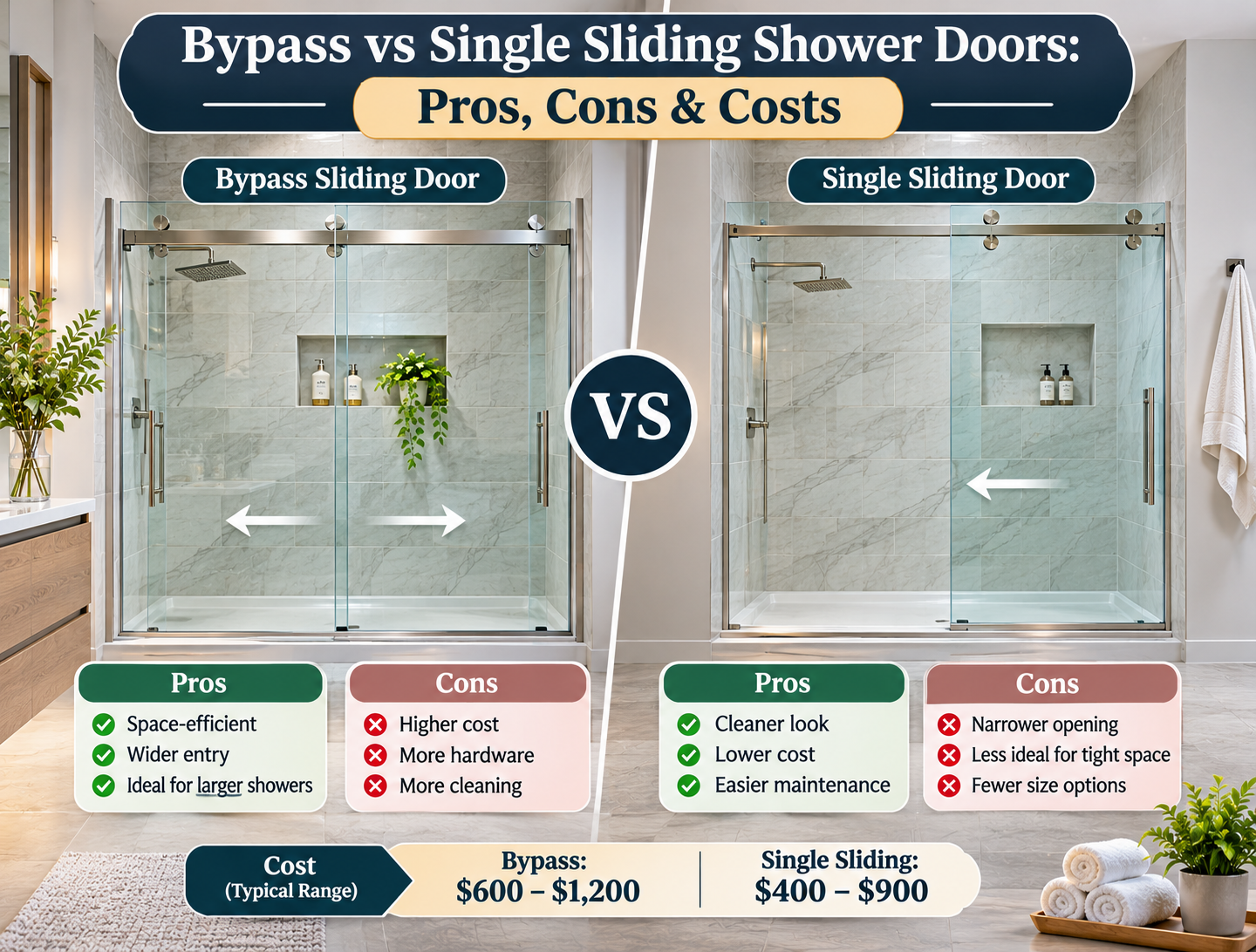


Choosing between a bypass sliding shower door and a single sliding shower door can significantly affect how your bathroom looks, functions, and feels during everyday use. Both configurations offer space-saving advantages over traditional swinging shower doors, but their panel movement, hardware requirements, maintenance needs, and installation costs are different.
A bypass shower door uses two movable glass panels that slide past each other, while a single sliding shower door generally consists of one moving panel and one stationary panel. Understanding this distinction is especially important when planning a bathroom renovation, replacing an existing enclosure, or selecting hardware for a custom glass installation.
This guide compares the advantages, disadvantages, installation considerations, and costs of both systems so you can determine which option is best suited to your bathroom.
What Is a Bypass Sliding Shower Door?
A bypass sliding shower door consists of two glass panels mounted on separate sliding paths. Both panels move horizontally, allowing users to enter the shower from either side of the enclosure. Because the doors slide past each other rather than swinging outward, the system does not require additional floor space in front of the shower.
Bypass configurations are commonly used for shower and bathtub combinations, particularly in bathrooms where toilets, vanities, or other fixtures limit the available space. They are also useful for larger shower openings where access from either end offers greater flexibility.
Modern bypass systems are available with framed, semi-frameless, and frameless-inspired designs. Higher-end models may incorporate precision rollers, concealed tracks, and soft-stop mechanisms to improve daily operation.
For example, the Tidewater Bypass Soft-Stop Sliding Shower Door Kit from Daltex Glass is designed for 3/8-inch glass and features a soft-stop mechanism that cushions movement as the doors approach the ends of their travel. This type of hardware can provide a more controlled sliding experience than conventional systems without a soft-stop feature.
What Is a Single Sliding Shower Door?
A single sliding shower door uses one movable glass panel that slides horizontally alongside a stationary glass panel. The fixed panel remains in place, while the sliding panel provides access through one designated side of the shower enclosure.
This configuration is particularly popular in contemporary bathrooms because it can create a streamlined appearance with fewer moving components. The stationary panel can also provide a stable surface for supporting the enclosure when installed with compatible clamps, channels, or brackets.
Single sliding systems are suitable for shower alcoves, custom frameless enclosures, and bathrooms where the entry location is clearly defined. Depending on the hardware, the opening arrangement may be reversible, allowing the installer to position the moving panel according to the bathroom layout.
However, unlike a bypass system, a conventional single slider does not allow both panels to move. The fixed panel determines which portion of the enclosure remains covered during normal operation.
Bypass vs Single Sliding Shower Doors: Key Differences
The most important difference between these two systems is how the glass panels move. A bypass arrangement has two movable panels, while a single sliding system has one. This affects access, hardware complexity, cleaning, and installation planning.
Bypass doors offer flexibility because either panel can be moved to create an entrance. This can be useful for bathtub enclosures where users may want to reach plumbing fixtures or enter from different sides. However, the overlapping glass panels and dual sliding paths introduce additional surfaces and components that require regular cleaning.
Single sliding doors typically have a simpler operating arrangement. With only one moving panel, there are fewer moving roller assemblies to inspect and maintain. The stationary glass also contributes to the modern appearance of many frameless shower designs.
Neither configuration is automatically more durable or more expensive. Actual performance depends on the glass thickness, material quality, roller design, mounting conditions, and installation accuracy.
Advantages of Bypass Sliding Shower Doors
Flexible Access From Either Side
One of the biggest advantages of a bypass sliding shower door is the ability to enter the shower from either end. This flexibility can improve usability in shared bathrooms and bathtub-shower combinations where the most convenient entrance may vary.
Having two movable panels can also make it easier to reach certain areas of the tub or enclosure during cleaning. The actual accessible opening depends on the panel dimensions, overlap, and handle placement.
Space-Saving Operation
Bypass shower doors slide horizontally without swinging into the bathroom. This makes them particularly effective in compact layouts where a hinged glass door might interfere with a vanity, toilet, cabinet, or nearby wall.
A properly selected bypass system provides enclosed shower access without requiring additional outward door clearance.
Suitable for Different Bathroom Styles
Modern bypass sliding systems can complement traditional and contemporary bathrooms. Glass thickness, hardware finishes, track profiles, and handle designs all influence the final appearance.
Features such as soft-stop hardware can also make premium bypass enclosures feel smoother and more refined during everyday use.
Disadvantages of Bypass Sliding Shower Doors
Additional Cleaning Requirements
Because bypass doors have two sliding panels, the overlapping glass surfaces and parallel track areas can require more attention during cleaning. Soap residue, mineral deposits, and moisture can accumulate around guides and other hardware if they are not maintained regularly.
Cleaning requirements vary by system, particularly between traditional framed designs and modern configurations with reduced visible framing.
More Moving Components
A bypass system generally requires roller assemblies and related operating hardware for both glass panels. These parts must remain properly aligned to support smooth movement and prevent the glass from rubbing against adjacent components.
Although high-quality systems can provide years of reliable performance, their moving components should be inspected periodically.
Panel Overlap Limits the Entrance
The two glass panels must overlap to maintain the enclosure’s intended coverage and help control water. Therefore, the usable entrance will be smaller than the full width of the shower opening.
This limitation should be considered when selecting a system for a narrow enclosure.
Advantages of Single Sliding Shower Doors
Clean, Contemporary Appearance
Single sliding shower doors are often selected for modern bathrooms because their fixed-and-moving-panel arrangement creates a simple visual design. Many frameless systems use exposed precision rollers or compact headers that complement clear tempered glass.
When combined with coordinated hardware, the design can make a smaller bathroom feel more open and less visually crowded.
Fewer Moving Parts
A single slider has one moving panel rather than two. This can simplify roller inspection, adjustment, and ongoing maintenance, although the actual maintenance requirements still depend on the hardware design.
The fixed panel also remains stationary during everyday operation, reducing the number of components subjected to repeated movement.
Defined Entrance Layout
A single sliding system works particularly well when the shower entrance is best positioned on one side. This allows the enclosure to be designed around the showerhead, nearby fixtures, and preferred access route.
The hardware and glass dimensions must still be coordinated to ensure sufficient entrance clearance and proper water containment.
Disadvantages of Single Sliding Shower Doors
The primary limitation of a single sliding shower door is its fixed entrance arrangement. Because one glass panel remains stationary, access is generally limited to the side served by the sliding panel.
This can be inconvenient in some bathtub-shower combinations, particularly when users need to reach plumbing fixtures or clean areas behind the fixed panel.
Single sliding systems may also require precise structural attachment for the fixed glass and header. If the walls, curb, or support points are unsuitable, additional installation preparation may be necessary.
How Much Do Bypass and Single Sliding Shower Doors Cost?
The total cost of a sliding shower door depends on the glass configuration, enclosure dimensions, hardware quality, glass thickness, finish, and installation requirements.
As a broad U.S. market reference, professionally installed sliding or bypass shower doors can cost approximately $700 to $2,000, with custom frameless installations potentially exceeding that range. This estimate is not a Daltex Glass product quote and should not be treated as a fixed price for either configuration.
Framed products commonly cost less than premium frameless systems because the glass and supporting hardware requirements differ. Custom tempered glass, specialized finishes, structural preparation, and additional installation labor can increase the final cost.
A bypass system is not necessarily more expensive than a single slider. A standard framed bypass enclosure may cost less than a custom frameless single sliding door with thicker glass and premium hardware.
When comparing estimates, confirm whether the price includes glass fabrication, hardware, professional measurement, installation, sealing, and removal of the existing enclosure.
Which Sliding Shower Door Is Easier to Maintain?
Maintenance depends more on the hardware design and installation quality than on whether the system is bypass or single sliding.
Bypass doors typically have more moving components and overlapping areas to clean. Regular attention to both sliding paths helps prevent residue from affecting the door movement.
Single sliding systems may have fewer moving components, but the fixed panel, bottom guide, seals, and header still require cleaning and inspection.
For either configuration, use nonabrasive cleaning products approved for the glass and hardware finish. Keep the sliding path free from debris, inspect seals for wear, and address unusual roller noise or resistance before continuing regular operation.
How to Choose the Right Sliding Shower Door
The best configuration depends on how the bathroom is used and the available installation space. For a bathtub-shower combination where access from either end is beneficial, a bypass sliding shower door may provide greater convenience.
For a modern walk-in shower with a clearly defined entrance, a single sliding system may offer a more streamlined appearance and simpler operation.
Before selecting either option, measure the finished opening, assess wall alignment, verify the curb condition, and confirm the glass thickness supported by the hardware. You should also consider handle clearance, water direction, entrance width, and the structural support required for safe installation.
Daltex Glass offers a variety of sliding shower door systems for different enclosure layouts and design preferences. Comparing the exact system specifications before ordering helps avoid compatibility problems during glass fabrication.
Final Thoughts
Both bypass and single sliding shower doors provide practical solutions for bathrooms where outward door clearance is limited. Bypass doors are particularly useful when flexible entry is important, while single sliding doors are well suited to modern enclosures with a designated entrance.
The best long-term choice is not determined by the number of moving panels alone. Accurate measurement, compatible tempered glass, properly engineered hardware, and professional installation are essential for reliable operation.
Choosing the appropriate system for your bathroom layout can improve daily convenience, reduce maintenance problems, and create an enclosure that remains functional and attractive for years.
Frequently Asked Questions
Is a bypass sliding shower door better than a single sliding door?
A bypass sliding shower door is better when access from either side is important, particularly in bathtub-shower combinations. A single slider may be preferable when the bathroom has a designated entrance and a cleaner, fixed-panel appearance is desired.
Are bypass shower doors more expensive?
Not necessarily. The total cost depends on glass thickness, framing, hardware quality, enclosure size, and labor. A standard framed bypass door may cost less than a custom frameless single sliding system.
Do bypass shower doors leak more?
Not inherently. Leakage depends on panel overlap, seals, track drainage, showerhead placement, and installation accuracy. A properly installed bypass system should direct normal shower spray back into the enclosure.
Can both panels move on a bypass shower door?
Yes. A conventional bypass shower door uses two movable panels that slide past one another on separate paths. This allows access from either side, subject to the system’s opening and handle limitations.
How long do sliding shower doors last?
A well-installed sliding shower door can provide many years of service. Its lifespan depends on glass and hardware quality, usage, cleaning practices, water conditions, and periodic maintenance of rollers, guides, and seals.


