

Sliding Shower Door Bottom Guides: Types and How to Choose
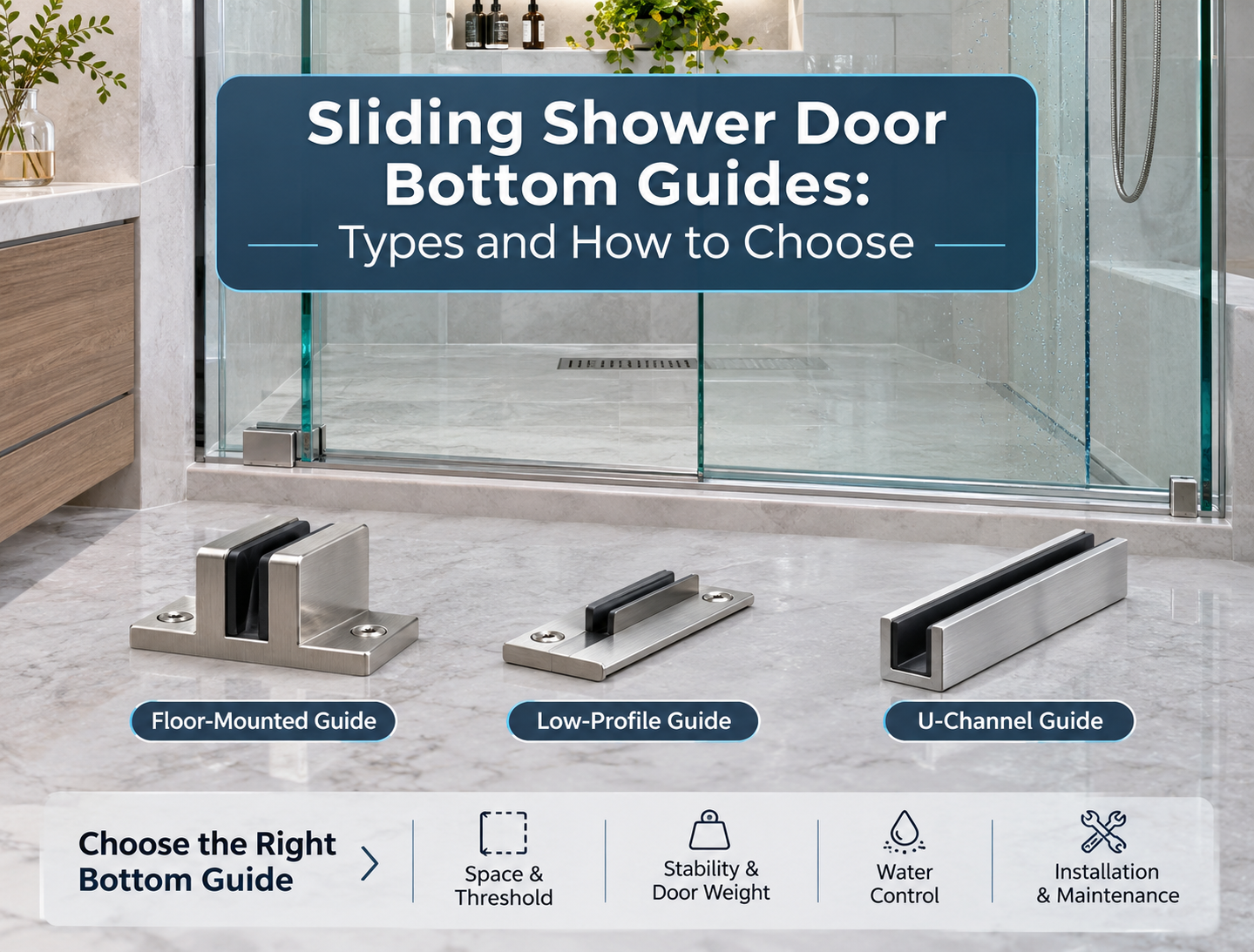


A sliding shower door bottom guide is a small component with an important job. It keeps the lower edge of the moving glass panel aligned while the rollers and upper track control horizontal movement. Without the correct guide, a sliding door can wobble, swing sideways, rub against another panel or move outside its intended travel path.
Bottom guides are not universal, even when two products appear to have a similar shape. The guide must correspond with the door configuration, glass thickness, panel overlap, track position and clearances established by the original shower system. Choosing a replacement by appearance alone can create excessive movement or place the glass too close to tile, metal and adjacent panels.
What Does a Sliding Shower Door Bottom Guide Do?
In most top-hung sliding systems, the upper rollers carry the weight of the moving door while the bottom guide controls lateral movement. The guide does not normally support the entire weight of the glass. Instead, it creates a controlled path that prevents the bottom of the panel from swinging inward or outward during normal use.
A correctly installed guide should allow the glass to move freely without producing excessive friction. It should also maintain enough clearance to prevent direct glass-to-metal contact. Daltex’s hardware guide explains how guides, rollers, tracks, stops and anti-jump components work together as a coordinated sliding system.
Common Types of Sliding Shower Door Bottom Guides
The correct bottom guide depends primarily on how the glass panels are arranged. A single-slider enclosure, bypass door and bottom-rolling system may all use different components. The following comparison explains the guide styles commonly found in residential shower enclosures.
| Bottom guide type | How it works | Common application |
|---|---|---|
| Single-panel floor guide | Controls one moving panel from the curb or floor | Frameless door with one sliding and one fixed panel |
| Bypass center guide | Separates and aligns two overlapping moving panels | Two-panel bypass shower doors |
| Glass-mounted guide | Attaches to a stationary panel rather than the curb | Selected frameless sliding systems |
| Multiway guide | Provides more than one approved panel path or mounting configuration | Reversible or adaptable shower layouts |
| Full lower channel | Guides the panel through a continuous bottom track | Framed and semi-frameless sliding doors |
| Bottom-rolling track | Carries rollers and door weight at the lower edge | Heavy-glass bottom-rolling systems |
These guide types are not automatically interchangeable. A full lower channel may carry out a different function from a small center guide, while a bottom-rolling track can be part of the door’s load-bearing structure. The original system specifications should determine which component is used.
Single-Slider Bottom Guides
A single-slider enclosure normally has one moving panel and one stationary panel. The bottom guide keeps the moving door aligned with the fixed glass and maintains the specified overlap between the panels. Depending on the system, the guide may attach to the curb, floor or fixed panel.
The guide opening must match the approved glass thickness and operating clearance. A channel that is too wide can allow the door to swing, while a narrow channel may cause the glass to drag. Protective inserts or gaskets must also remain in place when they are included in the original design.
Bypass Shower Door Guides
A bypass shower enclosure uses two panels that move past one another. Its center guide generally separates the panels and keeps them in their parallel travel paths. Because either panel may move, the guide must control both pieces of glass without interfering with the overlap or attached seals.
The Napa bottom guide is designed specifically for the Napa Series sliding shower door system. The Napa system uses two bypass panels made from 3/8-inch tempered glass, so this guide should be considered when replacing an original Napa component rather than as a universal guide for unrelated doors. Confirm the system model and finish before ordering.
Multiway and Reversible Guides
Some shower systems use a multiway guide that accommodates approved variations in panel orientation. This can be useful when a system allows the entrance to be positioned on either side or when the guide must coordinate a moving panel with a fixed panel. The installer must still follow the layout specified for that particular kit.
A multiway design does not mean the component will fit every sliding enclosure. Glass thickness, guide spacing, panel overlap and mounting location remain product-specific. When the original guide is unavailable, record the manufacturer, product number and complete dimensions before evaluating a replacement.
Bottom Guides for Framed Sliding Doors
Framed and semi-frameless doors frequently use a continuous lower track rather than a small isolated guide. The panel wheels or edges may travel inside this track, and the surrounding frame helps control movement. These systems can use thinner glass because the frame provides support and alignment that a fully frameless enclosure does not provide.
Replacing a continuous track may require more than matching its length. The track profile, drainage path, roller shape and connection to the side jambs must remain compatible. A replacement that traps water or changes the door position can create new operating and maintenance problems.
How to Choose the Correct Bottom Guide
Begin by identifying the shower manufacturer and system before taking measurements. Check the upper track, roller covers, handles, original invoice and installation documents for a name or item number. Daltex’s guide to replacement parts provides a practical identification process for unfamiliar shower hardware.
Next, measure the glass thickness and record the number and arrangement of moving panels. Determine whether the guide attaches to the curb, floor, track or fixed glass. The panel overlap, distance between panels and available mounting space should also be compared with the original installation instructions.
| Selection factor | Why it matters |
|---|---|
| Shower system | Proprietary components are normally designed to work together |
| Glass thickness | Determines the required guide opening and clearance |
| Panel configuration | Single-slider and bypass systems need different control paths |
| Mounting location | Guides may attach to the curb, floor or stationary glass |
| Panel overlap | Incorrect spacing can affect sealing and door travel |
| Hardware finish | Helps the guide coordinate with the remaining shower hardware |
| Existing condition | Damaged glass, track or rollers may require more than a new guide |
Signs a Bottom Guide Needs Replacement
A worn or damaged guide may allow the bottom of the glass to move sideways during operation. Other warning signs include cracking, loose mounting hardware, missing inserts, visible rubbing marks and repeated contact between the panels. A door that repeatedly leaves its guide should not continue to be used until the rollers, track and stops have also been inspected.
Do not assume that every alignment problem begins at the bottom of the door. Worn rollers or an uneven upper track can cause the glass to enter the guide at the wrong angle. The guide should be replaced only after the complete movement system has been evaluated.
Installation and Glass Safety
A bottom guide must be positioned according to the manufacturer’s approved dimensions. Mounting it too close to the glass can cause binding, while excessive clearance can allow the door to swing. When drilling into a curb or mounting surface, the installer must also consider waterproofing and any concealed materials beneath the finished surface.
Tempered shower glass should never be drilled, cut or notched after manufacturing. If a glass-mounted guide requires preparation that is not already present, correctly fabricated replacement glass may be necessary. Daltex’s guide to choosing a sliding hardware kit explains why the glass, guide, rollers and track should be selected as a coordinated system.
Choosing a Bottom Guide for a Dallas-Fort Worth Project
For a replacement project in Dallas-Fort Worth, begin with the existing hardware system rather than selecting a guide based on finish. Clear photographs, glass-thickness measurements and the original product number can make identification more reliable. If the door is unstable or the glass must be removed, an experienced installer should handle the inspection and replacement.
Daltex provides custom shower enclosures and compatible shower hardware for residential and contractor projects. Coordinating the glass and hardware before fabrication helps prevent clearance, mounting and alignment problems during installation.
Final Takeaway
The best sliding shower door bottom guide is the component approved for the door’s glass thickness, panel arrangement, mounting location and track system. Single-slider, bypass, multiway and framed guides perform different functions, so similar appearance does not confirm compatibility. For a Napa Series bypass enclosure, the system-specific Napa guide provides a more reliable solution than an unverified universal component.
Frequently Asked Questions
1. Are sliding shower door bottom guides universal?
Sliding shower door bottom guides are not universal because panel spacing, glass thickness, mounting method and track position vary between systems. The replacement should match the original manufacturer or meet every published compatibility requirement.
2. How do I measure for a replacement shower door guide?
Measure the glass thickness, channel width, panel spacing, guide dimensions and mounting-hole locations. You should also identify whether the enclosure has one sliding panel, two bypass panels or a bottom-rolling configuration.
3. Can a loose bottom guide make the shower door wobble?
A loose or worn guide can allow the bottom of the panel to swing sideways. Worn rollers, track misalignment and incorrect panel overlap can cause similar movement, so the complete system should be inspected.
4. Does a bottom guide carry the weight of the shower door?
A small guide in a top-hung system generally controls alignment rather than carrying the door’s weight. A bottom-rolling system is different because its lower track and rollers may support most of the moving load.
5. Can I replace a Napa guide with a universal guide?
A universal guide should not be used unless its manufacturer confirms compatibility with the Napa system, glass and panel spacing. The Napa bottom guide is designed specifically for the coordinated Napa Series enclosure.
6. When should a professional replace the bottom guide?
Professional service is recommended when the glass is unstable, the panel must be removed, mounting requires drilling near waterproofed surfaces or the original system cannot be identified. Heavy frameless glass should not be handled without suitable training and equipment.


