

Blog
What Are Positive-Close Shower Door Hinges?

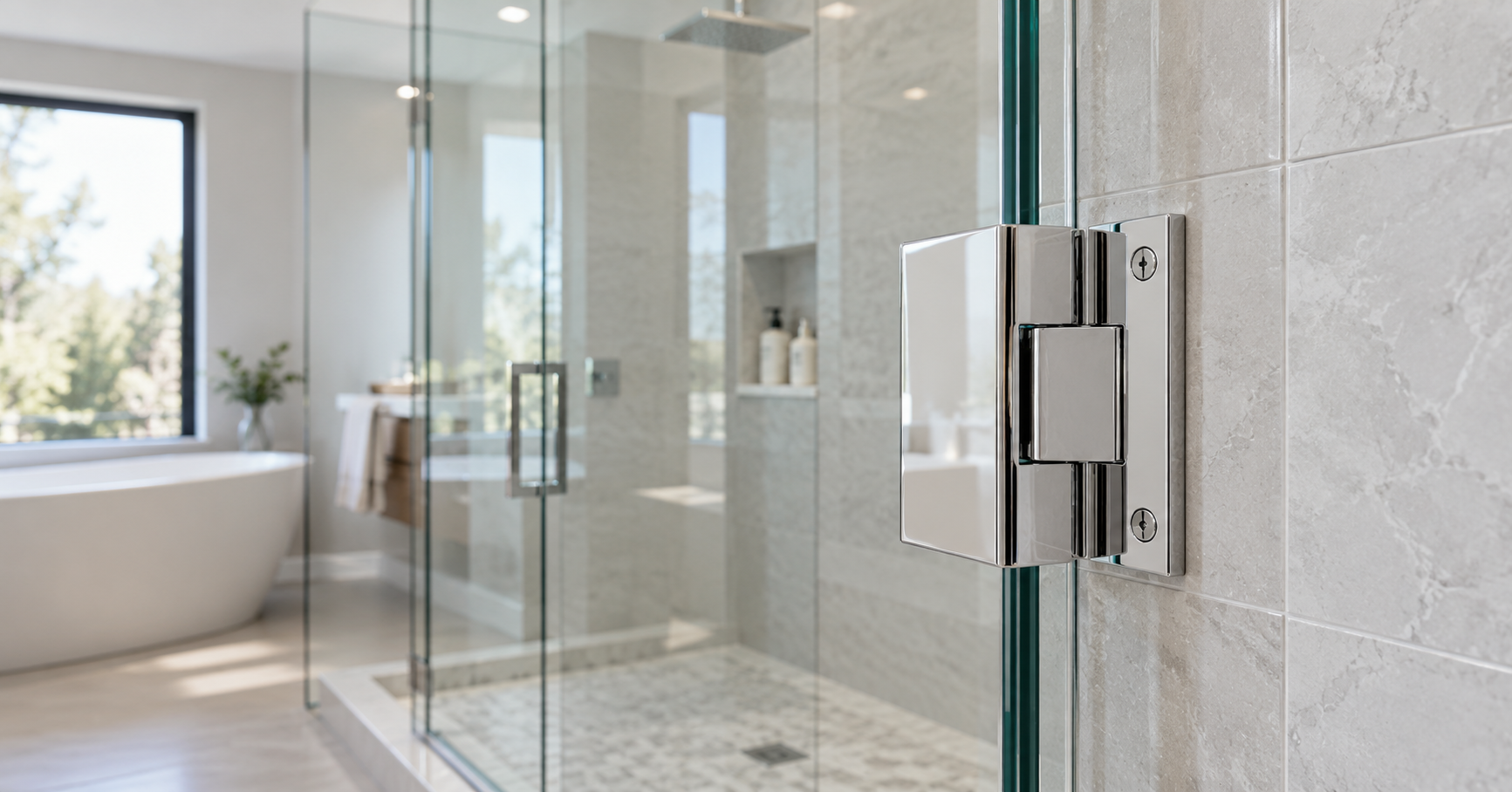


Positive-close shower door hinges are specialized glass hinges designed to guide a swinging shower door into a precise closed position. Instead of allowing the door to stop slightly open or rest inconsistently against the seal, the hinge uses an internal pivot, cam or grooved closing mechanism to establish a defined resting point. Depending on the model, that position may be exactly aligned at zero degrees or set slightly inward to create firmer contact with a jamb or shower door seal. This controlled closing action is especially useful in frameless glass enclosures where small alignment differences can affect water control, appearance and everyday door operation.
Positive-close hinges are often discussed together with self-closing and self-centering shower door hinges, but the terms are not completely interchangeable. A standard self-centering hinge generally helps return the glass toward its central resting position during the final portion of the swing. A positive-close hinge is designed to produce a more deliberate and precise final closing action, sometimes applying additional pressure against a compatible seal or jamb. It should not be confused with a soft-close hinge, which primarily slows the speed of the door to reduce abrupt closing.
How Do Positive-Close Shower Door Hinges Work?
The internal mechanism varies between hinge manufacturers and product series, but many positive-close shower door hinges use a specially shaped pivot pin or cam. As the door approaches the designated closing position, the internal components guide the hinge leaves toward a fixed resting point. The mechanism helps the glass settle into alignment instead of remaining partly open or drifting away from the seal. The hinge may still allow the door to swing inward, outward or in both directions, but its final closing behavior depends on the model’s construction and adjustment settings.
Some positive-close hinges return the door directly to a zero-degree position, meaning that the moving glass aligns with its intended closed plane. Other models offer a 5-degree positive-close setting that brings the door slightly farther inward. This tighter closing position can help the glass maintain contact with a clear jamb, strike seal or magnetic seal when the complete enclosure is designed for that configuration. A 5-degree setting should not be used automatically because excessive pressure against an incompatible seal can prevent smooth operation or place unnecessary stress on the glass and hardware.
Positive-Close vs Self-Centering vs Soft-Close Hinges
The most important distinction is what each mechanism controls. Positive-close hardware controls the final resting position, self-centering hardware guides the door toward a central position, and soft-close hardware controls closing speed. Some premium shower door hinges combine more than one of these functions, but a product should not be assumed to include all of them unless its specifications clearly say so.
| Hinge function | Primary purpose | Typical closing behavior |
|---|---|---|
| Positive close | Creates a precise final closing position | Guides the door firmly toward zero degrees or a specified offset |
| Self-centering | Returns the door toward its set center point | Pulls the door toward the resting position near the end of travel |
| Self-closing | Helps close the door without continuous manual force | Uses a spring, cam or hydraulic mechanism to continue closing |
| Soft close | Controls speed and reduces abrupt impact | Slows the door during the final part of its movement |
| Free swing | Allows movement without an active closing mechanism | The door remains where the user leaves it |
A positive-close hinge does not necessarily pull the door shut from every open angle. Many glass shower hinges begin influencing the door only after it reaches a certain point near the closed position. The activation range, swing direction and holding force vary by product, so buyers should review the technical data rather than assuming that every self-closing shower hinge behaves identically. Daltex’s guide to different hinge types provides additional information about wall-mounted, glass-to-glass, pivot, adjustable and soft-close configurations.
Where Are Positive-Close Hinges Used?
Positive-close shower door hinges are commonly used on frameless glass enclosures where the door must align consistently with a fixed panel, wall jamb or seal. A wall-to-glass version connects the moving glass directly to a structurally supported wall, while a glass-to-glass hinge transfers the door load to a stationary glass panel. Glass-to-glass models may be designed for 90-degree, 135-degree or 180-degree configurations, depending on the relationship between the door and the fixed panel. The mounting angle and positive-close position must match the actual enclosure geometry.
These hinges can be helpful when a standard self-centering door repeatedly stops slightly short of its intended position. They may also improve seal contact in an enclosure where the design requires the door to close against a clear vinyl jamb or another water-control component. Positive-close hardware cannot correct an incorrectly measured door, a severely out-of-plumb wall or an unsupported fixed panel. The glass, hinge, seal and surrounding structure must still be planned as one compatible system.
What Is a 5-Degree Positive-Close Hinge?
A 5-degree positive-close hinge is configured so that the door’s preferred resting position sits slightly inside the shower rather than stopping at a perfectly straight zero-degree position. This small offset can create firmer contact against a jamb or seal and help prevent the door from resting partly open. In some adjustable hinges, the installer can rotate or reposition the pivot pin to choose between a standard closing position and the additional 5-degree setting. Other hinges are manufactured with the closing position already preset.
The 5-degree feature is useful only when the enclosure design allows the glass to move into that position without binding. The door handle, bottom sweep, vertical seals and nearby fixed panels must all have sufficient clearance. If the shower door is intended to swing freely in both directions without meeting a jamb, a tighter positive-close position may be unnecessary. Daltex offers a positive-close hinge designed for a specific glass-to-glass configuration, demonstrating why the angle, glass thickness and hinge model must be matched carefully.
Benefits of Positive-Close Shower Door Hinges
The main benefit is consistent glass-door alignment. When a shower door returns to the same closing position after each use, the vertical seal, strike jamb and bottom sweep can function as intended. Consistent alignment also improves the appearance of a frameless enclosure because the door edges and panel gaps remain visually balanced. This can be particularly valuable in custom showers where narrow clearances make small positional differences more noticeable.
Positive-close hinges may also reduce the need to pull or push the door repeatedly to make it sit correctly. The defined closing action can help prevent the door from remaining slightly open after someone leaves the shower. However, positive close should not be treated as a substitute for accurate fabrication or installation. A properly functioning hinge still depends on suitable glass cutouts, correctly aligned hinge plates, adequate structural backing and a door that falls within the manufacturer’s width and weight limits.
How to Select the Correct Positive-Close Hinge
The selection process should begin with the mounting configuration. A wall-to-glass hinge requires suitable backing behind the tile or wall finish, while a glass-to-glass hinge requires a stationary panel capable of supporting the moving door. The hinge angle must also match the enclosure, because a 180-degree inline hinge cannot replace a 90-degree or 135-degree model without changing the door geometry. Buyers comparing shower hardware should therefore filter by connection type before considering finish or decorative profile.
Glass thickness, door width, door weight and the required number of hinges must be checked against the specifications for the exact model. The hinge must also match the glass cutout, gasket design, screw arrangement, back-plate shape and opening direction. Some hinges allow inward and outward movement, while others have a restricted swing or require a separate stop. Finish selection should come last, after the functional requirements have been confirmed, because polished chrome, brushed nickel, matte black or brass-tone finishes do not indicate whether the hardware can safely support the door.
Positive-Close Hinges and Water Control
A positive-close hinge can help the door return to a position where the seals overlap correctly, but the hinge itself does not make a shower enclosure watertight. Water containment also depends on the curb slope, showerhead direction, panel overlap, bottom sweep, strike seal and gaps required for glass movement. If the door closes firmly but water continues to escape, the problem may involve the seal profile or enclosure layout rather than the hinge.
Excessive closing force can create a different problem by compressing the seal too tightly. The door may become difficult to open, the seal may deform, or the glass may rebound away from the intended position. The best result comes from coordinating the positive-close setting with the exact seal and glass clearances. A professional custom enclosure should account for these relationships before the glass is fabricated.
Installation and Glass Fabrication Requirements
Many frameless shower door hinges require holes or notches in the glass, and those cutouts must match the manufacturer’s template. Tempered glass cannot be safely drilled, trimmed or notched after tempering, so the positive-close hinge should be selected before the door is manufactured. Substituting a different hinge later may not be possible even when the exterior dimensions appear similar. Differences in cutout shape, hole spacing or plate position can prevent the new hardware from fitting the existing glass.
The mounting surfaces must also provide adequate structural support. Wall-mounted hinges generally require appropriate backing rather than relying only on tile or drywall, while glass-to-glass hinges transfer the door load into a fixed panel that may need additional clamps, channels or stabilizer bars. Hinge plates should be installed with the specified gaskets and tightened according to the manufacturer’s instructions. Uneven tightening or direct metal-to-glass contact can create concentrated stress around the cutout.
Can Positive-Close Hinges Be Adjusted?
Some positive-close shower door hinges have an adjustable pivot pin or closing position, while others are factory-set and should not be altered. Adjustable models may allow an installer to change the final resting angle, compensate for a small alignment difference or apply a firmer closing position against a jamb. The available adjustment range is usually limited and should not be used to hide major measurement or installation errors. Product instructions must be followed because the adjustment procedure differs between hinge series.
A door that has stopped closing properly does not automatically need more hinge tension. Loose mounting screws, sagging glass, worn gaskets, seal friction or movement in the fixed panel can produce similar symptoms. The door should be supported before hinge plates are loosened because frameless glass panels are heavy and difficult to control once the hardware is released. If the internal closing mechanism is worn, adjusting the glass position may provide only a temporary improvement.
Replacing an Existing Positive-Close Hinge
Replacement requires more than finding a hinge with the same finish and general shape. The new hardware must match the existing mounting style, glass thickness, cutout pattern, plate dimensions, door weight and closing position. If the original hinge uses a 5-degree positive-close setting, replacing it with a standard self-centering hinge may change how the door meets the seal. A different back plate or screw location may also require wall repairs even when the glass cutout remains compatible.
The safest approach is to identify the manufacturer, series and model number before removing the old hardware. Photographs, detailed dimensions and the original glass template may help when the product number is unavailable. Manufacturer-approved replacement parts are preferable to improvised components that have not been tested with the hinge. Cracked, chipped or damaged glass around a hinge cutout should be evaluated before installing new hardware.
Common Problems With Positive-Close Hinges
A door that stops short of the closed position may be encountering resistance from a bottom sweep, magnetic seal or vertical jamb. The glass may also have sagged because the hinge plates loosened or the supporting wall moved slightly. If the door reaches the correct position but immediately springs back, the pivot may be set incorrectly for the enclosure or the seal may be applying more resistance than the mechanism can overcome. Each possibility should be checked before the hinge is replaced.
Grinding, clicking outside the normal closing point or inconsistent movement can indicate contamination, damaged internal parts or misalignment between hinges. Applying an unapproved lubricant may damage gaskets, attract residue or interfere with the internal mechanism. Cleaning and maintenance should follow the manufacturer’s instructions, particularly on plated or coated finishes. A hinge that no longer supports the glass securely should not remain in service while waiting for the problem to become more obvious.
Frequently Asked Questions
Are positive-close hinges the same as self-closing hinges?
Not exactly. A self-closing hinge helps move the door toward a closed position, while a positive-close hinge emphasizes a precise final resting point. A model may include both functions, but the product specifications should confirm how and when its closing mechanism engages.
Are positive-close hinges the same as soft-close hinges?
No. Positive-close hinges control where the door finishes, while soft-close hinges primarily control how quickly it reaches that position. Hydraulic or damped hardware may combine controlled speed with self-closing action, but a standard positive-close hinge does not automatically provide slow closing.
Does every frameless shower door need positive-close hinges?
No. Many frameless shower doors operate correctly with standard self-centering, pivot or adjustable hinges. Positive-close hardware is useful when the enclosure requires a specific resting position or firmer engagement with a compatible jamb or seal.
Can positive-close hinges stop shower-door leaks?
They may improve alignment between the door and seal, which can help with water control when poor closure is the actual cause. They cannot fix incorrect panel overlap, damaged seals, an improperly sloped curb or water directed toward an unsealed gap. The complete enclosure should be inspected before attributing leakage to the hinges.
Can positive-close hinges be installed on existing glass?
They can be installed only when the existing glass thickness, dimensions and cutouts match the new hinge requirements. Tempered shower glass cannot be drilled or notched after manufacturing. If the hardware is incompatible with the existing fabrication, a new glass door may be required.
Final Considerations
Positive-close shower door hinges provide a precise and repeatable closing position for frameless glass doors. They can improve door alignment, seal contact and everyday operation, but their performance depends on matching the hinge to the enclosure geometry, glass specifications, door weight and mounting structure. The difference between positive close, self-centering, self-closing and soft close should be understood before hardware is ordered. Selecting the complete glass-and-hardware system before fabrication remains the most reliable way to achieve safe, smooth and consistent door operation.


