

Blog
Types of Shower Door Hinges: A Complete Buyer’s Guide

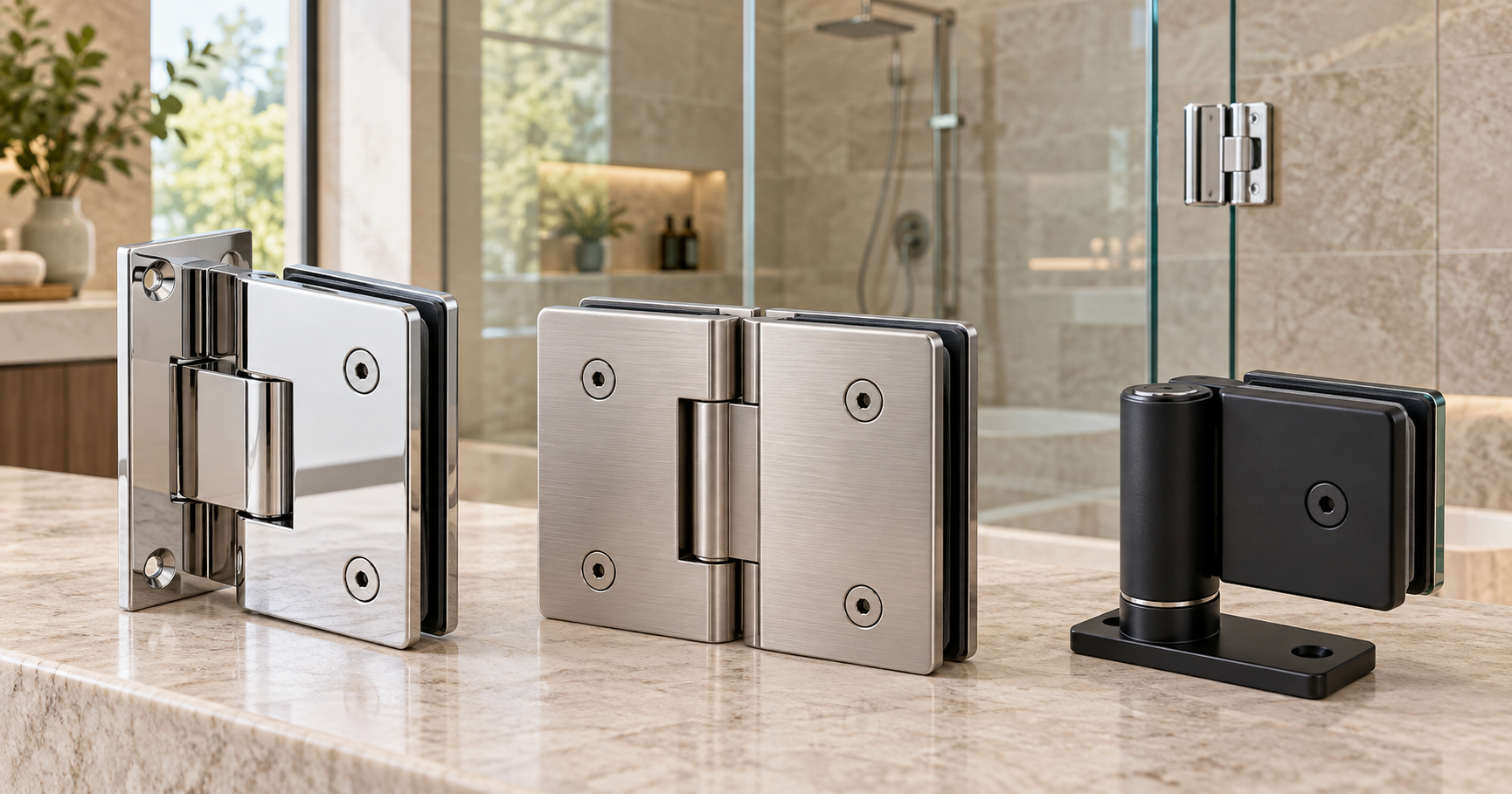


The main types of shower door hinges are wall-to-glass hinges, glass-to-glass hinges, pivot hinges, continuous hinges, framed-door hinges and specialised offset or adjustable hinges. The correct choice depends on the enclosure layout, glass thickness, door weight, swing direction, mounting surface and required opening angle.
A hinge should never be selected by appearance alone. It must be rated for the exact glass and door configuration while matching the existing cutouts, fasteners, gaskets and structural support.
What Is a Shower Door Hinge?
A shower door hinge connects the moving door to a wall, fixed glass panel, frame, header or threshold. It carries the weight of the door while allowing the glass to open and close safely.
Many modern glass shower hinges also contain springs or cams that help return the door to a closed position. Gaskets installed between the metal and glass protect the tempered glass and distribute pressure.
The hinge is part of a complete system that includes the glass, handle, seals, clamps, support bars and other shower hardware. Each component must be compatible with the enclosure design.
Shower Door Hinge Types at a Glance
| Hinge type | Connection | Common application | Main consideration |
|---|---|---|---|
| Wall-to-glass hinge | Wall to moving glass | Frameless doors beside a tiled wall | Requires structural backing |
| Glass-to-glass hinge | Fixed panel to moving glass | Frameless enclosures with side panels | Must match the panel angle |
| Pivot hinge | Top and bottom of door | Frameless or semi-frameless doors | Pivot position affects clearance |
| Continuous hinge | Runs along much of the door height | Framed and semi-frameless doors | More visible metal |
| Framed-door hinge | Connects through the metal frame | Traditional framed enclosures | Must match the frame system |
| Offset hinge | Moves the swing axis away from the mounting point | Special clearance conditions | Requires exact geometry |
| Adjustable hinge | Allows limited alignment adjustment | Custom glass enclosures | Adjustment range varies |
| Soft-close hinge | Controls final door movement | Premium shower systems | Must be rated for wet environments |
These categories may overlap. For example, a wall-to-glass hinge can also be self-centering or adjustable.
1. Wall-to-Glass Shower Door Hinges
A wall-to-glass hinge connects the moving glass door directly to a wall or vertical structural surface. It is one of the most common options for frameless shower enclosures.
The wall side normally includes a mounting plate secured through tile or another finished surface into suitable structural backing. The glass side clamps around a prepared cutout in the tempered door.
Advantages of Wall-to-Glass Hinges
Wall-to-glass hinges create a clean appearance because the door does not require a full metal frame. They are available in numerous finishes, sizes and weight capacities.
They may also reduce the amount of fixed glass needed when the opening is positioned directly beside a suitable wall.
Important Considerations
The hinge cannot safely rely on tile, backer board or drywall alone. The wall must contain appropriate wood blocking, metal reinforcement or another approved structural support.
The wall should also be plumb. A significantly uneven surface can make alignment difficult and place uneven pressure on the hinges.
Wall-to-glass hinges are available with full back plates, short back plates and different opening angles. The required version depends on the door position and available wall space.
2. Glass-to-Glass Shower Door Hinges
A glass-to-glass hinge connects the moving door to a fixed glass panel. This configuration is common when the door is positioned away from a structural wall.
These hinges are generally identified by the angle between the door and fixed panel.
90-Degree Glass-to-Glass Hinges
A 90-degree hinge is used when the fixed panel and door meet at a right angle. This configuration is common in corner shower enclosures.
The hinge geometry must allow the door to swing without striking the panel, handle, wall or nearby fixture.
135-Degree Glass-to-Glass Hinges
A 135-degree hinge is commonly used in neo-angle enclosures. The fixed panel and door meet at an angled corner rather than a standard right angle.
The hinge angle should match the enclosure precisely. Substituting a different angle can prevent the door from closing correctly.
180-Degree Glass-to-Glass Hinges
A 180-degree hinge connects two inline pieces of glass. The fixed panel and door sit in the same plane when the door is closed.
This style can create a visually continuous glass surface, but the fixed panel must be strong enough and properly supported to carry the door load.
Fixed Panel Support
A glass-to-glass hinge transfers the door’s weight to the fixed panel. That panel may require clamps, a channel, support bar or connection to another structural surface.
The complete support system should be evaluated rather than assuming the fixed panel can carry any door.
3. Pivot Shower Door Hinges
Pivot hinges support the door near its upper and lower edges. The door rotates around a vertical pivot line rather than relying entirely on side-mounted hinges.
Depending on the enclosure, the upper pivot may attach to a header, ceiling support, fixed glass panel or specialised bracket. The lower pivot may connect to the threshold, curb, floor or bottom fitting.
Benefits of Pivot Hinges
Pivot hinges can create a minimalist appearance because large side plates are not required along the wall. They may work well where side mounting is difficult or where the design calls for a specific swing point.
The pivot can sometimes be positioned slightly inward from the edge of the door. This creates a different swing path and may help manage clearance in certain layouts.
Limitations of Pivot Hinges
The lower mounting point requires careful waterproofing and structural preparation. Drilling or fastening near a shower curb should never compromise the waterproofing system.
Pivot placement also changes how much of the door moves inside and outside the enclosure. Clearance must be checked on both sides.
The comparison between a pivot and side-mounted hinge should consider door size, support, threshold construction and desired appearance rather than style alone.
4. Top-and-Bottom Mount Hinges
Top-and-bottom mount hinges are closely related to pivot systems. Instead of connecting through the vertical side edge, the hardware engages prepared areas near the upper and lower corners of the door.
These hinges are often used when a clean side profile is preferred. They may also suit enclosures with a header or another secure upper support.
The top and bottom fittings must align precisely. Even a small difference in the pivot line can cause the door to bind, move unevenly or fail to close.
Because these hinges support the door at only two locations, their load rating and installation tolerances are especially important.
5. Continuous Shower Door Hinges
A continuous hinge extends along most of the door’s vertical edge. It distributes the door load across a longer area rather than concentrating it at two or three individual hinges.
Continuous hinges are frequently used on framed and semi-frameless shower doors. They may also be called piano hinges.
Advantages of Continuous Hinges
The long profile provides consistent support and can conceal part of the door edge. It may also help create a more controlled swing in certain framed systems.
Disadvantages of Continuous Hinges
A continuous hinge introduces more visible metal than a pair of frameless glass hinges. Soap residue and moisture may also collect around the longer profile if it is not cleaned regularly.
Replacement usually requires a component designed for the exact frame and door system. Continuous hinges are not universally interchangeable.
6. Framed Shower Door Hinges
Framed shower doors have metal surrounding most or all of the glass. Their hinges typically connect to the door frame rather than clamping directly onto exposed glass.
The hinge may use pins, brackets, screws or a continuous profile. Some framed doors use top and bottom pivot components that fit within the surrounding enclosure frame.
These systems often require brand-specific or model-specific replacement parts.
Before replacing a framed-door hinge, inspect the complete frame for corrosion, loose fasteners and distortion. A new hinge may not correct a door that has moved out of square.
7. Offset Shower Door Hinges
An offset hinge moves the door’s pivot axis away from the mounting surface. This can provide additional clearance around trim, tile projections, handles or nearby glass.
Offset hinges are useful for specialised layouts, but they change the movement of the door and the forces placed on the mounting point.
The offset distance, opening angle and load capacity must be confirmed before ordering. A hinge that moves the door farther from the wall may require different seals or clearances.
8. Adjustable Shower Door Hinges
Some shower door hinges allow limited adjustment for alignment, closing position or spring tension. Adjustability can help compensate for minor installation variations.
The available adjustment depends on the hinge model. It may include:
- Vertical door alignment
- Horizontal positioning
- Closing-angle adjustment
- Spring-tension adjustment
- Self-centering position
- Opening-angle limitation
Adjustable does not mean universal. The hinge must still match the glass thickness, cutout pattern and weight of the door.
Excessive adjustment should not be used to compensate for a severely uneven wall, unsupported panel or incorrectly sized door.
9. Self-Centering Shower Door Hinges
A self-centering hinge uses an internal spring or cam to return the door toward a set closed position.
This feature helps the door meet the strike seal consistently and reduces the chance of it remaining partly open. The exact closing range varies by model.
Some self-centering hinges begin pulling the door closed only during the final part of its travel. Others allow the installer to set the resting position.
If the door stops closing properly, the cause may be hinge wear, incorrect adjustment, loose fasteners or a seal that creates too much resistance.
10. Soft-Close Shower Door Hinges
Soft-close hinges control the final movement of the door to reduce slamming. They may use hydraulic or mechanical damping inside the hinge body.
This type of hinge can improve the feel of a premium enclosure, but it must be manufactured specifically for shower conditions. Ordinary furniture or cabinet soft-close hardware is not suitable for supporting heavy shower glass.
The soft-close mechanism must also be rated for the door’s dimensions and weight. Mixing hinges from different systems can produce inconsistent movement.
Side-Mount Hinges vs Pivot Hinges
Side-mount and pivot hinges create different support and movement patterns.
| Feature | Side-mount hinge | Pivot hinge |
|---|---|---|
| Mounting position | Vertical side edge | Top and bottom |
| Common support | Wall or fixed glass panel | Header, glass, curb or floor fitting |
| Visual appearance | Visible side plates | Cleaner side edge |
| Door movement | Swings from side edge | Rotates around pivot line |
| Structural requirement | Strong wall or fixed panel | Aligned upper and lower support |
| Waterproofing concern | Wall fastener penetrations | Lower pivot and curb connection |
| Best application | Standard frameless openings | Custom layouts and specific clearances |
Neither option is automatically stronger. Performance depends on the hardware rating, glass configuration, mounting structure and installation quality.
How to Choose the Right Shower Door Hinge
Confirm the Door Configuration
Begin by identifying where the door will be supported. Determine whether it will connect to a wall, fixed panel, frame, header or threshold.
This decision usually determines the basic hinge category.
Check the Glass Thickness
Shower door hinges are designed for specific glass thickness ranges. Common frameless configurations may use 3/8-inch or 1/2-inch tempered glass, but the project specification should always be confirmed.
A hinge designed for one thickness should not be forced onto another. The gaskets, clamp dimensions and fastener engagement may not work correctly.
Calculate the Door Weight
Glass weight increases with thickness, width and height. The hinge manufacturer normally provides a maximum door size and weight for each model.
Do not assume that adding another hinge automatically allows any door size. Hinge spacing, glass cutouts and manufacturer requirements must also be followed.
Heavy or oversized doors may require specially rated heavy-duty shower hinges.
Check the Door Width and Height
A wide door places greater leverage on the hinges. A tall door may also require different hinge spacing or additional support.
The complete door dimensions should be compared with the hinge specification, not just the glass thickness.
Confirm the Opening Angle
Hinges may allow 90, 135 or 180 degrees of movement, while others limit the door to a smaller range.
The selected opening angle must prevent the glass from striking:
- A wall
- A fixed panel
- A toilet or vanity
- A towel rail
- A handle
- Another door
- A sloped ceiling
- Exterior trim
The required clear floor space should also be considered before choosing a swinging door.
Determine the Swing Direction
Some shower doors open outward, while others can swing in both directions. Many local requirements expect the door to be capable of opening outward for access and safety, but the applicable code should be confirmed for the project location.
Hinge, seal and handle selection must support the intended swing.
Inspect the Mounting Surface
A wall-mounted hinge requires suitable structural backing behind the finished surface. Tile and wallboard should not carry the door load by themselves.
For glass-to-glass hinges, verify that the fixed panel is properly secured and rated to support the moving door.
Match the Glass Cutouts
Tempered glass cannot be drilled, notched or cut after tempering. The hinge must match the existing holes and cutouts when replacing hardware on an installed door.
Even two similar-looking hinges may use different cutout dimensions, screw spacing or plate shapes.
A replacement hinge should be selected using the manufacturer’s technical drawing whenever possible.
Consider Seal Clearance
The hinge location affects the gaps around the door. Those gaps must work with the selected vertical seals, bottom sweep and strike profile.
A hinge that changes the door position may create a wider opening than the existing seal can cover.
Choose a Compatible Finish
Common shower hinge finishes include:
- Chrome
- Brushed nickel
- Polished nickel
- Matte black
- Oil-rubbed bronze
- Brushed bronze
- Polished brass
- Brushed brass
- Gold-toned finishes
- Stainless steel
Finish names are not standard across every manufacturer. A matte black hinge from one brand may differ slightly from the handle or clamps supplied by another.
It is usually easier to achieve a consistent appearance when the visible hardware comes from the same collection.
Shower Hinge Materials
Solid Brass
Solid brass is widely used for frameless shower door hinges because it can be machined accurately and finished in many colours.
The external finish still requires proper care. Abrasive cleaners can damage plated or coated surfaces.
Stainless Steel
Stainless steel offers good corrosion resistance and a modern appearance. The exact grade and construction should be confirmed because the phrase “stainless finish” does not always mean the entire hinge is manufactured from stainless steel.
Zinc or Aluminium Alloys
Certain framed, lightweight or decorative hinge components may use zinc or aluminium alloys. Suitability depends on the door weight, product design and exposure conditions.
Material alone does not establish load capacity. The complete hinge should be evaluated using the manufacturer’s rating.
How Many Hinges Does a Shower Door Need?
Many frameless shower doors use two hinges, while taller or heavier doors may require three. However, the correct number cannot be determined from height alone.
The decision depends on:
- Door width
- Door height
- Glass thickness
- Total glass weight
- Hinge load rating
- Cutout positions
- Mounting surface
- Manufacturer instructions
Installing too few hinges can cause sagging, poor closing and excessive pressure around the glass cutouts.
Adding an unapproved third hinge to an existing tempered door may not be possible because new holes cannot be drilled after tempering.
Are Shower Door Hinges Universal?
No. Shower door hinges vary by glass thickness, mounting configuration, cutout pattern, opening angle, door weight, gasket design and finish.
A hinge may look almost identical to the existing hardware while using a different hole spacing or plate dimension.
For shower door hinge replacement, identify the original manufacturer and model whenever possible. If that information is unavailable, detailed measurements and photographs of the hinge and glass cutout may be required.
Common Shower Door Hinge Selection Mistakes
Selecting by Finish Alone
A matching colour does not confirm structural compatibility. Load rating, glass thickness and mounting type should be evaluated first.
Ignoring the Glass Cutout
Tempered glass cannot be altered after manufacturing. A replacement hinge must fit the existing cutout precisely.
Mounting Into an Unsupported Wall
A wall-to-glass hinge needs structural backing. Fasteners installed only into tile or wallboard may loosen under the repeated movement of the door.
Exceeding the Weight Rating
An undersized hinge can sag, fail to close or place concentrated stress on the glass.
Mixing Different Hinge Models
Different springs, opening angles or plate dimensions can cause the hinges to work against each other.
Forgetting Door Clearance
A hinge may technically support the door while allowing it to strike a wall, panel or fixture.
Reusing Damaged Gaskets
The gaskets between the hinge and glass help distribute pressure. Torn, hardened or incorrectly positioned gaskets should not be reused.
Overtightening the Screws
Excessive torque can damage the gasket, distort the hinge or concentrate pressure on the tempered glass. Fasteners should be tightened according to the hardware instructions.
Signs That Shower Door Hinges Need Attention
Hinges should be inspected when the door:
- Sags or appears uneven
- Rubs against the curb
- Strikes a fixed panel
- Fails to stay closed
- Moves suddenly or unevenly
- Makes grinding or clicking sounds
- Has loose mounting plates
- Shows corrosion or damaged finishes
- Has torn or displaced gaskets
- Moves around the glass cutout
- Requires unusual force to open
Loose hardware should be assessed promptly. Continued use may increase stress on the glass and surrounding components.
Can Shower Door Hinges Be Adjusted?
Some hinges allow minor adjustment, but the method varies by model. Adjustment may involve repositioning the plates, resetting the self-centering angle or changing spring tension.
A heavy glass door should be supported before hinge screws are loosened. Removing pressure without supporting the door can cause sudden movement.
Adjustment should not be attempted when the glass edge is chipped, the hinge is cracked or the mounting surface is moving. These conditions may require professional glass repair or hardware replacement.
How to Maintain Shower Door Hinges
Clean hinges with a soft cloth and a mild cleaner suitable for the finish. Rinse away soap residue and dry the hardware to reduce mineral buildup.
Avoid abrasive pads, harsh acids and strong chemical cleaners. These products can damage protective coatings and cause discolouration.
Check periodically for loose screws, displaced gaskets and changes in door alignment. Do not apply lubricant unless the hinge manufacturer recommends a specific product.
Water should not remain trapped around wall plates or lower pivot fittings. Failed sealant around mounting points should be inspected before moisture affects the surrounding surface.
When Professional Installation Is Recommended
Professional installation is particularly important for frameless and heavy-glass shower doors.
Assistance may be required when:
- The door is large or heavy
- Structural backing must be confirmed
- The enclosure uses glass-to-glass hinges
- A pivot fitting penetrates the curb
- The existing hinge model cannot be identified
- The glass cutout does not match the new hinge
- The door is sagging or striking another panel
- The glass edge is chipped
- Multiple hardware components need replacement
- The enclosure requires a custom angle
Well-designed shower enclosures depend on accurate glass fabrication, structural preparation and compatible hardware.
Frequently Asked Questions
What are the main types of shower door hinges?
The main types are wall-to-glass, glass-to-glass, pivot, top-and-bottom mount, continuous, framed-door, offset, adjustable and soft-close hinges.
What is the best hinge for a frameless shower door?
The best option depends on the enclosure. Wall-to-glass hinges suit doors beside a supported wall, while glass-to-glass hinges connect the door to a fixed panel. Pivot hinges may suit layouts requiring a different swing axis.
What is the difference between a pivot hinge and a side-mount hinge?
A pivot hinge supports the door near its top and bottom. A side-mount hinge connects along the vertical edge of the door to a wall or fixed glass panel.
Can a shower door hinge be attached directly to tile?
The mounting screws may pass through tile, but the hinge should be secured to appropriate structural backing behind the finished surface. Tile alone should not support a heavy glass door.
How many hinges are needed for a glass shower door?
Many doors use two hinges, while heavier or taller doors may require three. The correct number must follow the hinge manufacturer’s door-size and weight limits.
Can glass shower door hinges be replaced?
Yes, if the replacement matches the glass thickness, cutout pattern, mounting configuration and door weight. Tempered glass cannot be modified to accept a different cutout after manufacturing.
Can shower door hinges be adjusted?
Some models allow alignment, tension or closing-position adjustments. Others have little or no adjustment. The door should be supported before any hinge is loosened.
What is a self-centering shower hinge?
A self-centering hinge uses a spring or cam to guide the door back toward its closed position during the final part of the swing.
Are stainless steel shower hinges better than brass?
Both materials can perform well when properly designed and rated. The better choice depends on the hardware construction, finish, corrosion resistance and required load capacity.
Can I use different hinge models on the same door?
Mixing hinge models is not recommended. Differences in spring tension, plate dimensions and opening movement can prevent the hinges from sharing the load correctly.
Why does my shower door keep sagging?
Possible causes include loose fasteners, insufficient structural backing, worn hinges, damaged gaskets, excessive door weight or movement in the fixed panel.
Do shower door hinges require special glass?
Frameless hinges normally require tempered safety glass with cutouts created before tempering. The cutout shape and location must match the selected hardware.
Final Takeaway
The correct shower door hinge must match the enclosure configuration, glass thickness, door dimensions, weight, opening angle and structural support.
Wall-to-glass hinges suit doors mounted beside a properly reinforced wall. Glass-to-glass hinges work with fixed panels at specific angles, while pivot hinges support the door from the top and bottom. Continuous and framed-door hinges provide different options for traditional metal-framed systems.
Before purchasing, confirm the manufacturer’s load rating, glass cutout, gasket design, mounting surface and finish. Proper selection helps the shower door move smoothly, close consistently and remain safely supported throughout the life of the enclosure.


One thought on “Types of Shower Door Hinges: A Complete Buyer’s Guide”