What to Do When Your Storefront Glass Breaks
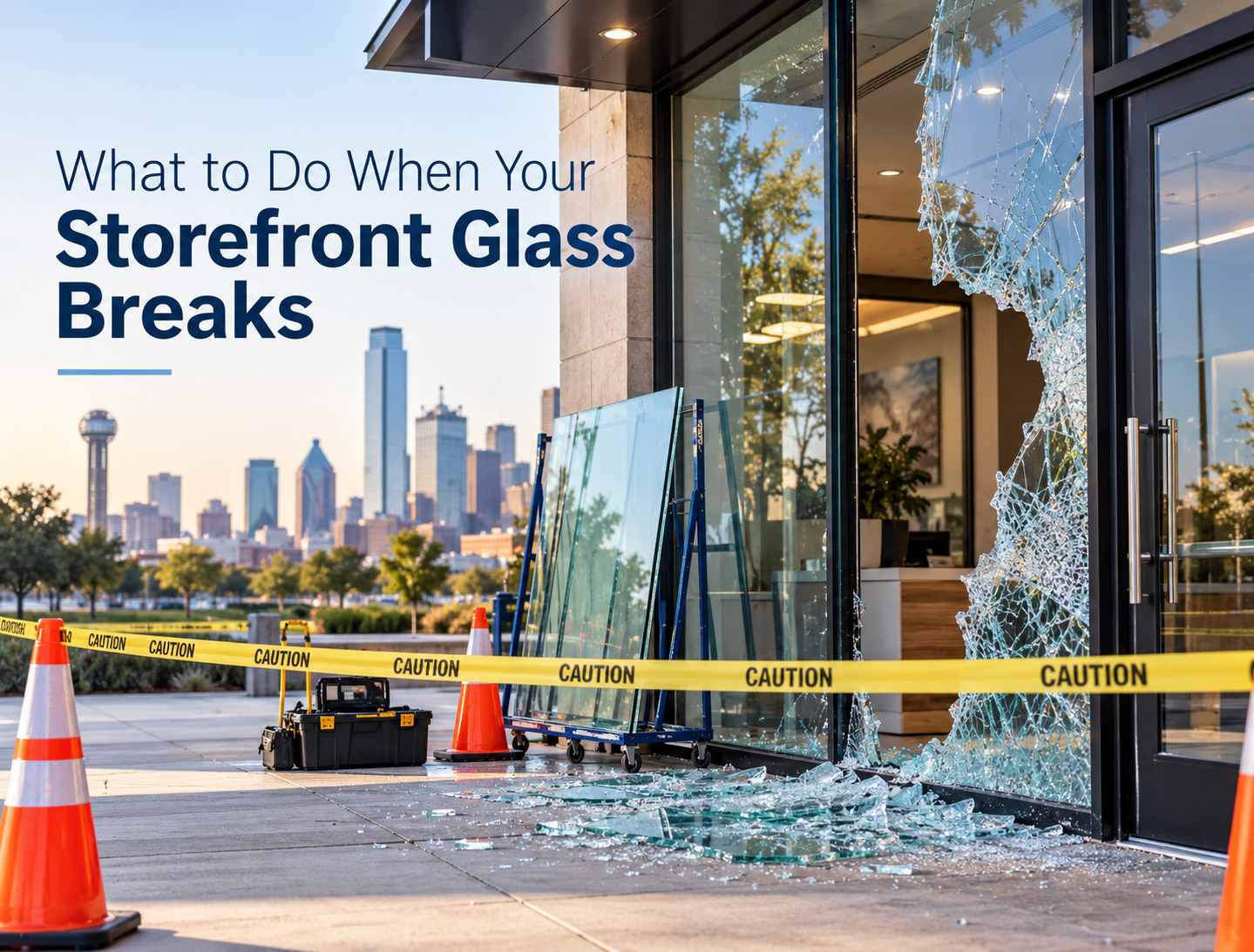


A broken storefront window is more than a cosmetic problem. Large pieces of damaged glass can remain unstable in the frame, sharp fragments may fall into pedestrian areas, and an exposed opening can leave merchandise, equipment and the building interior vulnerable to weather or unauthorized access. The safest response is to isolate the area, document what happened from a safe distance, contact a professional glass company, secure the opening when permanent replacement cannot happen immediately, and inspect the complete storefront system before installing new glass.
For Dallas businesses, the repair process may involve more than replacing one visible pane. Commercial storefronts typically combine glass, aluminum framing, entrance doors, gaskets, glazing stops and hardware as one system. Daltex Glass provides storefront systems and replacement services across Dallas-Fort Worth, including temporary board-up when a custom replacement panel is not immediately available.
Keep People Away From the Broken Glass First
The first priority after storefront glass breaks should be controlling access to the damaged area. Do not allow customers or employees to walk beneath cracked glass that remains in the frame, and do not assume a partially broken panel is stable simply because part of it is still standing.
Impact can create cracks that continue spreading after the initial event. Fragments may also remain suspended within gaskets or aluminum channels before falling later. If the damage is close to a public sidewalk, entrance or parking area, establish a safe perimeter that keeps people away from both the exterior and interior sides of the opening.
Employees should not try to remove large unstable pieces unless they are trained and equipped for glass handling. Commercial panes can be heavy, and broken edges can cause serious injury. Professional removal is especially important where a cracked panel sits above another pane, beside an entrance door or within a damaged aluminum frame.
Photograph the Damage Before Cleanup Begins
Once the immediate area is isolated, photograph the storefront from a safe position. Take wider images showing the complete opening and closer photographs showing the glass, frame, door, locks and surrounding building surfaces where it is safe to do so.
This documentation can help establish the condition immediately after a break-in, storm, collision or vandalism event. It may also help an insurance carrier, property manager or glass contractor understand the scope of the incident before the first site visit.
Do not place yourself near hanging glass simply to obtain a better photograph. A general image and an approximate opening size are usually enough to begin a repair conversation. Daltex’s glass repair service specifically advises providing a photograph and approximate dimensions when reporting a breakage.
Identify Whether the Storefront Is Still Secure
A crack does not always mean the panel has completely fallen from its frame, but the business should still consider whether the opening can safely remain exposed. A damaged panel may leave the building vulnerable even when part of the glass remains in position.
Security becomes more urgent when the breakage exposes merchandise or creates direct access to the interior. Retail stores, restaurants, offices and other ground-floor businesses may also need to consider whether a damaged entrance can continue operating without placing visitors near loose glass.
A professional assessment can determine whether the existing panel can remain temporarily in place, whether unstable material needs to be removed or whether the entire opening should be boarded until replacement glass is ready.
When Does a Storefront Need Temporary Board-Up?
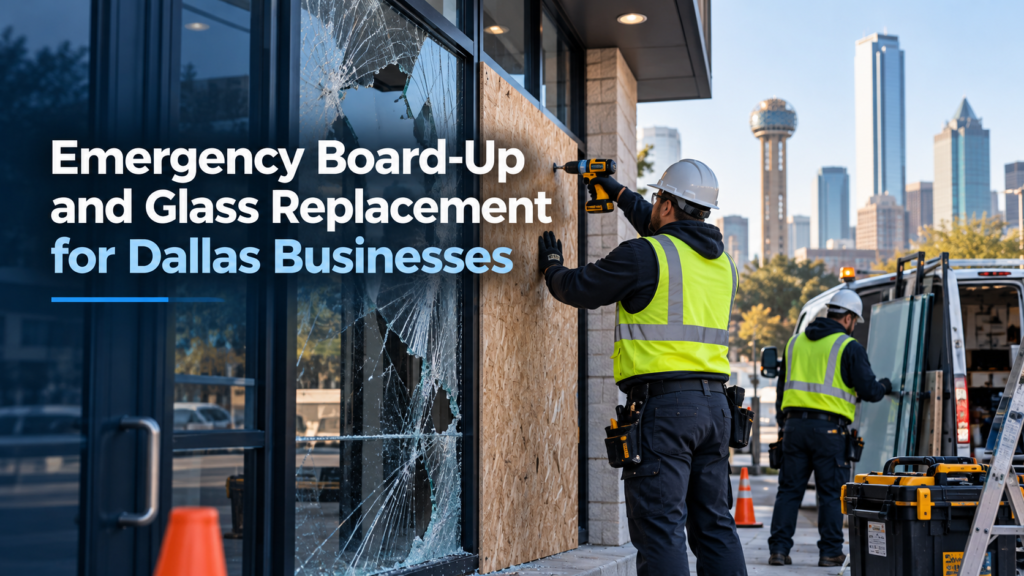
Temporary board-up is useful when the damaged glass cannot be replaced safely during the initial visit. This is common with custom-size panels, tempered glass, laminated glass, insulated glass units, tinted products or glazing that requires special fabrication.
Board-up closes the opening temporarily so the property is less exposed while the replacement glass is being measured and fabricated. It should not be treated as the permanent repair, and it needs to be installed in a way that does not unnecessarily damage reusable aluminum framing or interfere with an entrance door.
Daltex notes that temporary board-up can be used while custom storefront glass is being produced. Permanent replacement timing depends on the glass specification rather than simply the visible dimensions of the opening.
Why Storefront Glass Cannot Always Be Replaced Immediately
A common misconception is that a glass contractor can simply arrive with a standard sheet, cut it to the opening and install it immediately. Commercial storefront glazing often requires more planning.
The panel may need a specific thickness, safety treatment, tint, coating or insulated construction. Tempered glass must be cut, drilled and otherwise processed before heat treatment because it cannot be resized after tempering. Laminated glass uses multiple layers bonded around an interlayer, while insulated glass units combine multiple panes around a sealed cavity.
Daltex’s glass fabrication capabilities include tempered, laminated, insulated and custom-cut glazing fabricated to confirmed project dimensions.
The initial visit may therefore focus on making the opening safe, obtaining accurate measurements and identifying the required specification. Permanent installation can then take place after the replacement pane has been fabricated correctly.
Inspect the Aluminum Frame Before Ordering Replacement Glass
Storefront glass often breaks because of an impact, and the force that damaged the pane may also affect the surrounding framing. A vehicle strike, attempted forced entry or heavy object can bend mullions, disturb glazing stops, damage gaskets or move a doorframe out of square.
Installing a perfectly fabricated new pane into distorted framing can create new problems. Uneven pressure at the glass edge may increase the risk of failure, while damaged gaskets or sealant can cause water infiltration and air leakage.
The frame should therefore be checked for visible bending, loosened anchorage, damaged stops, deteriorated glazing materials and changes in alignment. Daltex’s repair process specifically includes evaluating framing because replacement glass should not be installed into an opening that can no longer support it correctly.
Check the Storefront Door at the Same Time
When broken glass is located close to a commercial entrance, inspect the door system as well. Storefront impacts can affect pivots, closers, locks, thresholds and door alignment even when the door glass itself remains intact.
A door that suddenly drags, fails to latch, closes too quickly or no longer aligns with the frame may indicate movement elsewhere in the storefront system. Correcting these issues during the glass repair can be more efficient than replacing the pane first and discovering a hardware or framing problem afterward.
Commercial storefronts are complete assemblies rather than isolated glass panels. Daltex’s storefront service includes entrance doors, sidelights, transoms and associated hardware in addition to fixed glass.
What Type of Glass Should Replace a Broken Storefront?
The replacement needs to meet the requirements of the opening rather than simply look similar to the damaged panel. Depending on location and use, a storefront may use tempered, laminated or insulated glass.
Tempered glass is heat treated so that, when it fails, it breaks differently from ordinary annealed glass and is widely used for safety glazing applications. Laminated glass uses an interlayer that helps retain fragments after breakage and can be appropriate where additional security or acoustic performance is needed. Insulated glass may be selected where energy performance is important.
Ground-level storefront entrances and other hazardous glazing locations can be subject to safety-glazing requirements. Dallas currently uses the 2021 ICC code family with local amendments, so a contractor should evaluate the actual opening rather than assuming the original panel specification remains appropriate for every replacement.
Tempered Glass Versus Laminated Glass for Storefront Repair
Tempered and laminated glass behave differently after impact. Tempered glass is designed to break into relatively small fragments when it fails completely. Laminated glass contains an interlayer that helps hold broken pieces together, allowing the damaged pane to remain as a barrier to some extent after breakage.
This does not mean laminated glass should automatically replace every broken storefront. Thickness, framing capacity, security objectives, local requirements, acoustic goals and the original glazing system all matter.
For a retail frontage exposed to repeated vandalism or security concerns, laminated configurations may be worth evaluating. For another opening, tempered glass may remain the appropriate and more straightforward choice. The specification should be based on the project rather than a generic assumption.
Should the New Glass Match the Existing Storefront?
Yes, particularly when only one panel is being replaced within a larger elevation. Glass that differs noticeably in tint, reflection, coating or thickness can make one section of the storefront stand out from adjacent panes.
Matching can become more challenging on older buildings because the original glazing product may no longer be manufactured in exactly the same form. Photographs, original construction documents or previous glass specifications can help the fabricator identify a close replacement.
If several older units are already scratched, fogged or mismatched, the breakage may also provide an opportunity to assess whether a larger section of the facade should be reglazed. That should be an intentional renovation decision rather than an automatic response to one broken panel.
What If the Broken Storefront Uses Insulated Glass?
A storefront may contain an insulated glass unit rather than a single sheet. An IGU typically uses two or more panes separated by a spacer and sealed around the perimeter. Some units also incorporate low-emissivity coatings, gas fills or laminated components.
A broken IGU generally requires replacement of the complete sealed unit. Simply replacing one pane on site does not restore the original factory-sealed assembly.
Daltex manufactures insulated units in-house and can produce them to specific project dimensions and make-ups, including coating, spacer and laminated-component options.
This fabrication requirement is another reason a temporary board-up may be necessary while permanent glass is prepared.
Can a Storefront Stay Open During Glass Repair?
Sometimes, depending on the position and severity of the damage. A break in a fixed sidelight away from the main entrance may be easier to isolate than a damaged door or large pane directly beside the primary customer path.
The business should not remain open in a way that requires customers to pass beneath unstable glass or through an unsafe entrance. Where possible, a secondary door may be used while the affected area is isolated.
For larger repair or renovation work, storefront replacement can sometimes be phased so the business continues operating. The feasibility depends on access, opening configuration, business hours and whether a safe path can be maintained.
Contact the Property Manager or Landlord When Appropriate
Tenants should check whether the lease places responsibility for storefront glazing on the tenant or building owner. Commercial leases can divide responsibility differently for exterior glass, entrance systems and damage caused by specific events.
The landlord or property manager may also have approved contractors, facade specifications or insurance requirements that need to be followed before permanent replacement.
Do not allow administrative questions to delay immediate safety measures. The area still needs to be isolated and secured. Ownership and insurance responsibilities can be clarified while temporary protection is being arranged.
Record the Cause of Breakage When Possible
Knowing why the glass failed can influence the repair recommendation. Vandalism, accidental impact, severe weather, thermal stress and frame-related pressure do not necessarily call for the same corrective action.
A pane that breaks repeatedly without obvious external impact deserves further investigation. Binding frames, insufficient edge clearance, hardware movement or other conditions may be contributing factors. Simply replacing the glass repeatedly without identifying the underlying issue can lead to another failure.
This is where professional inspection matters. The objective should be to restore the entire opening, not only remove evidence of the latest breakage.
Do Not Ignore Small Storefront Cracks
A pane does not need to fall out before it deserves attention. Cracks can spread from the original damage, particularly when the glass experiences temperature changes, vibration or continued stress.
A damaged storefront also creates uncertainty about how much strength remains in the panel. If the crack is near an edge, door or public walkway, arrange an assessment rather than assuming the pane will remain stable indefinitely.
Temporary planning is generally easier when the glass is still contained within the opening than after a larger failure exposes the business completely.
What Information Should You Give the Glass Company?
Provide the business location, several safe photographs, approximate dimensions and a description of how the glass broke if known. Mention whether the damage affects the main entrance, whether glass remains hanging in the frame and whether the property is currently secure.
If original specifications are available, share information about glass thickness, tint, laminated construction, insulated units or coatings. Also explain any access limitations such as restricted loading areas, interior merchandise close to the glass or operating hours that affect installation.
Good information at the beginning allows the contractor to prepare for the site and determine whether temporary board-up equipment, additional installers or specialized handling may be required.
How to Reduce Business Disruption During Storefront Glass Repair
The fastest repair is not always the one in which the new pane is installed immediately. A correct sequence can reduce the chance of having to repeat the work.
Secure the property first, inspect the frame, confirm the glass specification and fabricate the replacement accurately. Once the permanent panel is ready, coordinate installation around customer traffic and business hours where possible.
For businesses that experience repeated storefront damage, it may also be worth reviewing whether the current glazing, door hardware or surrounding site conditions remain appropriate. Improvements should be based on the actual source of risk rather than added automatically after every breakage.
Final Takeaway
When storefront glass breaks, the first priorities are people, security and accurate assessment. Keep customers and employees away from unstable glass, photograph the damage safely, arrange professional evaluation and use temporary board-up when a replacement cannot be installed immediately.
The permanent repair should include more than measuring the visible hole. The glass type needs to be confirmed, the aluminum frame and entrance components should be inspected, and the replacement should be fabricated for the actual opening.
For businesses needing storefront glass repair in Dallas-Fort Worth, a complete repair process helps restore not only the appearance of the facade but also the safety, security and operation of the storefront.
Frequently Asked Questions
What should I do immediately after storefront glass breaks?
Keep people away from the damaged area, avoid touching unstable glass, photograph the opening from a safe distance and contact a professional commercial glass company. If the opening cannot be permanently repaired immediately, temporary board-up may be needed.
Can broken storefront glass be replaced the same day?
It depends on the glass type, dimensions and availability. Custom tempered, laminated, coated or insulated glass may require fabrication before installation. Temporary board-up can secure the opening while the correct replacement is produced.
Can only the broken storefront pane be replaced?
Often yes, if the existing aluminum frame remains square, stable and properly anchored. When impact has bent framing, damaged gaskets or affected the entrance system, those conditions should be corrected as part of the repair.
What glass is normally used for storefront replacement?
Tempered, laminated and insulated glass are all used in commercial storefronts. The correct choice depends on the location, safety requirements, security goals, energy performance and existing framing system.
Should a cracked storefront window be replaced before it falls out?
A cracked pane should be professionally assessed rather than left indefinitely. Cracks can spread, and glass remaining in the frame may still be unstable, particularly near entrances and public walking areas.
Does Daltex Glass provide storefront glass repair in Dallas?
Daltex Glass provides storefront glass replacement, aluminum framing work, commercial entrance services and temporary board-up across Dallas-Fort Worth. The company also fabricates custom glass for replacement openings.