

Tempered vs Laminated Glass: Which Does Your Project Need?
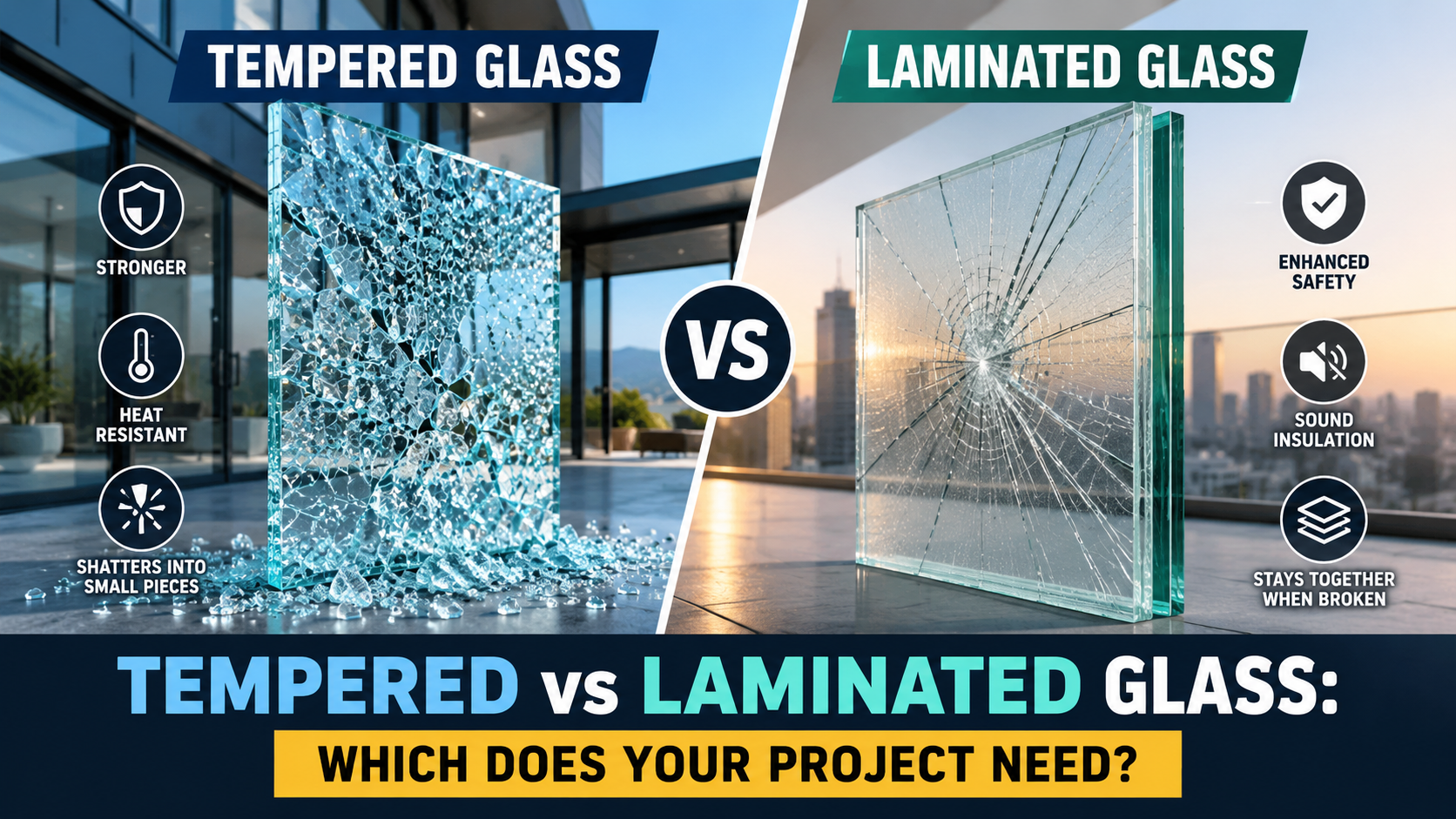


The difference between tempered and laminated glass becomes most important after breakage. Tempered glass receives controlled heat treatment and generally breaks into many smaller particles instead of large sharp shards. Laminated glass bonds two or more panes around an interlayer, allowing broken fragments to remain attached rather than falling freely from the opening. Both can qualify as safety glazing in appropriate constructions, but they control risk in different ways.
Choosing between tempered vs laminated glass requires evaluating the location, panel size, support system, post-breakage behavior, security, sound control and applicable project requirements. Tempered glass is widely used for shower enclosures, doors, storefronts and interior partitions, while laminated glass is often selected where the opening should remain covered after impact or where additional security and acoustic performance are important.
How Tempered Glass Is Manufactured
Tempered glass begins as annealed glass that is cut, edged, drilled and notched to its finished dimensions. It is then heated and rapidly cooled under controlled conditions. This process creates compressive stress at the surfaces and tensile stress within the glass, increasing resistance to impact and temperature differences compared with ordinary annealed glass.
All fabrication must be completed before tempering because the finished panel cannot be safely cut, drilled or reshaped. Daltex’s glass fabrication capabilities include cutting, edgework, drilling, notching and tempering based on confirmed drawings, templates or cut lists.
How Laminated Glass Is Manufactured
Laminated glass uses two or more panes bonded together with a clear or tinted interlayer. The assembly is processed under heat and pressure so that the glass and interlayer form a single unit. When the glass breaks, the fragments tend to remain attached to the interlayer, allowing the panel to continue covering the opening.
Laminated glass can use annealed, heat-strengthened or tempered components depending on the required application. The pane thicknesses, interlayer type and overall make-up influence strength, fragment retention, security and acoustic performance. Laminated glass should therefore be specified as a complete construction rather than only by total thickness.
Breakage Pattern and Post-Breakage Behavior
Tempered glass is designed to break into relatively small particles. This reduces the risk associated with large sharp shards, but the entire panel normally loses its integrity and falls from the opening. The area may need immediate protection or board-up until new glass is manufactured and installed.
Laminated glass behaves differently because its interlayer retains much of the broken material. The panel may crack extensively while remaining inside the frame. This retention can be valuable for guards, overhead glazing, security applications and other locations where maintaining a temporary barrier after breakage is important.
Strength and Impact Resistance
Tempered glass is stronger than annealed glass of the same thickness under many impact and thermal conditions. This makes it useful for large doors, shower panels, storefronts and other applications that experience regular movement or temperature changes. Its strength does not mean it is unbreakable, and damage to an exposed edge can still cause sudden failure.
Laminated glass strength depends on its individual panes and interlayer. An annealed laminated panel may provide strong fragment retention without offering the same impact resistance as monolithic tempered glass. Laminated tempered glass can combine greater pre-breakage strength with post-breakage retention when both properties are required.
Safety After Breakage
Tempered glass manages safety by changing the size and shape of the fragments. Laminated glass manages safety by retaining broken fragments and limiting the open area. The better option depends on what must happen after impact, not simply which product appears stronger before it breaks.
For an interior door, shower enclosure or ground-level panel where smaller fragments are a priority, tempered glass may be suitable. For a guard protecting an elevated edge, an overhead panel or a security opening, maintaining a barrier may be more important. Final selection should follow the project design and applicable requirements.
Storefronts and Commercial Entrances
Tempered glass is commonly used in ground-level commercial doors and storefront panels because these openings require safety glazing and clear visibility. It can accommodate large sizes and regular door movement when properly supported. If the panel breaks, however, the opening generally becomes exposed and may require temporary board-up.
Laminated glass may be selected within storefront systems when security, sound reduction or glass retention is important. Insulated storefront units can also use tempered or laminated panes as part of a larger glass make-up. The frame, edge clearance and glazing materials must be compatible with the selected construction.
Shower Enclosures
Frameless shower doors and panels commonly use tempered glass because the material offers strength, clear visibility and a safer breakage pattern than annealed glass. Hinges, clamps, handles and support hardware must be coordinated before fabrication because holes and notches cannot be added after tempering.
Custom shower enclosures may use different glass thicknesses according to panel size, hardware and support conditions. Laminated glass is less common in standard frameless showers because exposed laminated edges and moisture compatibility require careful detailing. The enclosure design should determine the correct glass rather than assuming that one thickness suits every opening.
Glass Railings and Guards
Railing and guard glass performs a structural safety function, so post-breakage behavior is especially important. Monolithic tempered glass can lose the entire barrier when it breaks. Laminated glass keeps fragments connected to the interlayer, and laminated tempered configurations combine heat-treated panes with fragment retention.
Daltex’s glass railings page explains that guard requirements vary according to jurisdiction, building use and the protected drop. The glass make-up, base shoe, clamps, standoffs, cap rail and structural substrate should be evaluated as a complete guard system.
Office Partitions and Interior Doors
Tempered glass is widely used for frameless office walls and interior all-glass doors because it supports large clear panels and pre-fabricated hardware cutouts. When privacy or branding is needed, film, etching or other treatments can be coordinated with the tempered panels.
Laminated glass can be beneficial for office rooms requiring improved sound control or retained fragments after breakage. Double-glazed office partitions may combine laminated panes, wider cavities and perimeter seals for stronger acoustic separation. Door gaps, ceiling construction and surrounding walls also affect actual sound performance.
Security and Forced-Entry Resistance
Standard tempered glass can resist greater impact than basic annealed glass, but once it breaks, the opening is generally exposed. Laminated glass continues to hold fragments within the interlayer, making it more difficult to create an immediate clear opening. Thicker or multiple interlayers can provide additional resistance when specifically designed for security.
Laminated glass should not automatically be described as bullet-resistant, hurricane-resistant or forced-entry rated without tested documentation for the complete make-up and framing system. Security performance depends on the glass construction, interlayer, frame engagement, anchors and installation rather than the word laminated alone.
Sound-Control Performance
Laminated glass can improve acoustic performance because the interlayer helps dampen vibration. Different pane thicknesses and specialized acoustic interlayers may provide additional sound reduction when included in a tested assembly. This can be valuable for offices, hotels, roadside buildings, studios and properties near airports.
Tempered glass does not provide the same damping effect simply because it has been heat-treated. Acoustic performance depends more on thickness, asymmetry, lamination, cavity design and perimeter sealing. Projects with a specific sound target should use product data and complete-system testing rather than relying on general descriptions.
Thermal and Insulated Glass Applications
Tempered and laminated glass can both be incorporated into insulated glass units. A commercial exterior unit may use a tempered outer pane, Low-E coating, sealed cavity and laminated inner pane according to safety, solar and acoustic requirements. The unit must be manufactured with the correct coating position, spacer and edge-seal compatibility.
The glass choice alone does not determine thermal performance. Low-E coatings, cavity width, gas fill, spacer and frame have a greater direct influence on heat transfer. Tempering primarily changes strength and breakage behavior, while laminating primarily adds fragment retention and can support security or acoustic objectives.
Fabrication and Installation Considerations
Tempered panels must be completely fabricated before heat treatment. Hole positions, notches, edgework and corner details should be dimensioned from clearly identified reference edges. A missing or misplaced cutout usually requires the panel to be remade because field modification is not a safe option.
Laminated glass also requires accurate fabrication and compatible handling. Exposed edges should be protected from incompatible sealants, prolonged moisture and physical damage. Panel weight, interlayer behavior and frame bite should be included in the installation plan, particularly for large or structural applications.
Cost and Lead-Time Differences
The price difference between tempered and laminated glass depends on thickness, size, processing, interlayer, heat treatment and quantity. Standard tempered panels may be more readily available for common doors and shower applications. Custom laminated or laminated tempered configurations can require additional manufacturing steps and longer production times.
Cost should be evaluated against the performance the project requires. Selecting tempered glass solely because it is less expensive may be unsuitable where post-breakage retention is essential. Selecting laminated glass for every opening can add cost and weight without providing a necessary benefit.
Selecting the Appropriate Glass
Begin with the application, location and required post-breakage behavior. Determine whether the opening needs a safer fragmentation pattern, continued retention, enhanced security, improved sound control or a combination of these properties. Panel dimensions, edge exposure, hardware and frame support should then be reviewed.
The final specification may use tempered glass, laminated glass or laminated tempered glass. Architects, engineers, contractors and glass professionals should coordinate the complete assembly before fabrication. Applicable building requirements and tested product information should take priority over general product preferences.
Frequently Asked Questions
1. Which is stronger, tempered or laminated glass?
Tempered glass is generally stronger than basic annealed glass of the same thickness under many impact and thermal conditions. Laminated glass strength varies according to the individual panes and interlayer used in its construction. Laminated tempered glass can combine heat-treated strength with the retention provided by an interlayer.
2. Which is safer, tempered or laminated glass?
Both products can provide safety benefits, but they manage breakage differently. Tempered glass breaks into smaller particles, while laminated glass holds broken fragments together and continues covering the opening. The safer option depends on the location and whether fragment size or post-breakage retention is more important.
3. Can laminated glass also be tempered?
Laminated glass can be manufactured from tempered panes. This configuration provides the strength and breakage characteristics of heat-treated glass while allowing the interlayer to retain fragments. The complete make-up must be designed and fabricated for the intended application.
4. Can tempered or laminated glass be cut after manufacturing?
Tempered glass cannot be safely cut, drilled or notched after heat treatment. Finished laminated glass is also not normally modified at the jobsite because cutting can damage the edges, interlayer and dimensional accuracy. All measurements and fabrication details should be confirmed before production.
5. Which glass is better for reducing noise?
Laminated glass generally offers better sound-damping potential because its interlayer helps reduce vibration. Acoustic performance still depends on pane thickness, interlayer, cavity, frame and perimeter seals. A tested laminated or insulated configuration should be selected when a project has a defined sound-control target.
6. Which glass should be used for storefronts, showers and railings?
Tempered glass is commonly used for storefront doors, shower enclosures and many interior applications because of its strength and safer fragmentation. Railings and security openings may require laminated or laminated tempered glass so the panel remains a barrier after breakage. The final choice must follow the complete system design and applicable project requirements.
Final Takeaway
The tempered vs laminated glass decision depends on the behavior required before and after breakage. Tempered glass offers increased strength and breaks into smaller particles, while laminated glass retains fragments and can provide added security and acoustic performance. Some projects benefit from laminated tempered glass because it combines both properties. The glass, frame, hardware and installation method should always be specified as one coordinated system.


