

90-Degree Corner Sliding Shower Kits: How They Work
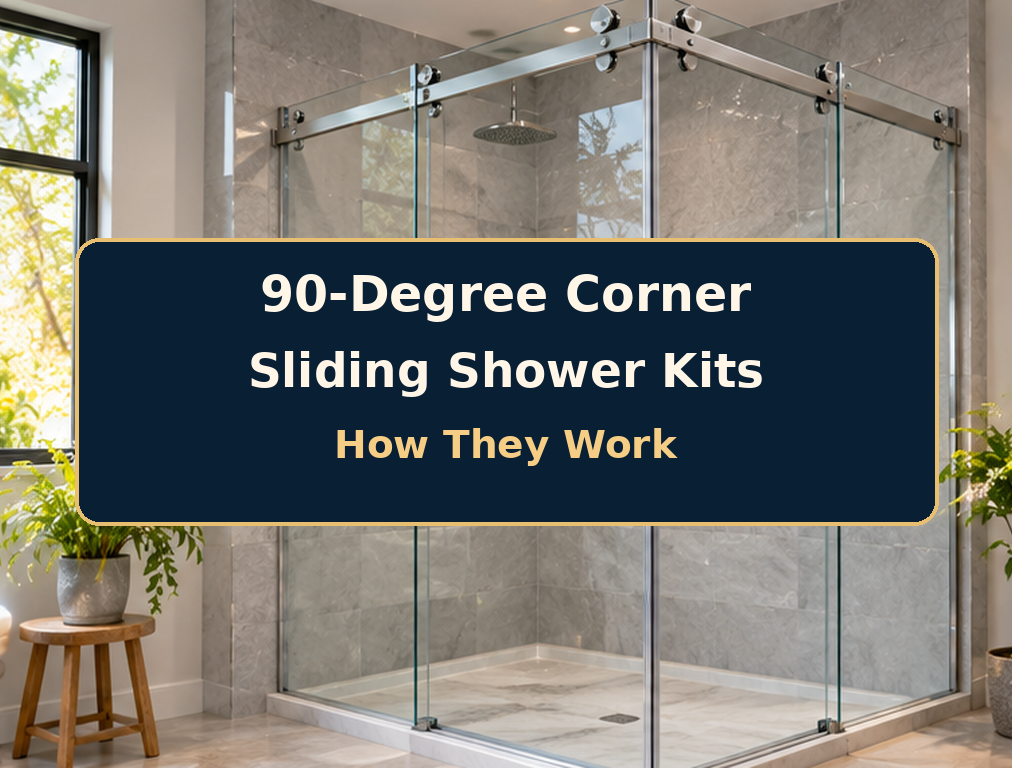


A 90-degree corner sliding shower door kit allows a sliding enclosure to turn at a right angle instead of running between two walls in a straight line. The main opening normally contains the sliding door and fixed inline panel, while a second stationary panel forms the perpendicular return side. This creates an L-shaped frameless enclosure that can fit corner showers where a traditional inline system would leave one side open.
The 90-degree accessory does not cause the door itself to travel around a corner. The sliding panel continues moving along a straight header, while the adapter connects or stabilizes the header at the return-panel junction. Understanding this distinction is important because the moving panel, inline fixed glass, return panel, curb, and supporting hardware require separate dimensions and fabrication details.
Main Components of a Corner Sliding Enclosure
| Component | Main Function |
|---|---|
| Sliding glass panel | Opens and closes along the inline header |
| Inline fixed panel | Provides overlap and supports the main layout |
| Return glass panel | Forms the 90-degree side of the enclosure |
| Header track | Controls the straight sliding path |
| 90-degree adapter | Connects the header at the return-panel area |
| Corner bracket | Supports the glass or hardware junction when required |
| Bottom guide | Controls lateral door movement |
| Stops and seals | Control travel and help manage water |
How the Denali 90-Degree Accessory Works
The Denali accessory is identified as item DEN90 and allows a compatible Denali 180-degree sliding system to be used with a perpendicular return panel. The fitting creates the required transition between the inline header and the glass forming the side of the enclosure. It is also listed for use with compatible Compass sliding systems, although every component must be matched to the selected series.
The accessory is available in Brushed Bronze, Brushed Stainless, Matte Black, Polished Stainless, and Satin Brass. Matching the adapter with the header, rollers, brackets, handles, and other visible hardware helps maintain a consistent finish. Similar finish names from unrelated product lines may still show differences in tone or sheen.
The Accessory Kit Is Not a Complete Shower System
A 90-degree accessory kit should not be confused with a complete corner shower enclosure. The base Denali system provides the header, rollers, guides, stops, and other primary components for the inline sliding door. The return panel, glass preparation, corner support, fixed-panel hardware, handles, seals, and installation-specific fasteners must also be identified.
The standard Denali DEN90 adapter is associated with the 3/8-inch Denali system, while the Grande Denali collection uses separate components for 1/2-inch glass. Parts should not be mixed only because their shapes appear similar. Product numbers and current technical instructions should control the final selection.
Planning the 90-Degree Layout
The first step is confirming which side will contain the sliding entrance and which side will form the stationary return. The showerhead, controls, vanity, toilet, room entrance, and available floor space should all influence this decision. The Denali system has a reversible sliding and fixed-panel arrangement, but orientation must be finalized before glass fabrication.
The return panel should normally meet the inline panel and curb at a true right angle. Walls and curbs are not always square, so measurements must be taken at several heights and positions after tile installation is complete. A difference of even a small amount can affect the corner gap, adapter alignment, glass size, and final seal placement.
Glass Requirements
The standard Denali sliding system is designed for compatible tempered safety glass prepared according to the current fabrication templates. Roller holes, fixed-panel standoff holes, handle preparation, and return-panel hardware openings must be included before tempering. Finished tempered glass cannot be drilled, trimmed, or notched during installation.
The return panel must also be sized for the adapter, curb, wall attachment, and any required clamps or U-channel. Its thickness must match the approved system rather than being selected independently. Daltex’s guide to choosing a sliding kit explains how glass thickness, dimensions, weight, and hardware compatibility affect the complete enclosure.
Structural Support and Header Alignment
The header carries and guides the sliding panel, which makes accurate support at both ends essential. In a corner enclosure, one end may connect to a wall while the other is coordinated with the return glass and 90-degree adapter. The return panel must be adequately secured so that normal door movement does not cause the header or glass junction to shift.
Depending on the exact layout, an additional 90-degree corner bracket or fixed-panel support may be required. The adapter alone should not be assumed to provide every structural connection needed for the project. Wall backing, curb construction, waterproofing, panel dimensions, and manufacturer instructions should determine the final supporting hardware.
Entrance Clearance and Door Travel
A corner layout can create a generous enclosure without requiring a swinging door to occupy bathroom floor space. However, the clear entrance remains smaller than the total inline opening because the fixed and sliding panels overlap. The handle, guide, stopper, and return-panel position must not interfere with the moving door’s complete travel.
The door should open far enough for comfortable entry while maintaining the minimum required glass overlap when closed. Moving the stoppers to increase the opening can change the way the panel meets the seals or hardware. Door travel should be calculated during planning rather than adjusted by trial after installation.
Water Management
A frameless corner shower manages normal splashing through panel overlap, seals, thresholds, curb slope, and showerhead placement. It does not function as a completely watertight container, so the direction of water spray should be considered when choosing the entrance side. Directing the showerhead toward an open door edge can increase water escape even when the hardware is correctly installed.
The joint between the inline and return panels requires particular attention. Glass gaps, adapter placement, seals, and silicone joints must follow the approved design without blocking drainage paths. A seal should not be used to disguise glass that is incorrectly sized or installed out of alignment.
Professional Installation Requirements
Installation begins with confirming the finished opening, exact corner angle, glass thickness, approved templates, adapter position, and all required supporting components. The header must remain level while the return panel stays plumb and square to the inline system. If either panel is misaligned, the sliding door may rub, drift, or fail to meet the jamb consistently.
Large glass panels require rated lifting equipment and suitable installation tools. The complete enclosure should be assembled and tested before final sealing, with attention to door travel, stopper engagement, guide position, panel gaps, header support, and water direction. Professional installation is strongly recommended for multi-panel corner systems.
Is a Corner Sliding Kit Right for Your Bathroom?
A corner sliding shower door kit is a strong choice when the shower occupies a corner, requires a return panel, and lacks sufficient space for a swinging door. It can create a clean frameless enclosure while preserving bathroom floor clearance. The design works best when both walls, the curb, and the return-panel position can support accurate measurement and structural attachment.
The system may be less suitable when the corner is significantly out of square, the curb is too narrow for the required hardware, or the return panel cannot be supported appropriately. Daltex’s custom enclosures service can coordinate the inline glass, return panel, adapter, brackets, seals, and fabrication. Planning the entire system together helps prevent incompatible glass and incomplete hardware orders.
Frequently Asked Questions
What is a 90-degree corner sliding shower kit?
It is a hardware arrangement that combines a straight sliding door system with a perpendicular fixed return panel. The moving door continues sliding along a straight header. The 90-degree accessory connects or supports the header near the return glass.
Does the sliding door turn around the corner?
The door does not travel around the 90-degree corner. It moves in a straight line beside the inline fixed panel. The return panel remains stationary and forms the side of the enclosure.
Is the Denali 90-degree accessory a complete kit?
DEN90 is an accessory for a compatible Denali sliding system rather than a complete glass enclosure. The base sliding kit, return glass, supporting hardware, seals, and installation components are also required. Confirm the complete parts list before ordering.
What glass thickness works with the standard DEN90 accessory?
The standard DEN90 component is associated with the 3/8-inch Denali system. Grande Denali applications for 1/2-inch glass use separate compatible components. Product numbers should be checked before glass fabrication.
Can a 90-degree adapter correct an out-of-square corner?
The adapter cannot correct walls, curbs, or glass that are substantially out of square. Actual angles and dimensions must be measured after the finished surfaces are complete. Custom glass deductions may be required for minor site variation.
Can the return panel support the sliding header?
The return panel may contribute to the header connection when the complete system is designed for that configuration. It must be properly sized, fabricated, and secured with approved hardware. The adapter should not be treated as the only structural support unless the manufacturer’s instructions allow it.


