

Blog
Argon vs Air-Filled IGUs: Which Is Better?

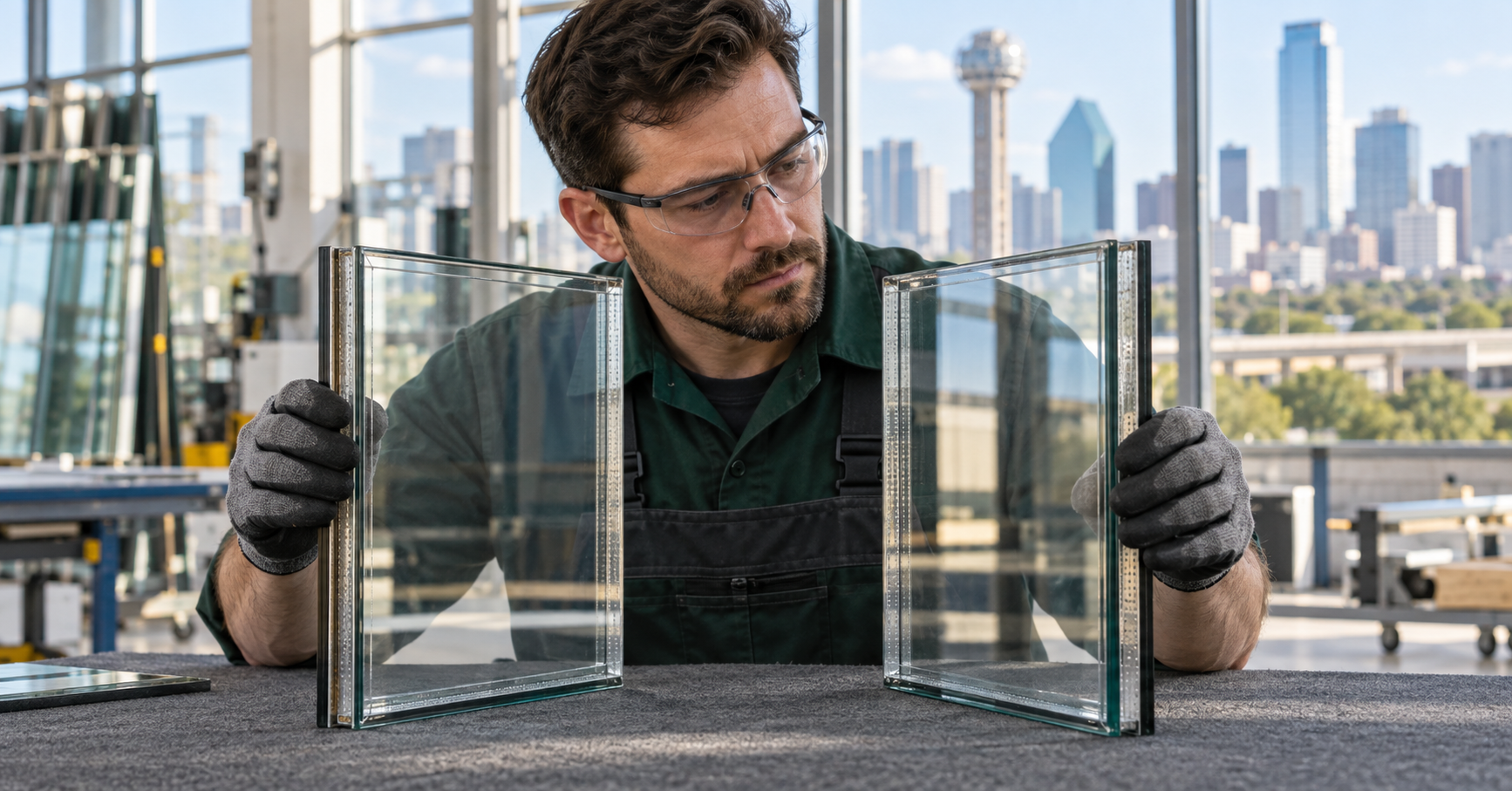


When comparing argon vs air-filled IGUs, argon-filled units generally provide better thermal insulation because argon transfers heat less readily than air. Air-filled units usually cost less and still perform better than basic single-pane glass, but they do not reduce heat transfer as effectively as a properly manufactured argon-filled unit.
For exterior windows in air-conditioned Texas buildings, argon is often the stronger performance choice. However, gas fill is only one part of the specification. Glass coatings, cavity width, spacer design, frame construction, window orientation and installation quality also affect the finished window.
Quick Comparison: Argon vs Air-Filled IGUs
| Feature | Argon-filled IGU | Air-filled IGU |
|---|---|---|
| Thermal insulation | Better | Standard |
| Heat transfer | Lower | Higher |
| Initial cost | Usually higher | Usually lower |
| Appearance | Clear and invisible | Clear and invisible |
| Safety | Non-toxic and odorless | Safe |
| Solar-heat control | Depends mainly on the glass coating | Depends mainly on the glass coating |
| Gas loss | Can occur gradually | Not applicable in the same way |
| Best use | Exterior and performance-focused glazing | Cost-sensitive or lower-performance applications |
| Texas suitability | Often preferred for conditioned buildings | May suit shaded or less demanding openings |
Argon is usually the better choice when thermal performance is a priority. Air may remain suitable when the project has modest energy requirements or when initial material cost is the main consideration.
What Is an Air-Filled IGU?
An air-filled insulated glass unit contains two or more panes separated by a spacer. The sealed cavity between the panes contains dry air.
The trapped air slows heat transfer compared with a single pane of glass. This is why even a basic double-pane unit can provide better insulation than ordinary single glazing.
The spacer maintains the correct distance between the panes, while perimeter seals restrict moisture and air movement. A desiccant within the spacer system may absorb small amounts of residual moisture from the cavity.
The complete insulated glass unit includes the glass panes, spacer, sealed cavity, desiccant and perimeter seals. Its performance depends on all these components working together.
What Is an Argon-Filled IGU?
An argon-filled IGU has the same basic construction as an air-filled unit, but the cavity is filled with argon during manufacturing.
Argon is a clear, odorless and non-toxic gas. It is denser than air and reduces conductive and convective heat transfer within the space between the panes.
The gas does not change the colour or transparency of the window. A person normally cannot identify an argon-filled unit simply by looking through the glass.
According to the NFRC Consumer Guide, filling the cavity with argon or krypton can improve efficiency because these gases reduce heat transfer more effectively than air. NFRC describes argon as a popular and comparatively affordable gas-fill option.
Why Does Argon Insulate Better Than Air?
Heat can move through an insulated glass unit in several ways:
- Conduction through the glass, spacer and cavity.
- Convection as gas circulates within the cavity.
- Radiation between the glass surfaces.
- Heat transfer through the surrounding frame.
Argon helps reduce conduction and convection inside the cavity. Because it transfers heat less readily than air, less heat moves from one pane to the other.
In summer, this can help reduce the movement of outdoor heat toward the conditioned interior. During colder weather, it can help slow the movement of indoor heat toward the exterior.
Argon does not eliminate heat transfer, and it does not perform every function within the window. The glass coating, spacer and frame remain important.
Does Argon Control Solar Heat?
Argon primarily reduces conductive and convective heat transfer. It is not a substitute for a solar-control coating.
Solar heat passes through glass as radiation. A Low-E coating is designed to manage this radiant energy. This distinction is particularly important in Texas, where strong sunlight can create substantial cooling demand.
Argon and Low-E can be used together because they perform different functions:
- Argon improves the insulation of the sealed cavity.
- Low-E coating controls radiant heat transfer.
- A suitable spacer reduces heat transfer around the glass edge.
- A thermally efficient frame supports whole-window performance.
The guide to Low-E glass options explains why coating type, Solar Heat Gain Coefficient and visible-light transmission must be considered separately from gas fill.
Is Argon Worth It in Texas?
Argon can be worthwhile in Texas, especially for exterior windows in conditioned homes and commercial buildings.
Texas buildings often experience long cooling seasons, intense sunlight and substantial temperature differences between indoor and outdoor environments. Argon can improve thermal performance by reducing heat transfer across the sealed cavity.
It may be particularly useful for:
- Large exterior windows.
- Air-conditioned offices and retail spaces.
- Multifamily and residential properties.
- West-facing and south-facing openings.
- Commercial façades.
- Replacement projects upgrading older glass.
- Windows using Low-E coatings.
- Projects with defined U-factor requirements.
However, argon alone will not solve excessive solar heat gain. For a strongly exposed window, the appropriate Low-E coating and Solar Heat Gain Coefficient may have a greater effect on cooling performance.
Daltex Glass supplies commercial window systems with glass, cavity, coating and frame specifications selected according to the opening and project requirements.
When Can an Air-Filled IGU Be Suitable?
An air-filled IGU may be appropriate when:
- The opening receives limited direct sunlight.
- The required U-factor can be achieved without gas fill.
- Initial material cost is a major concern.
- The glass is used in a less demanding application.
- The surrounding space is not continuously conditioned.
- Existing adjacent units must be matched.
- The project specification calls for an air-filled cavity.
- The complete window system already meets the required performance.
Air-filled glass should not automatically be considered low quality. Manufacturing accuracy, seal durability, spacer construction and installation remain important regardless of the gas inside the cavity.
A properly fabricated air-filled unit may perform more reliably than a poorly manufactured or incorrectly installed argon-filled unit.
How Much More Efficient Is Argon?
The exact improvement cannot be represented by one percentage for every insulated glass unit.
Performance depends on:
- The width of the sealed cavity.
- The initial concentration of argon.
- The number of panes.
- Glass thickness.
- Low-E coating.
- Spacer material.
- Frame construction.
- Unit size and shape.
- Overall fabrication quality.
- Installation conditions.
A performance comparison should use the published U-factor for the complete window or the specified centre-of-glass value when evaluating the glass separately.
A lower U-factor indicates less heat transfer. Contractors and property owners should avoid comparing windows based only on descriptions such as “double-pane” or “argon-filled.”
Why Does Cavity Width Matter?
The distance between the panes affects how both air and argon perform.
If the cavity is too narrow, it may not provide the intended insulating benefit. If it is excessively wide, convection can increase within the cavity and reduce performance.
The ideal cavity width depends on the selected gas, glass configuration, spacer and project requirements. It should be established during design and manufacturing rather than changed on the jobsite.
Daltex provides glass fabrication services for commercial and residential projects. Insulated units can be manufactured according to confirmed dimensions, glass make-up, coating, spacer and cavity requirements.
Does Argon Leak Out Over Time?
A small amount of gas may gradually move through the perimeter seal over the service life of an insulated glass unit.
NFRC states that an efficient window may lose approximately 0.5 percent of its gas fill per year. At that rate, a window could retain around 90 percent of its original performance after 20 years.
Gradual gas loss does not mean the window suddenly stops working. The change in thermal performance is usually progressive.
Significant gas loss may occur more quickly if:
- The perimeter seal is damaged.
- The unit was manufactured incorrectly.
- The glass edge is exposed to prolonged moisture.
- The frame places uneven stress on the unit.
- The installation does not allow proper drainage.
- Impact or building movement damages the glass or seal.
Can You Tell When Argon Has Escaped?
Argon is clear and odorless, so gas loss usually cannot be identified by appearance alone. Specialised equipment may be required to measure the gas concentration inside an installed unit.
Fogging, haze or droplets between the panes indicate a more serious problem. These symptoms normally mean moisture has entered the sealed cavity because the perimeter seal is no longer performing correctly.
The article covering seal failure signs explains why condensation trapped between the panes cannot be removed by cleaning the accessible glass surfaces.
Is Argon Gas Safe?
Argon used in insulated glass is non-toxic, clear and odorless. If a small amount escapes from a window, it disperses into the surrounding air and does not normally create a health concern.
Argon is naturally present in the atmosphere. The amount contained within a window cavity is limited, and the gas is not flammable.
Its purpose inside an IGU is thermal performance, not structural support or fire protection.
Does Argon Improve Sound Insulation?
Argon-filled units are primarily specified for thermal performance. Argon should not be selected as the main solution for a sound-control problem.
Acoustic performance depends more heavily on:
- Glass thickness.
- Different pane thicknesses.
- Laminated glass.
- Cavity depth.
- Frame and seal condition.
- Installation quality.
- The frequency of the exterior noise.
A project with specific acoustic targets should use an assembly designed and tested for sound reduction rather than assuming that argon alone will provide a major improvement.
Does Argon Extend the Life of an IGU?
Argon does not automatically make an insulated glass unit last longer.
IGU lifespan depends mainly on:
- Perimeter seal durability.
- Manufacturing quality.
- Spacer construction.
- Protection from moisture.
- Frame condition.
- Correct setting blocks.
- Drainage.
- Installation quality.
- Environmental exposure.
An argon-filled unit can perform for many years when the seals remain intact. An air-filled unit can also provide a long service life under suitable conditions.
Gas type affects thermal performance, while seal and installation quality have a greater influence on durability.
Can an Existing Air-Filled IGU Be Upgraded With Argon?
Argon generally cannot be added to an existing sealed unit as a practical field upgrade.
An IGU is assembled, filled and sealed during manufacturing. Opening the unit to add gas would compromise the original sealed construction.
Upgrading usually requires a new insulated glass unit manufactured with the required gas fill, cavity width, coating and overall thickness. The existing frame must be inspected to confirm that it can accept the replacement unit.
Argon vs Air-Filled IGUs: Cost Considerations
Argon-filled IGUs usually cost more than comparable air-filled units because gas filling adds material, production and quality-control requirements.
The additional cost varies according to:
- Unit dimensions.
- Glass thickness.
- Number of panes.
- Low-E coating.
- Spacer type.
- Safety-glazing requirements.
- Tempered or laminated components.
- Order quantity.
- Delivery and installation requirements.
The lowest initial price is not always the lowest long-term cost. Contractors and building owners should compare the required performance, expected building use and complete window specification before deciding.
Questions to Ask Before Choosing a Gas Fill
Before ordering an insulated glass unit, confirm:
- Will the unit be installed in an exterior or interior opening?
- Is the space continuously heated or cooled?
- What U-factor is required?
- What Solar Heat Gain Coefficient is required?
- Which direction does the window face?
- How much direct sunlight reaches the opening?
- Is a Low-E coating required?
- What cavity width is available?
- Can the existing frame accept the required unit thickness?
- Must the new glass match adjacent windows?
- Does the project require tempered or laminated glass?
- Is the order supply-only or does it include installation?
These details help determine whether argon provides meaningful value for the specific opening.
Frequently Asked Questions
Are all insulated glass units filled with argon?
No. Some units contain dry air, while others use argon, krypton or a combination of gases. The correct option depends on the required performance and glass design.
Is argon better than air in double-pane windows?
Argon generally provides better thermal insulation because it reduces heat transfer more effectively than air. The total improvement depends on the complete window construction.
Can you see argon inside a window?
No. Argon is clear, colourless and odorless. An argon-filled window should not look different from a comparable air-filled unit.
Does argon gas prevent window condensation?
Argon can help keep the interior glass surface closer to the indoor temperature, which may reduce certain surface-condensation conditions. It cannot prevent condensation caused by excessive indoor humidity, and it cannot prevent internal fogging after seal failure.
Is argon still effective in hot climates?
Yes. Argon reduces heat transfer in both directions, so it can support thermal performance in hot climates. Texas windows should also be evaluated for solar heat gain and Low-E coating performance.
What happens if argon leaks from a window?
Gradual gas loss causes a gradual reduction in insulating performance. It is not normally a safety concern. Visible fogging suggests that moisture has entered through a failed seal and the unit may require replacement.
Can argon and Low-E glass be used together?
Yes. They are commonly combined because argon reduces conduction and convection within the cavity, while Low-E glass manages radiant heat transfer.
Which option is better for commercial buildings?
Argon is often suitable for conditioned commercial buildings with exterior glazing and defined energy requirements. Air-filled units may remain appropriate for less demanding or cost-sensitive applications.
Final Takeaway
Argon-filled IGUs generally provide better thermal insulation than air-filled units because argon reduces conductive and convective heat transfer within the sealed cavity.
Air-filled IGUs remain a practical option for projects with moderate performance requirements or tighter initial budgets. However, exterior windows in air-conditioned Texas buildings may benefit from the improved insulation provided by argon.
The final decision should not be based on gas fill alone. Cavity width, Low-E coating, spacer design, glass type, frame performance and installation quality must be evaluated together to create an effective insulated glass system.


