Sliding Shower Door Rollers: 6 Signs They Need Replacing


Sliding shower door rollers carry or guide a moving glass panel every time the enclosure is used. When they are in good condition, the door should travel quietly, remain level and move with consistent resistance from one end of the track to the other. When the wheels, bearings or mounting components begin to wear, the door may become noisy, unstable or difficult to operate long before the roller completely fails.
Roller problems should be addressed early because a malfunction can affect more than convenience. Uneven movement can place additional pressure on the track, bottom guide, stops, glass mounting holes and adjacent panels. Understanding the following six warning signs can help determine when cleaning or adjustment is still appropriate and when replacement is the safer decision.
1. The Door Drags or Requires More Force
A noticeable increase in operating force is one of the most common signs of worn sliding shower door rollers. The door may begin moving normally and then bind at a particular point, or it may feel heavy throughout its travel. Residue in the track can cause similar symptoms, so the accessible running surface should be cleaned before condemning the hardware.
If cleaning does not restore smooth movement, inspect the wheels for flat spots and the bearings for resistance. A roller that no longer rotates freely may slide across the track instead of rolling, which can damage both surfaces. Forcing the handle can also transfer unnecessary stress to the glass and mounting connections.
2. The Door Wobbles While Moving
Side-to-side movement can indicate wear inside the bearing, a loose axle, damaged mounting hardware or incorrect roller adjustment. A small amount of engineered clearance may be normal for certain systems, but the glass should not rock noticeably or change its angle as it travels. The bottom guide should also control lateral movement without pinching the panel.
Do not assume the bottom guide is the only cause of a wobbling door. The rollers, guide and track should be inspected together because movement at the top of the glass can produce a larger swing at the bottom. Daltex’s guide to common shower parts explains how these components share the work of supporting and controlling a sliding door.
3. You Hear Grinding, Clicking or Persistent Squeaking
A clean, correctly adjusted sliding door should not produce grinding or repeated clicking sounds. Noise can develop when a bearing is damaged, a wheel is cracked, debris is embedded in the roller or the assembly is contacting the track incorrectly. A squeak that disappears after cleaning may not indicate failure, but a sound that quickly returns deserves closer inspection.
Avoid applying household oil or an unapproved lubricant without checking the manufacturer’s maintenance instructions. Some products can attract residue, affect polymer wheels or stain nearby stone and tile. If the noise comes from inside a sealed bearing or damaged wheel, replacing the assembly is generally more dependable than attempting to lubricate it.
4. The Wheel Shows Cracks, Flat Spots or Corrosion
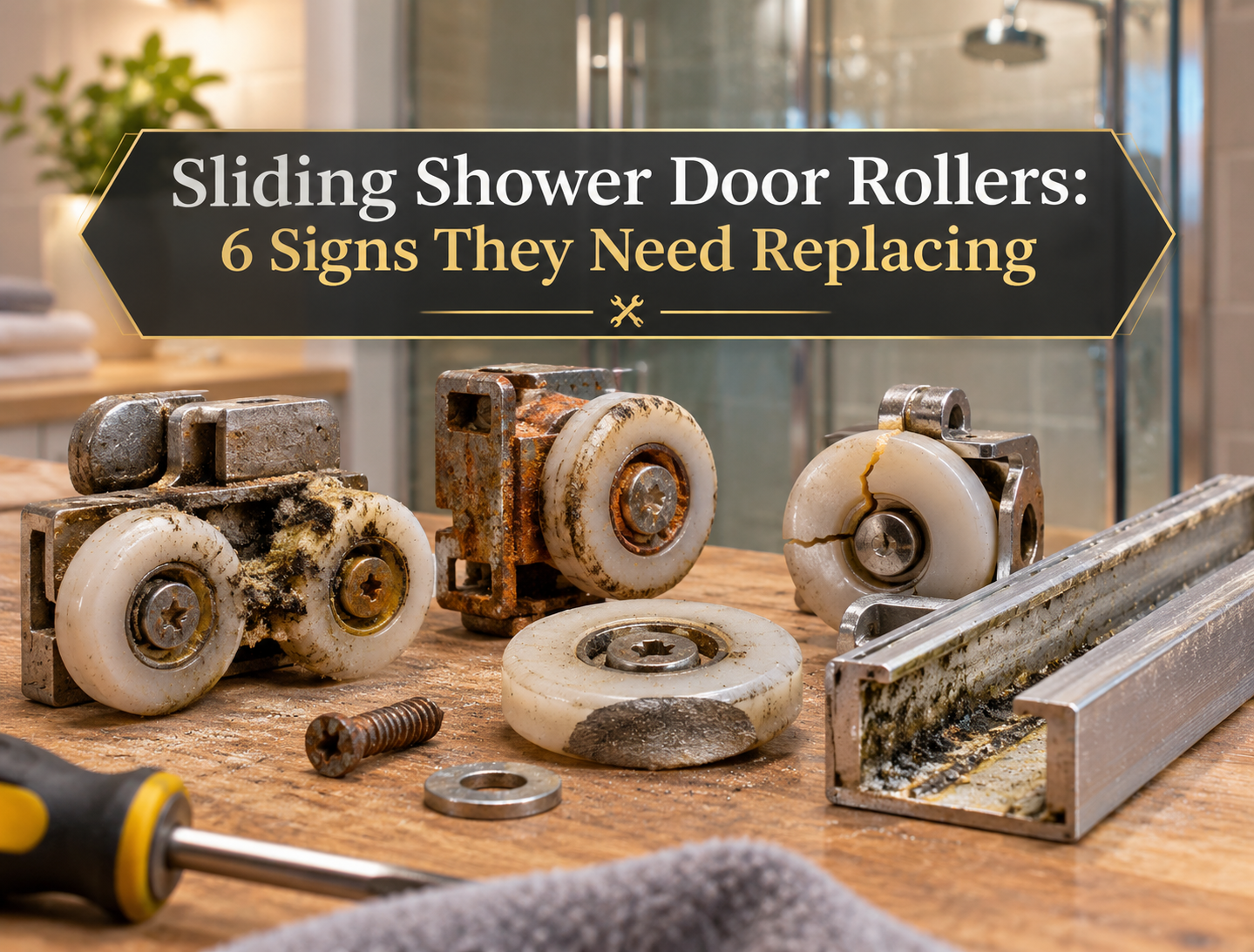
Visible damage is a strong reason to replace the roller rather than continue adjusting it. A flat-spotted wheel may cause the door to rise and fall slightly as it moves, while a cracked wheel can fail without much additional warning. Corrosion around the axle, fastener or decorative cover may indicate that moisture has reached areas that should remain stable.
Inspect both rollers even if only one appears damaged. The second roller has usually completed the same number of operating cycles and may show early wear that is not yet affecting movement. Replacement decisions should follow the manufacturer’s instructions, especially when the rollers form part of a coordinated pair.
5. The Door Will Not Stay Level After Adjustment
Roller adjustment can correct minor alignment changes, but the setting should remain stable after the fasteners are properly secured. If the door repeatedly sags, loses clearance or begins rubbing after adjustment, an internal roller component, gasket or mounting connection may be worn. Continued tightening is not an acceptable solution because excessive pressure around the glass hole can create a dangerous stress concentration.
The complete assembly should be compared with an approved replacement before removal. Daltex’s parts identification resource explains why wheel diameter alone is not enough to confirm compatibility. Track shape, mounting-hole size, glass thickness, offset and door weight must also be considered.
6. The Door Repeatedly Comes Off the Track
A door that repeatedly leaves its intended path requires immediate attention. The problem may involve a worn roller, but missing anti-jump parts, incorrectly positioned stops, a loose guide or a damaged track can produce the same result. Stop using the door until the entire sliding system has been inspected.
Replacing the rollers without examining the related safety hardware may allow the problem to continue. Confirm that the bottom guide limits sideways movement, the stops control the end of travel and all anti-jump components are present. The door should be tested through its full range only after the glass is stable and every component is correctly secured.
How to Choose Compatible Replacement Rollers
Sliding shower door rollers are system-specific components, even when products from different manufacturers appear nearly identical. A correct replacement must match the original glass thickness, mounting preparation, track geometry, door weight and adjustment method. Finish matters for appearance, but it should be considered only after technical compatibility has been confirmed.
For a Denali Series enclosure using 3/8-inch glass, the Denali door roller is designed as the corresponding replacement component. It is available in multiple finishes and sold individually, allowing a damaged roller to be replaced while maintaining the intended Denali system. Before ordering, confirm the system model and compare both existing assemblies for wear.
If the original brand or model is unknown, photograph the front, back and side of the roller and record the glass thickness, wheel diameter, mounting-hole size and track profile. Do not remove the roller until the heavy glass panel has been safely supported. A broader sliding hardware guide can help contractors and homeowners understand which measurements affect compatibility.
Replace the Rollers or Replace the Complete System?
Roller replacement is usually appropriate when the glass, track, guide, stops and mounting surfaces remain in good condition. A complete hardware replacement may be more practical when multiple components are damaged, the original system has been discontinued or the existing glass preparation will not accept a safe replacement. Damaged or incorrectly fabricated glass may also change the scope of the project.
For remodeling projects, Daltex can help plan custom enclosures around the finished opening, glass requirements and selected hardware system. This can be useful when a recurring roller problem is connected to an undersized track, excessive panel weight or an enclosure that was not properly configured.
Final Takeaway
Sliding shower door rollers should be replaced when the door drags, wobbles, becomes noisy, shows visible wheel damage, loses its adjustment or repeatedly comes off the track. Early replacement can prevent additional wear on the track, guide and glass mounting points. The new roller must be matched to the original system rather than selected by appearance alone.
Frequently Asked Questions
1. How long do sliding shower door rollers last?
There is no single replacement interval because service life depends on door weight, installation quality, frequency of use, maintenance and moisture exposure. Regular inspection is more useful than replacing rollers according to age alone.
2. Should both shower door rollers be replaced together?
Both rollers should be inspected because they normally experience similar use. Whether they must be replaced as a pair depends on the manufacturer’s instructions and the condition of the second assembly.
3. Can shower door rollers be adjusted instead of replaced?
Adjustment may correct minor alignment issues when the wheel, bearing, mounting hardware and gaskets remain in good condition. Replacement is more appropriate when the roller is damaged, unstable or unable to hold its setting.
4. Why do new shower door rollers need to match the track?
The roller profile and track geometry determine how the door carries its load and remains engaged during movement. An incorrect combination can bind, wobble or defeat anti-jump safety features.
5. Can I replace only the wheel inside the roller?
Some assemblies include serviceable wheels, while others are designed to be replaced as complete units. Follow the manufacturer’s instructions because installing an unapproved wheel can change the axle fit, load capacity and track contact.
6. Where can I buy a Denali replacement roller?
Daltex Glass offers the Denali door roller for registered customers through its online product catalog. Verify that the existing enclosure is a compatible Denali Series system before ordering the replacement.