

Choosing Shower Door Seals for 3/8-Inch and 1/2-Inch Glass
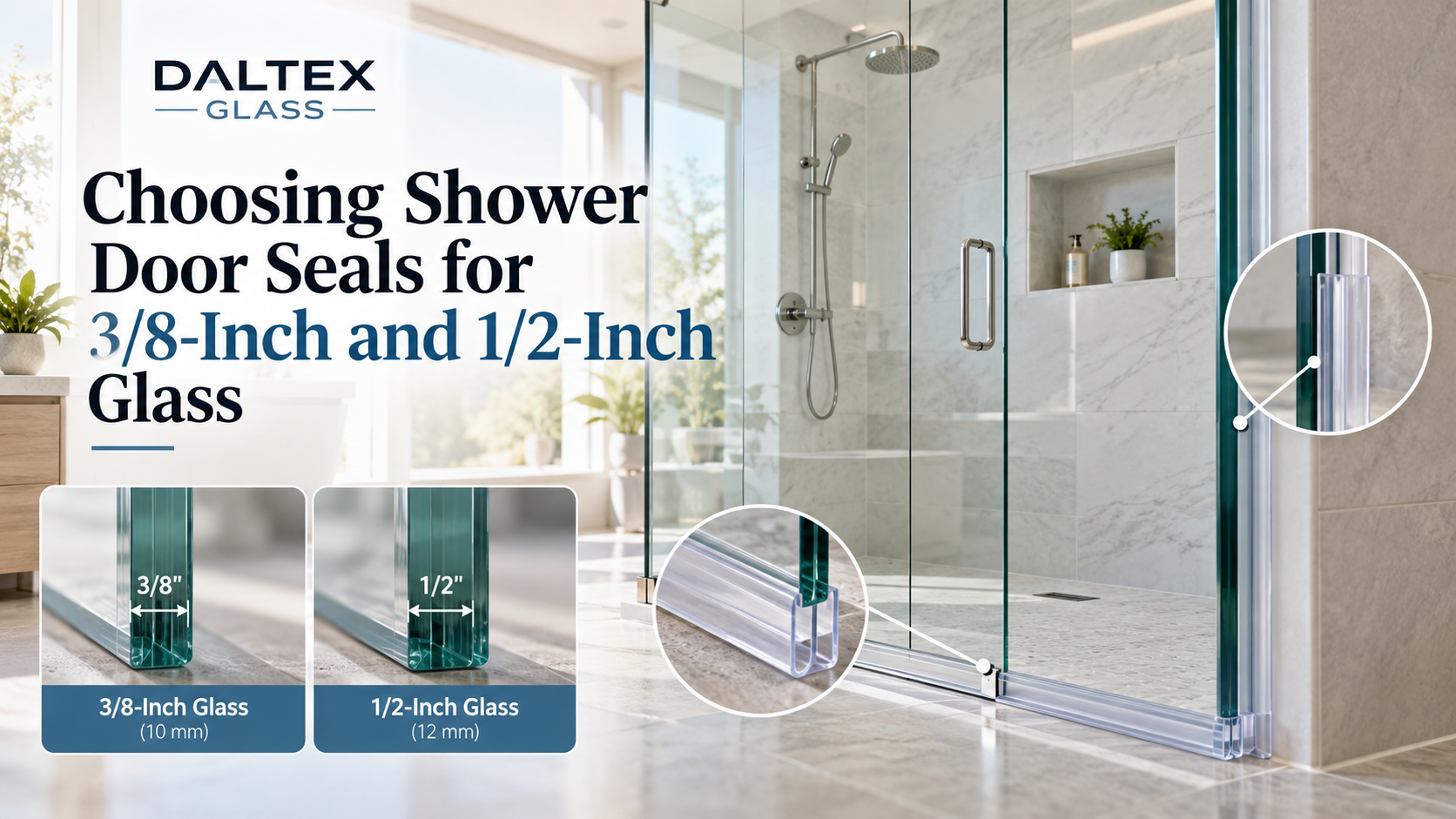


Choosing shower door seals for 3/8-inch and 1/2-inch glass begins with confirming the exact glass thickness, but thickness is only one part of the selection process. The replacement seal must also match its position on the enclosure, the width and angle of the gap, the direction in which the door moves and the way water should be redirected. A seal that fits the glass channel but uses the wrong fin or profile may still allow leaks, interfere with closing or detach during regular use.
Daltex Glass supplies shower door seals for frameless and semi-frameless enclosures, including bottom sweeps, wipes, jamb profiles, magnetic strikes and thresholds. Understanding how 3/8-inch and 1/2-inch glass systems differ can help homeowners, installers and contractors select a compatible seal without relying on appearance alone.
Why Glass Thickness Matters
Many frameless shower seals attach directly to the exposed edge of the glass with a rigid U-shaped channel. The internal width of that channel must correspond to the actual glass thickness. A seal manufactured for 3/8-inch glass may not open far enough to fit 1/2-inch glass, while a 1/2-inch channel may not grip a thinner 3/8-inch panel securely. An incorrect fit can cause the seal to slide, twist or fall away from the glass.
Glass thickness should be measured directly rather than estimated from the style or age of the enclosure. Frameless shower doors commonly use 3/8-inch or 1/2-inch tempered glass, but similar-looking enclosures may use different specifications. A caliper provides the most accurate measurement, although the edge of the glass can sometimes be measured carefully with a suitable ruler when it is fully accessible.
Shower Door Seals for 3/8-Inch Glass
Three-eighths-inch glass is widely used for frameless shower doors and fixed panels because it provides substantial rigidity without the additional weight of 1/2-inch glass. Replacement seals for this thickness are available in several profiles, including bottom wipes, drip rails, H-shaped seals, Y-shaped jambs, bulb seals and magnetic closures. The appropriate profile depends on whether the seal attaches to a moving door, stationary panel or adjoining glass edge.
A 3/8-inch bottom sweep should grip the lower edge securely while allowing the flexible fin to make light contact with the curb or threshold. Excessive contact creates drag and can place unnecessary resistance on the hinges. Insufficient contact leaves an open pathway through which water can escape, particularly when the showerhead directs water toward the door.
Shower Door Seals for 1/2-Inch Glass
Half-inch glass is heavier and is frequently selected for larger frameless panels or premium enclosures requiring additional rigidity. Seals manufactured for this thickness use a wider channel designed to fit securely over the glass edge. Forcing a smaller channel onto 1/2-inch glass can crack the vinyl, damage the seal or create excessive pressure along the glass edge.
The increased weight of a 1/2-inch door also makes smooth movement important. A bottom seal that drags heavily against the threshold can make the door difficult to operate and place additional load on hinges or sliding hardware. The fin should close the required gap without acting as a brake every time the door opens or closes.
Choosing the Correct Bottom Sweep
A bottom sweep fits along the lower edge of a swinging or sliding shower door. Its primary function is to close the space beneath the glass and redirect runoff toward the shower interior. Many designs include a flexible wiping fin and an angled drip rail that catches water running down the door surface.
The correct bottom water seal must match the glass thickness, door width and distance between the glass and curb. A sweep with a fin that is too short will not close the gap, while an oversized fin can fold, drag or prevent the door from closing naturally. The drip rail should face the shower interior so that water returns to the enclosure rather than being directed onto the bathroom floor.
Selecting Jamb and Strike Seals
Jamb seals close vertical gaps where a swinging door meets a wall, fixed panel or another door edge. H-shaped profiles may connect two inline pieces of glass, while Y-shaped or soft-fin profiles can accommodate a narrow gap between a moving door and adjacent panel. L-shaped seals and bumpers may be used where glass closes against a wall or solid surface.
The angle between the panels must be considered when choosing shower jamb seals. A 90-degree corner, 135-degree return and 180-degree inline connection require different profiles. Selecting a seal based only on glass thickness may leave the fin facing the wrong direction or prevent the door from closing correctly.
When to Use Magnetic Seals
Magnetic shower door seals are commonly used where two vertical edges meet and a positive closing action is required. Matching magnetic profiles can help align the door and reduce the open gap along the closing edge. They are available for different glass thicknesses, panel angles and opening directions, so one magnetic seal cannot be treated as a universal replacement.
The magnetic orientation must also match across both sides of the closure. Two profiles that physically fit the glass may repel one another or fail to meet properly when their magnetic arrangement is incompatible. The door should close naturally without requiring excessive force, and the magnetic strips should make consistent contact from top to bottom.
Consider the Gap Size and Door Movement
Glass thickness determines the channel size, while the surrounding gap determines the necessary fin, bulb or wipe length. Measure the distance between the bottom of the door and the curb, or between the door edge and the adjacent panel, at several points. Shower floors, curbs and walls are not always perfectly level, so the gap may vary across the opening.
Door movement must be checked before ordering. A swinging door needs clearance for the seal to travel without catching, while a sliding door requires a profile that will not interfere with the guide, track or overlapping panel. Daltex’s detailed seal selection guide explains how location, gap size and enclosure configuration influence the correct profile.
Measure the Required Seal Length
Measure the full width or height of the glass edge where the seal will be installed. Replacement seals are often supplied in standard lengths and trimmed during installation. The finished seal should cover the necessary edge without leaving an unnecessary projection that catches on a wall, curb or adjacent component.
Most vinyl and PVC seals can be cut with an appropriate fine-tooth tool. The cut should remain square and free from rough edges that could scratch nearby finishes or collect residue. The seal should be trial-fitted before final trimming because removing too much material can create a gap that cannot be corrected without purchasing another profile.
Avoid Common Selection Mistakes
One common mistake is ordering from a photograph without confirming glass thickness and gap dimensions. Another is assuming that every clear profile performs the same function. Bottom sweeps, jamb seals, strike seals and magnetic profiles may look similar online, but their channels, fins and angles are designed for different positions.
A replacement seal should not be used to compensate for a door that is severely misaligned or sagging. If the gap has changed because the hinges, rollers or fixed panels have moved, installing a larger seal may hide the problem temporarily without correcting its cause. The enclosure should be inspected and adjusted before the final replacement seal is selected.
Coordinating Seals With the Complete Enclosure
Shower seals work best when the glass, hardware, curb and drainage conditions have been planned as one system. Hinges must hold a swinging door in the correct closing position, while sliding rollers and guides must keep the panels aligned. The curb or shower base should direct water inward so that the seal is not expected to contain continuous standing water by itself.
For a new or extensively modified enclosure, professional shower enclosure services can coordinate glass thickness, hardware, panel clearances and seal profiles before fabrication. This is particularly important because tempered glass cannot be recut or drilled after production.
Frequently Asked Questions
Can a 3/8-inch seal fit 1/2-inch glass?
A seal designed specifically for 3/8-inch glass should not be forced onto 1/2-inch glass. The narrow channel may crack, deform or create excessive pressure along the glass edge. Choose a profile manufactured for the actual glass thickness and verify that its fin or wipe also matches the surrounding gap.
Are 3/8-inch and 1/2-inch shower seals interchangeable?
They are generally not interchangeable because the rigid channels are manufactured to grip different glass thicknesses. Some products are specifically labeled as compatible with both sizes, but that compatibility should be confirmed from the product specification. The seal position, profile, angle and gap must still match the enclosure.
Should the bottom sweep touch the threshold?
The flexible fin should normally make light and consistent contact with the threshold or curb. It should direct water inward without folding heavily or making the door difficult to move. If the contact changes significantly across the door width, the curb may be uneven or the door may require adjustment.
Final Takeaway
The correct shower door seal must match the glass thickness, installation position, gap size, panel angle and door movement. Three-eighths-inch and 1/2-inch seals are not automatically interchangeable because their attachment channels are designed for different glass dimensions. Measure the glass and surrounding gap carefully, identify whether the enclosure needs a bottom sweep, jamb, magnetic closure or another profile, and correct any alignment problem before installing the replacement.


