Shower Door Hardware: A Complete Guide to Every Component


Shower door hardware includes every component that supports the glass, controls door movement, connects stationary panels, and helps manage water inside a shower enclosure. Although finish and appearance are important, the correct hardware must also match the glass thickness, panel dimensions, door weight, mounting configuration, and existing glass cutouts. Understanding how these components work together makes it easier to design a new enclosure, identify worn parts, and avoid incompatible replacement hardware.
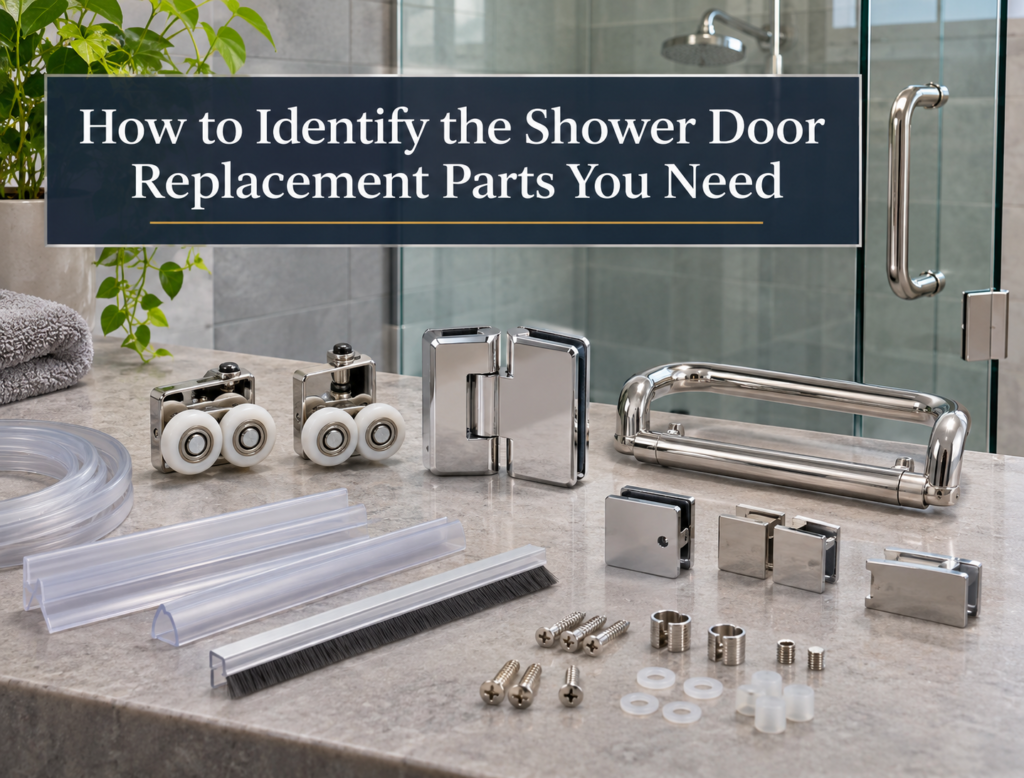
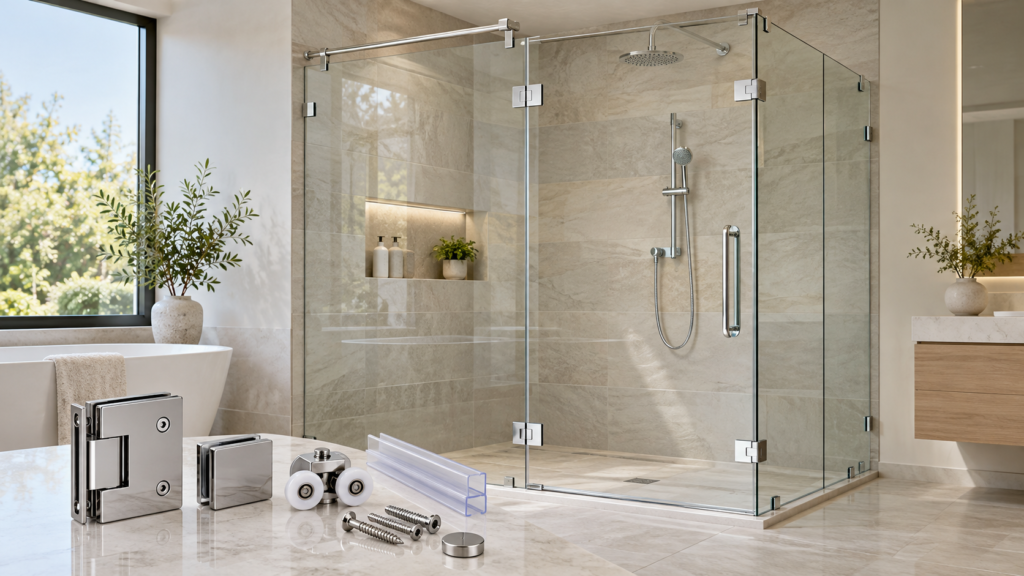
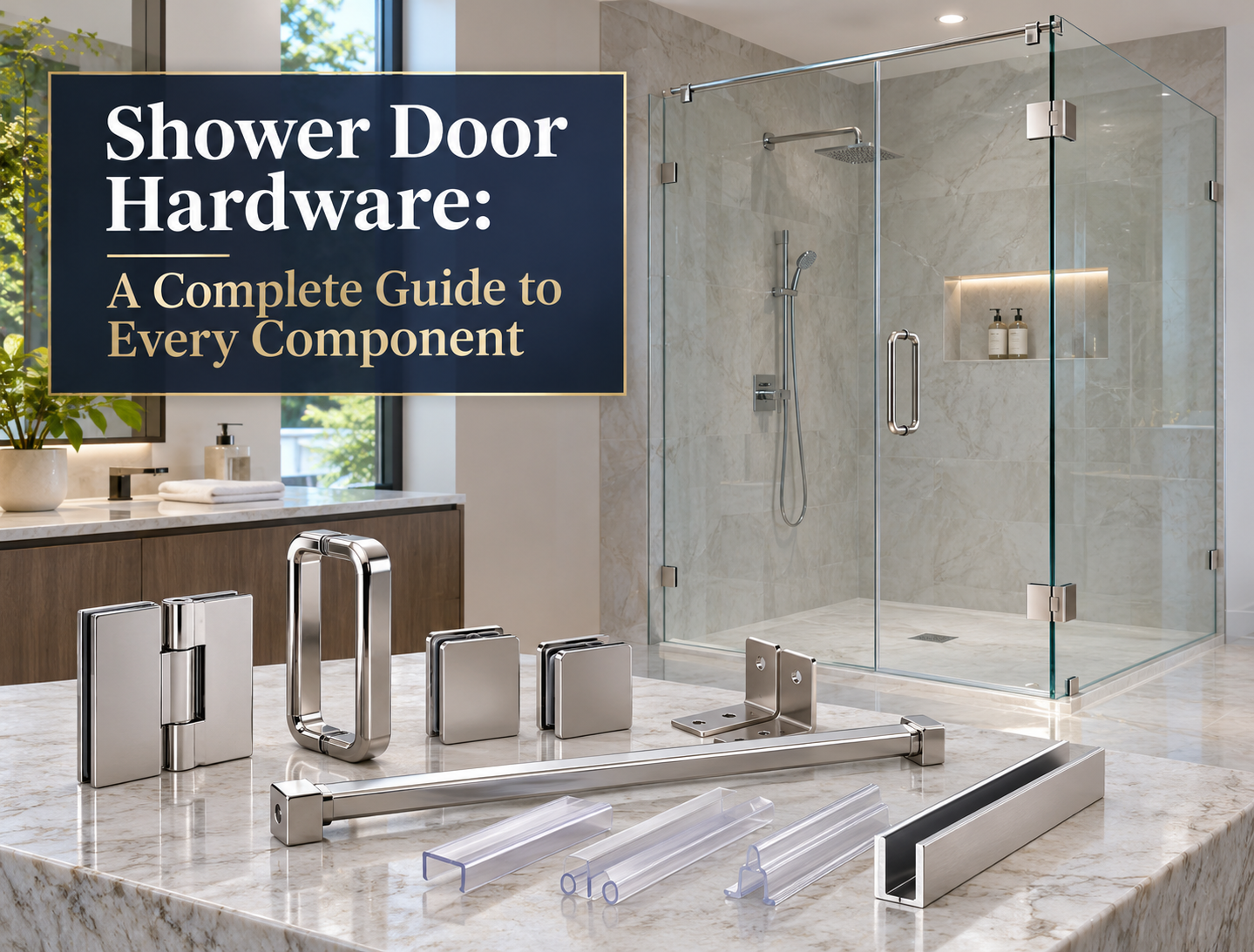
A complete system may include hinges, clamps, U-channels, support bars, handles, tracks, rollers, guides, seals, thresholds, gaskets, and specialized fasteners. Some enclosures require only a few of these components, while large frameless or sliding systems may require a carefully coordinated collection of parts. Hardware should always be selected as part of the complete enclosure rather than as separate decorative accessories.
Main Types of Shower Door Hardware
| Component | Primary Function | Common Application |
|---|---|---|
| Hinges | Support and pivot a swinging door | Frameless and semi-frameless doors |
| Pivot hardware | Allows top-and-bottom door rotation | Pivot shower doors |
| Glass clamps | Secure stationary glass panels | Frameless enclosures |
| U-channels | Hold and align fixed glass edges | Fixed panels and returns |
| Support bars | Stabilize tall or wide panels | Frameless glass systems |
| Handles and knobs | Provide a gripping point | Hinged and sliding doors |
| Tracks and rollers | Guide horizontal door movement | Sliding shower doors |
| Guides and stops | Control panel alignment and travel | Bypass and barn-style systems |
| Sweeps and seals | Reduce water escape through gaps | Nearly every enclosure type |
| Thresholds | Redirect water toward the shower | Hinged and sliding openings |
| Gaskets | Cushion glass inside metal hardware | Hinges, clamps, and handles |
Shower Door Hinges
Hinges carry the weight of a swinging glass door while allowing it to open and close along a controlled path. Wall-to-glass hinges attach the door directly to a properly reinforced wall, while glass-to-glass hinges connect the door to a stationary panel. Pivot hinges support the door from points near the top and bottom, and continuous hinges distribute the load across much of the door height.
A hinge must be approved for the glass thickness, door width, door weight, mounting position, and required opening angle. The hinge cutout must also match the fabrication of the tempered glass because new holes or notches cannot be added after tempering. Daltex’s guide to shower door hinges explains the main configurations and their appropriate applications.
Glass Clamps and U-Channels
Glass clamps secure fixed panels at selected mounting points, preserving the minimal appearance associated with frameless showers. They may connect glass to a wall, curb, ceiling, or adjoining panel, depending on the clamp design. Proper structural backing and compatible glass cutouts are essential because a clamp cannot safely support glass when it is attached only to tile or drywall.
U-channels support a longer section of the glass edge and can provide more installation tolerance than individual clamps. They are frequently installed along walls and curbs to hold fixed panels, while clamps are often selected when a more open appearance is desired. The choice between clamps and channels should consider panel size, enclosure geometry, available backing, waterproofing details, and the amount of adjustment required during installation.
Support Bars, Brackets, and Headers
A support bar helps stabilize a stationary panel that might otherwise flex or move under normal use. It is particularly useful for tall panels, wide panels, return panels, and configurations in which the fixed glass carries part of a door’s load. The bar must be connected to an appropriate structural surface and positioned without interfering with shower entry or door movement.
Headers provide continuous support across the top of certain multi-panel or sliding enclosures. They may also carry rollers or connect several structural components into one system. The support bar guide explains when additional panel stabilization may be required.
Handles, Knobs, and Towel Bars
Handles and knobs allow users to operate the door without touching the glass edge, but their hole spacing and glass-thickness range must match the existing panel. Back-to-back pull handles provide gripping surfaces on both sides, while single-sided knobs are often used when limited clearance is available. Combination handle and towel-bar sets can add storage without requiring a separate wall-mounted accessory.
These components should not be selected by finish alone because similar-looking handles may use different hole spacing, mounting hardware, or protective gaskets. Loose handles should be inspected promptly, since movement can damage the gaskets and allow metal components to contact the glass. Excessive weight should never be hung from a shower handle or towel bar unless the product is specifically designed for that load.
Sliding Shower Door Hardware
Sliding systems depend on tracks, rollers, guides, stops, anti-jump devices, and coordinated mounting brackets. The rollers carry the moving panels, the track establishes the travel path, and the bottom guide prevents the glass from swinging sideways. Stops control the end of travel, while anti-jump devices help prevent the door from lifting away from the track.
These components are normally engineered as a complete system, which makes mixing unrelated tracks and rollers risky. Glass thickness, panel weight, opening width, overlap, and required clearances must all match the selected kit. The guide to choosing a sliding hardware kit provides additional information about evaluating system compatibility.
Sweeps, Seals, and Thresholds
A bottom sweep attaches to the lower edge of a door and helps guide water back into the shower. Vertical jamb seals close gaps between a door and wall or between adjacent glass panels, while magnetic seals help two moving edges meet consistently. Thresholds create a low water barrier beneath the opening and are especially useful when the curb has limited inward slope.
The rigid channel of a push-on seal must match the actual glass thickness, and its flexible fin must suit the gap and movement of the door. A larger seal should not be used to hide a sagging or misaligned door because the underlying hardware problem will remain. Daltex’s guide to selecting the correct shower door seal explains how glass thickness, profile, and gap size affect seal selection.
Gaskets, Setting Blocks, and Fasteners
Gaskets protect the glass from direct contact with hinges, clamps, handles, and other metal hardware. Their thickness also affects how firmly the component grips the panel, which means random rubber, cardboard, or damaged old gaskets are not suitable substitutes. Compressed, cracked, or hardened gaskets should be replaced with components approved for the specific hardware.
Setting blocks support glass inside channels or frames and help maintain the required spacing around the panel. Fasteners transfer hardware loads into the supporting structure, so their size, material, and anchoring method must match the substrate and manufacturer’s instructions. These small components are easy to overlook, but they have a direct effect on enclosure alignment and long-term reliability.
How to Choose Compatible Shower Door Hardware
Begin by documenting the enclosure type, glass thickness, panel dimensions, mounting configuration, and finish. For replacement projects, record all hole locations, cutout dimensions, component markings, and clearances before removing the original hardware. The new component must match both the glass preparation and the structural requirements of the enclosure.
Hardware capacity should be confirmed through the manufacturer’s door-weight and width limits rather than estimated from appearance. Adding an extra hinge or clamp does not automatically make an undersized system safe because spacing, glass fabrication, and mounting conditions also affect performance. For a coordinated new system, Daltex’s custom shower enclosures service can help match the glass, hardware, seals, and support components.
When Shower Door Hardware Should Be Replaced
Hardware should be inspected when a door sags, drags, clicks, shifts, or no longer closes consistently. Corrosion, loose fasteners, split gaskets, worn rollers, missing guides, torn seals, and unexpected glass-to-metal contact are also signs that attention is required. Continued use may worsen the alignment problem and increase stress around holes, notches, or exposed glass edges.
Many hardware problems can be corrected without replacing undamaged glass, provided the replacement part matches the existing fabrication. New glass may be necessary when the panel is chipped, cracked, incorrectly cut, or incompatible with the intended hardware. A professional inspection is advisable whenever a structural component is loose or the door no longer follows its intended path.
Frequently Asked Questions
What hardware is required for a frameless shower door?
A typical frameless hinged door requires hinges or pivot hardware, a handle, a bottom sweep, and one or more vertical seals. Fixed panels may additionally require clamps, U-channels, support bars, or headers. The final component list depends on the panel dimensions, enclosure geometry, and mounting surfaces.
Are shower door hardware components universal?
Most shower door hardware is not universal because products differ in glass-thickness range, load capacity, mounting type, dimensions, and cutout requirements. Even visually similar hinges or handles may use different hole patterns. Compatibility should therefore be confirmed from specifications and measurements.
Can shower hardware be replaced without changing the glass?
Hardware can often be replaced while keeping the existing glass when the panel is undamaged and the new component matches every hole and cutout. The replacement must also support the door’s weight, width, and glass thickness. A different cutout normally requires a newly fabricated tempered-glass panel.
What holds a fixed frameless shower panel in place?
Fixed panels can be held by clamps, U-channels, support bars, headers, or a combination of these components. The correct arrangement depends on panel size, support conditions, and whether the panel carries any door load. Structural attachments should connect to suitable backing rather than tile or drywall alone.
What is the difference between a shower sweep and a jamb seal?
A sweep usually fits along the bottom of the door and redirects water across the curb or threshold. A jamb seal closes a vertical gap beside the door or between two glass panels. Each profile must match the glass thickness, gap size, and direction of door movement.
Can existing tempered shower glass be drilled for new hardware?
Tempered shower glass cannot be safely drilled, cut, or notched after manufacturing. Attempting to modify it can cause the entire panel to break. Replacement hardware must match the existing glass preparation, or a new panel must be fabricated.