Adjustable vs Fixed Shower Door Hinges: Which Should You Choose?
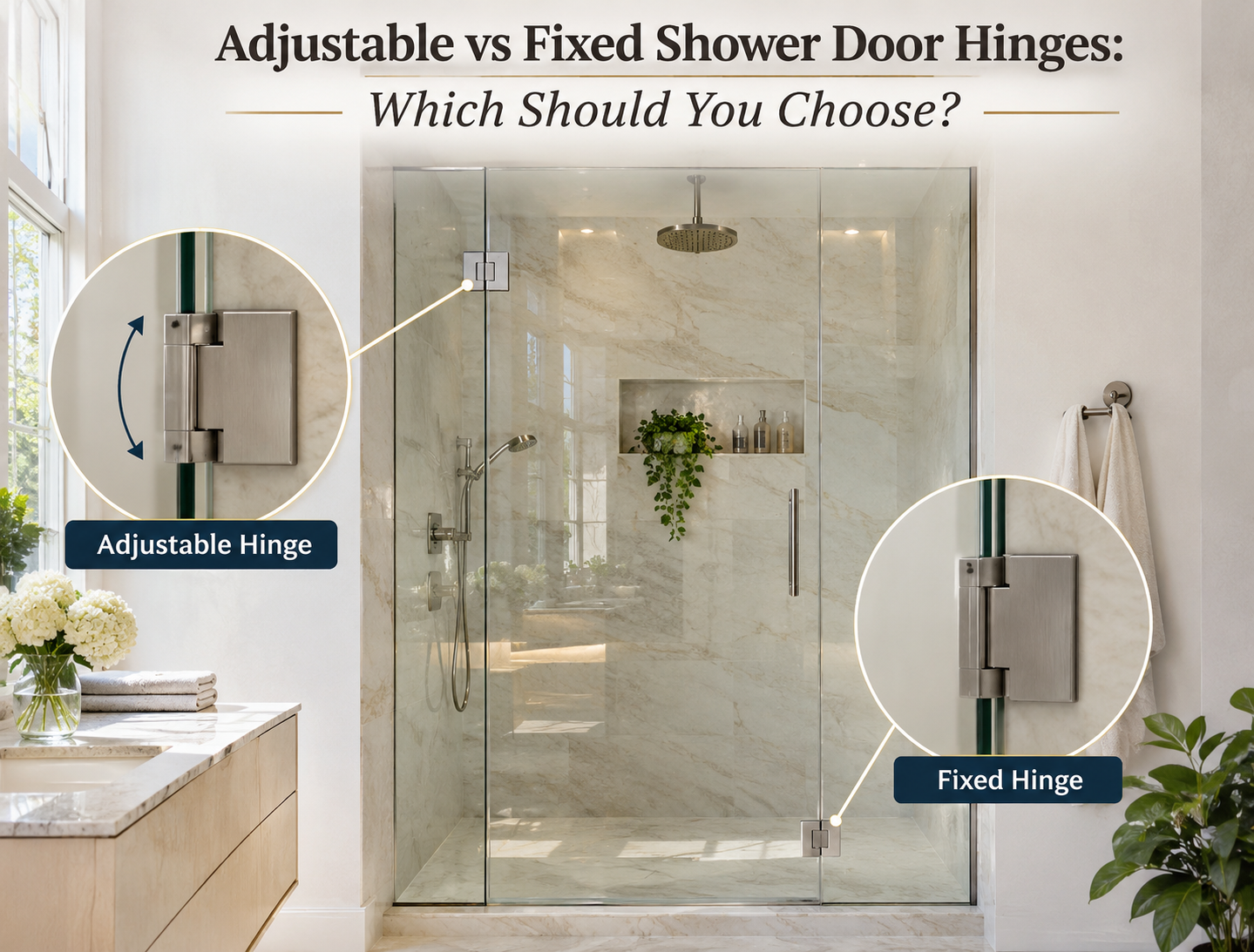


Adjustable shower door hinges allow an installer to modify certain aspects of alignment or the preferred closing position, while fixed hinges use a predetermined geometry established by the hardware design. Both types allow a glass door to open and close, so the word adjustable does not mean that fixed hinges are immovable. The practical difference concerns how much installation correction or closing-position control the hinge provides.
The best choice depends on enclosure geometry, wall conditions, glass preparation, door weight and the desired operation. Adjustability can be useful when minor field variations must be accommodated, while fixed hinges can provide a straightforward and stable configuration when the shower has been measured and built accurately.
What Are Adjustable Shower Door Hinges?
Adjustable hinges include a mechanism that allows limited changes to the door’s resting angle, alignment or closing position. Depending on the model, the adjustment may involve a pivot pin, cam, plate position or another manufacturer-designed component. The available adjustment range is specific to the product and should not be assumed from appearance.
These hinges can help establish consistent gaps and seal contact when construction varies slightly from the design. They are not intended to correct severely uneven walls, an incorrectly fabricated door or a fixed panel that lacks structural support.
What Are Fixed Shower Door Hinges?
Fixed hinges establish a predetermined relationship between the mounting surfaces and the door. The installer positions the glass according to the approved template and secures the plates without changing an internal closing angle. Accurate measurements and construction are especially important because the hardware provides less correction after fabrication.
Fixed hinges can be appropriate for straightforward wall-to-glass or glass-to-glass configurations where the desired geometry is already known. Their simpler setup can reduce unnecessary adjustments when the enclosure has been surveyed and fabricated accurately.
The Main Difference Between the Two Types
The main difference is installation flexibility rather than whether the door moves. Adjustable hinges offer a defined range within which the installer can refine alignment or closing position. Fixed hinges rely more directly on accurate walls, glass dimensions, cutouts and hardware placement.
The Daltex guide to hinge types explains that mounting style, glass thickness and door capacity should be considered before adjustability. An adjustable feature does not make an incompatible hinge suitable for the door.
Advantages of Adjustable Hinges
Adjustable hinges can help align door edges, balance clearances and improve contact with a jamb or seal. This flexibility is useful in custom bathrooms where finished walls or curbs have small variations that were difficult to predict during early construction. Some models also allow the installer to establish a slightly inward closing position.
Adjustment can support better operation, but every change must remain within the product’s approved range. Forcing the mechanism beyond that range may affect closing behavior, gaskets or glass pressure.
Limitations of Adjustable Hinges
Adjustable hardware may require more careful setup because multiple hinges must be aligned consistently. An incorrect setting can cause the upper and lower hinges to work against one another, creating binding or uneven movement. The installer must follow the product instructions rather than adjusting each hinge independently by trial and error.
Adjustment mechanisms are not a substitute for correct structural backing or accurate fabrication. If the door is too heavy or the cutout is incompatible, no alignment setting can make the installation suitable.
Advantages of Fixed Hinges
Fixed hinges offer predictable geometry when the enclosure and glass have been designed for the exact product. They can simplify installation because there is no closing-angle mechanism to calibrate. This can be beneficial in repeatable projects where walls, panels and hardware locations are carefully controlled.
A fixed hinge may also reduce the possibility of an adjustment being changed unintentionally. However, dependable performance still relies on correct door dimensions, wall backing, gaskets and plate installation.
Limitations of Fixed Hinges
Fixed hardware provides less flexibility when the wall is slightly out of plumb or the door needs a different resting position to meet a seal. Small measurement errors can become more noticeable because the hinge cannot be reset beyond the normal installation tolerance. The enclosure must therefore be surveyed accurately before glass production.
A fixed hinge should not be forced into alignment by overtightening its plates or compressing gaskets unevenly. Such methods can create concentrated pressure around the glass cutout without correcting the original dimensional problem.
Closing Position and Water Control
Door alignment affects how vertical seals, magnetic profiles and bottom sweeps overlap. Adjustable hinges can help establish a repeatable closing position, but the hardware itself does not make the enclosure waterproof. Curb slope, panel gaps, showerhead direction and seal selection also influence water control.
Certain positive-close hinges allow the door to rest slightly inward or return to a defined position. This feature should be coordinated with the seal so that the door closes securely without excessive resistance.
Compatibility With Glass and Cutouts
Both adjustable and fixed hinges must match the glass thickness, door dimensions, weight and existing fabrication. Tempered glass cannot be drilled or notched after manufacturing, so the hinge model should be selected before the door is produced. Similar exterior plate shapes do not guarantee identical cutouts.
When replacing existing hardware, identify the original manufacturer and model whenever possible. Compare technical drawings rather than relying only on measurements taken from the visible hinge plate.
Door Weight and Hinge Quantity
Adjustability does not determine how much weight a hinge can carry. Each model has limits for glass thickness, door width, height, weight and the number of hinges used. A fixed heavy-duty hinge may support a larger door than an adjustable model from another series.
The door should remain comfortably within the approved limits. Selecting hardware at the edge of its rating can make alignment more sensitive to installation conditions and repeated use.
Wall-to-Glass and Glass-to-Glass Applications
Wall-to-glass hinges require suitable structural backing behind the finished surface. Adjustable hardware can help with minor wall variation, but it cannot secure a door to tile or drywall without proper support. Fixed wall hinges work well when the supporting surface is stable and accurately positioned.
Glass-to-glass hinges transfer the door load into a stationary panel. The fixed glass may require clamps, channels, a header or support bar. Hinge adjustment cannot compensate for a panel that moves under the door load.
Installation and Adjustment Safety
A heavy glass door must be supported before hinge plates or adjustment mechanisms are loosened. Sudden movement can damage the glass edge, seals, curb or nearby panel. Adjustment instructions vary by model, so a method suitable for one hinge should not be applied automatically to another.
The complete hardware guide can help identify whether hinges, pivots, clamps or seals are contributing to the problem. Adjustment should stop if the glass is chipped or hardware movement cannot be controlled safely.
Choosing the Best Option
Choose adjustable hinges when the approved enclosure design benefits from limited alignment or closing-position control. They may be useful for custom layouts, angled panels or doors that need precise seal contact. Confirm that the available adjustment range is suitable before the glass is fabricated.
Choose fixed hinges when the geometry is straightforward, construction is accurate and a predetermined closing relationship is preferred. The hinge should still be selected by functional specifications before finish or decorative appearance.
Replacing Existing Hinges
Replacement hardware must match the glass thickness, cutout, mounting configuration, door weight and closing behavior. Changing from fixed to adjustable hinges may not be possible if the new product uses different glass preparation. New tempered glass may be required when the cutouts do not match.
Daltex’s glass repair service information notes that sagging or poorly closing shower doors may require hinge, clamp or strike replacement rather than a complete enclosure. The glass should still be inspected for chips and edge damage before new hardware is installed.
Frequently Asked Questions
1. What makes a shower door hinge adjustable?
An adjustable hinge includes a manufacturer-designed mechanism that permits limited changes to alignment, closing angle or resting position. The adjustment method and range vary by model. It does not mean that the hinge can fit any glass thickness, cutout or enclosure angle.
2. Are fixed shower door hinges more reliable?
Fixed hinges can provide dependable operation when the enclosure is accurately measured, fabricated and installed. Adjustable hinges can be equally reliable when correctly configured within their approved range. Product quality, load rating, structural support and installation matter more than adjustability alone.
3. Can adjustable hinges correct an out-of-plumb wall?
They may compensate for minor variation when the product is designed for that purpose. They cannot correct severe wall angles, structural movement or incorrect door dimensions. Significant construction problems should be addressed before the glass and hardware are installed.
4. Can fixed hinges be adjusted at all?
Fixed hinges may allow minor positioning during installation, but they do not normally provide a dedicated mechanism for changing the closing angle. Available tolerance depends on the product. The plates should never be forced or unevenly tightened to create unapproved adjustment.
5. Can fixed hinges be replaced with adjustable hinges?
The change is possible only when the new hinge matches the existing glass thickness, cutout pattern, mounting surfaces and door capacity. Tempered glass cannot be drilled to accept a different template. Incompatible fabrication may require a replacement glass door.
6. Which hinge is better for heavy glass?
The better hinge is the model specifically rated for the door’s thickness, dimensions and total weight. An adjustable hinge is not automatically stronger than a fixed hinge, and a fixed model is not automatically more durable. Compare the manufacturer’s approved load and installation configuration.
Final Takeaway
Adjustable shower door hinges provide limited control over alignment or closing position, while fixed hinges use a predetermined geometry. Adjustable hardware can help manage minor installation variation, but fixed hinges can provide simple and predictable operation in accurately built enclosures. Choose by glass compatibility, door weight, mounting configuration and structural support before considering adjustability or finish.