

90, 135 and 180 Degree Shower Hinges Explained
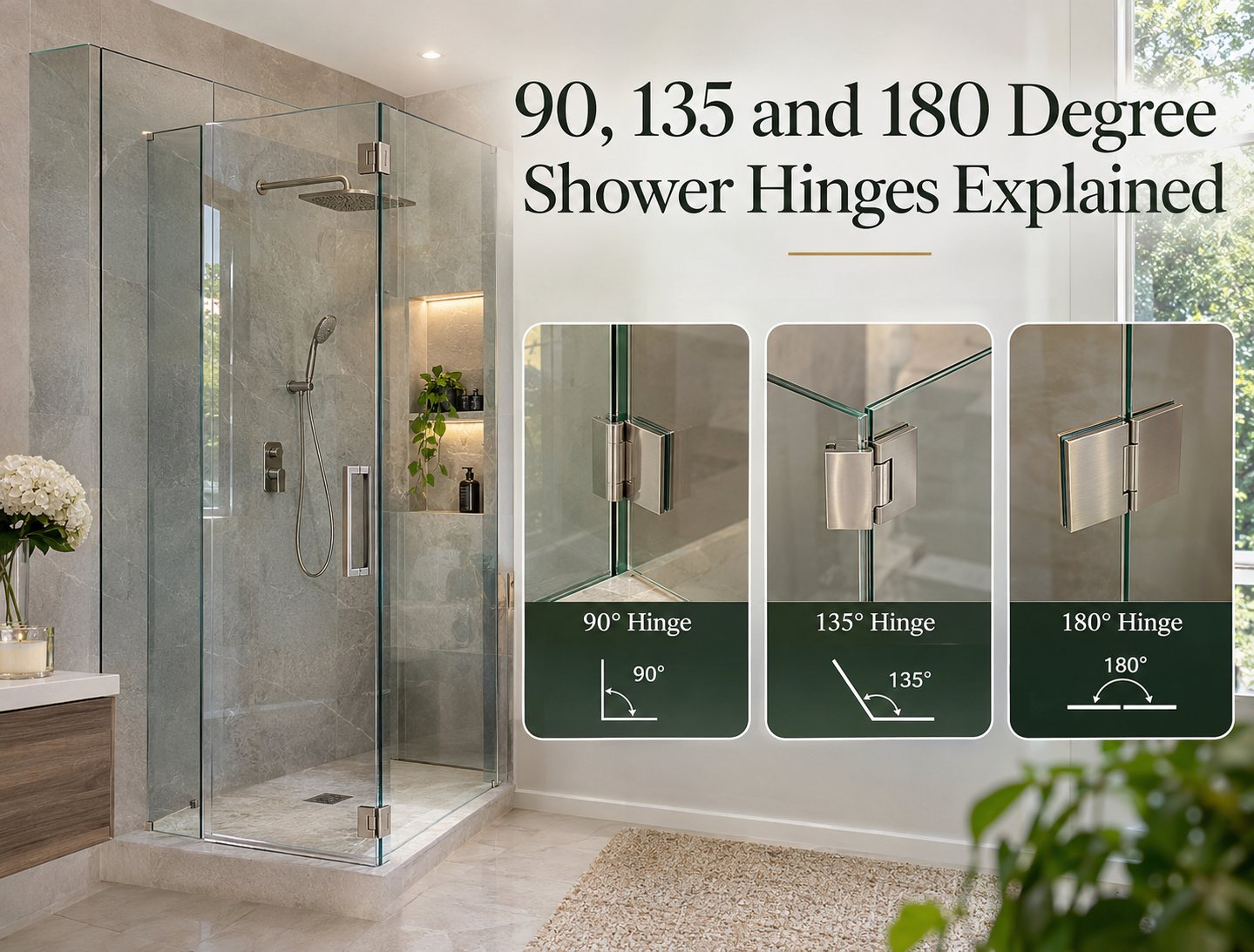


The 90, 135 and 180 degree labels used for glass shower door hinges generally describe the mounting relationship between the moving door and an adjoining wall or fixed glass panel. They do not always describe the maximum distance through which the door can swing. A 180-degree glass-to-glass hinge, for example, commonly connects two inline panels, while a 135-degree model connects panels arranged at an angled return.
Choosing the correct angle is essential because it affects panel layout, glass cutouts, door position and closing alignment. A hinge with the wrong geometry cannot usually be substituted after the tempered glass has been manufactured. Contractors, designers and homeowners should therefore confirm the enclosure plan and exact product specification before ordering the hinges or glass.
Understanding Hinge Angle Terminology
Shower hinge descriptions can refer to mounting geometry, the relationship between panels, the closed position or the permitted swing. These measurements are related but not identical. Product drawings should be reviewed because two hinges described with the same angle may use different cutouts, offsets or opening limitations.
The Daltex hinge guide explains the differences among wall-to-glass, glass-to-glass, pivot and other configurations. Connection type should be confirmed before comparing angle, finish or closing features.
What Is a 90 Degree Shower Hinge?
A 90 degree hinge is used when the connected surfaces or glass panels form a right-angle relationship. A wall-to-glass model may attach a door to a wall, while a glass-to-glass model may support a door from a return panel positioned at approximately 90 degrees. The product description must identify which mounting arrangement it supports.
This configuration is common in corner enclosures where a door meets a side wall or perpendicular fixed panel. The mounting surface needs adequate structural support, and glass-to-glass versions require the stationary panel to resist the load and movement created by the door.
What Is a 135 Degree Shower Hinge?
A 135 degree glass-to-glass hinge connects panels arranged at an angled relationship rather than a square corner or straight line. It is often used in neo-angle and other faceted shower layouts where the enclosure follows a diagonal entry. The hinge maintains the planned angle while allowing the door to swing from the fixed panel.
A 135 degree layout requires accurate field measurements because small angle changes affect panel widths, door clearances and joints. Adjustable 135 degree hardware may offer limited positioning flexibility, but it cannot compensate for an incorrectly designed enclosure or severely out-of-plumb construction.
What Is a 180 Degree Shower Hinge?
A 180 degree hinge commonly connects a door to an inline fixed panel, meaning the panels form a straight line when viewed from above. This configuration can create a clean frameless appearance because the door and stationary panel align along the same plane. It is frequently used where direct wall mounting is not practical or where the layout requires an extended glass wall.
Daltex’s glass hinge range includes 135 and 180 degree glass-to-glass configurations for specific glass thicknesses and fabrication templates. The exact product data must be followed because similar-looking hinges may not share the same cutout.
Mounting Angle Is Not the Same as Swing Angle
A hinge labeled 90, 135 or 180 degrees may still allow the door to swing inward, outward or in both directions, depending on its design. Some models include stops or hold-open positions, while others use self-centering or positive-close mechanisms. The mounting angle alone does not explain the complete door movement.
Door swing should be checked against toilets, vanities, towel bars, walls and nearby fixed glass. The bottom sweep and vertical seals must also move without binding. A technically compatible hinge can still be unsuitable if the door lacks safe opening clearance.
Relationship Between Hinge Angle and Enclosure Layout
The enclosure plan should determine the hinge angle, not the other way around. Square corner showers typically use 90 degree relationships, neo-angle layouts may require 135 degree connections and inline enclosures often use 180 degree hinges. Door location, fixed-panel width and available bathroom space influence which configuration is practical.
A professional custom shower survey records wall conditions, curb angles, panel relationships and opening clearances. These measurements allow the glass and hardware to be designed as one coordinated system.
Glass-to-Glass Hinges Need a Stable Fixed Panel
When a door hangs from another glass panel, the stationary panel carries forces created by both the door weight and repeated movement. A fixed panel secured only along its bottom edge may not provide enough stability for this role. Clamps, wall channels, headers or support bars may be needed according to the design.
The panel thickness and hardware must match the hinge specifications. Adding a heavy door to an inadequately supported panel can create movement, uneven gaps and stress around the hardware connections.
Adjustable and Fixed-Angle Models
Some 90, 135 and 180 degree hinges have a fixed closing relationship, while others provide limited adjustment during installation. Adjustable models can help align a door or establish a desired closed position when field conditions vary slightly. Fixed models offer a predetermined geometry when the surrounding construction is accurate.
Adjustment range should not be confused with universal compatibility. An adjustable 135 degree hinge is not automatically suitable for a 90 or 180 degree layout. The manufacturer’s approved range and installation method control how the product can be used.
Positive-Close and Self-Centering Functions
Certain angle-specific hinges include a mechanism that guides the door toward a defined resting position. This can improve alignment with jambs, magnetic seals and bottom sweeps. However, the closing mechanism must match the intended geometry and should not force the door against a seal with excessive pressure.
Daltex’s guide to positive-close hinges explains how closing position differs from mounting angle. Positive close can improve consistent alignment, but it cannot correct incorrect measurements, inadequate panel support or incompatible glass preparation.
Glass Fabrication Requirements
Most frameless shower hinges require holes or notches machined into the glass before tempering. The fabrication template for a 90 degree hinge may differ from the pattern used by a 135 or 180 degree model. Even hinges within the same angle category can use different dimensions.
Tempered glass cannot be safely drilled or trimmed after manufacturing. Select the exact manufacturer, series and model before releasing the door or fixed panel for fabrication. Retain the approved template with the project records in case replacement hardware is needed later.
Replacing an Existing Angle Hinge
A replacement hinge must match more than the angle printed in the product name. Glass thickness, cutout pattern, plate dimensions, gasket design, fasteners, door weight and closing action must also be compatible. Finish similarity does not confirm mechanical interchangeability.
The complete shower hardware system should be inspected during replacement. Loose fixed-panel clamps, damaged gaskets or poor wall anchoring may be contributing to the hinge problem and should not be hidden by installing new hardware alone.
Frequently Asked Questions
1. What does 90 degrees mean on a shower hinge?
The 90 degree label usually identifies a right-angle mounting relationship between the connected surfaces or panels. It may describe a wall-to-glass or glass-to-glass configuration depending on the model. The technical drawing should confirm the exact mounting method and permitted swing.
2. Where are 135 degree shower hinges used?
A 135 degree hinge is commonly used in neo-angle or faceted enclosures where the door connects to an angled fixed panel. Accurate measurements are important because the hinge, glass edges and curb must follow the same geometry. It should not be substituted for an inline or square connection.
3. What is a 180 degree glass-to-glass hinge?
A 180 degree hinge generally connects a moving door to a stationary panel positioned along the same straight line. The fixed panel must be supported adequately because it carries part of the door load. The product must also match the glass thickness and fabrication pattern.
4. Does a 180 degree hinge make the door open 180 degrees?
Not necessarily. The label may describe the inline relationship between the door and fixed panel rather than the full swing range. Stops, nearby surfaces and the internal hinge mechanism may restrict movement. Always review the manufacturer’s movement diagram.
5. Can a 135 degree hinge replace a 180 degree hinge?
These hinges are designed for different enclosure geometries and should not be treated as interchangeable. Their glass cutouts, offsets and closed positions may also differ. Replacing one with another can require redesigned panels and newly fabricated tempered glass.
6. Are angle-specific shower hinges adjustable?
Some angle-specific models provide limited alignment or closing-position adjustment, while others use a fixed geometry. Adjustment does not make the hinge suitable for every angle. The permitted range, glass thickness and door capacity must be confirmed from the exact product specification.
Final Takeaway
Ninety degree hinges suit right-angle connections, 135 degree hinges support angled or neo-angle layouts and 180 degree hinges commonly connect inline glass panels. These labels usually describe mounting geometry, not simply how far the door swings. Confirm the enclosure angle, mounting type, door weight, fixed-panel support and glass template before fabrication begins.


